Contents
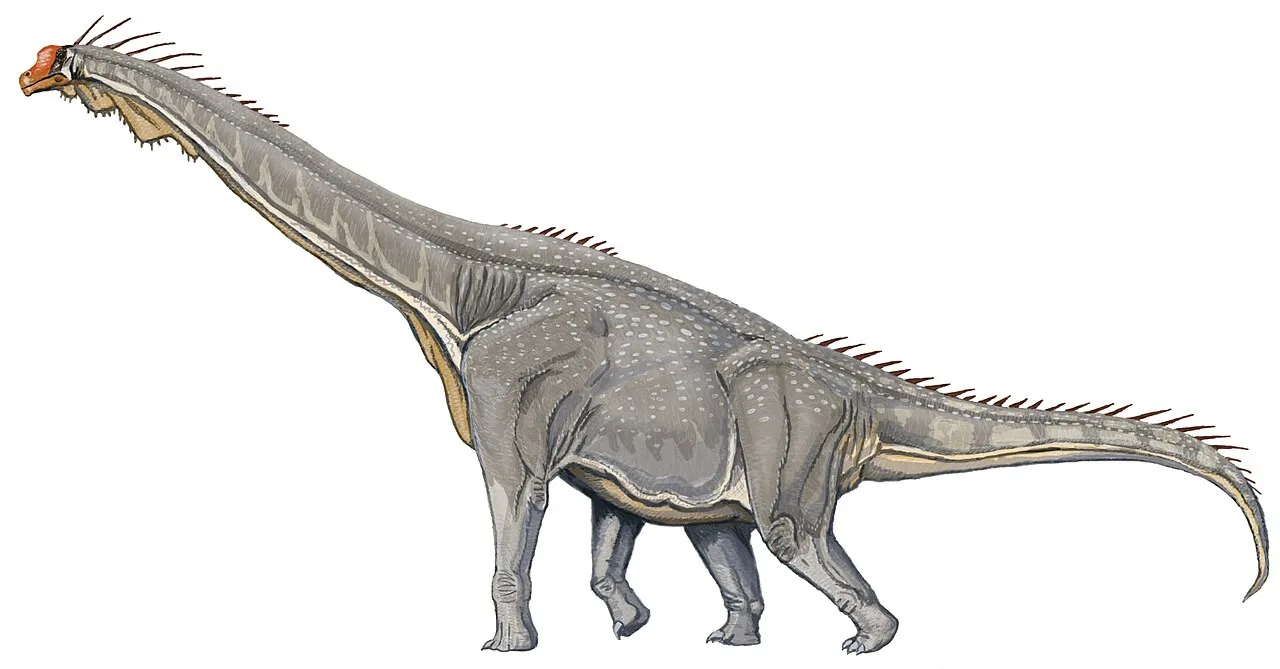
Brachiosaurus was a giant plant-eating dinosaur that lived in what is now Colorado, USA, during the Late Jurassic, about 152 to 145 million years ago. Its front legs were longer than its back legs, giving it an unusually steep, upright build that let it reach high into the trees to feed, and the Natural History Museum puts its length at 22 metres1.
How big was Brachiosaurus?
Size estimates for Brachiosaurus differ between studies of the same holotype skeleton. The Natural History Museum gives it a length of 22 metres and a weight of 46,900 kilograms1. Other studies instead put its length at 20 to 22 metres, or a shorter 18 metres. Weight estimates for the same animal have ranged from 28,300 to 46,900 kilograms across several studies. A higher maximum of 56,000 to 58,000 kilograms, proposed by Benson and colleagues, was later questioned by Nicolás Campione and David Evans for its large error range. Standing height estimates range from 9.4 metres up to 12 to 13 metres2.
What made Brachiosaurus unusual among sauropods was its build: it had longer forelimbs than hindlimbs, giving it a steeply inclined trunk and shorter tail, a shape the Natural History Museum says made it very well adapted for feeding on tall trees1. Its long neck had thirteen cervical vertebrae, held in an S-curve, bent at both ends with a straight middle, letting the animal browse vegetation up to 9 metres off the ground2.
The holotype skeleton itself was not full-grown: a suture between its coracoid and scapula had not yet fused, a sign researchers read as marking a subadult animal. Its preserved upper arm bone measured 204 centimetres, an estimated 216 centimetres complete, and its thigh bone measured 203 centimetres. A separate 2012 report described a nearly complete juvenile skeleton about 2 metres long2, nicknamed Toni, tentatively assigned to the species.
Brachiosaurus was smaller than some other giant sauropods: at 22 metres and 46,900 kilograms, it fell well short of Argentinosaurus, which the Natural History Museum puts at 35 metres long and 80,000 kilograms. Because the known fossils may be from an individual that was not fully grown, the real animal might have been a little larger than these estimates, though the museum thinks it would still not have matched Argentinosaurus’s colossal size1.
What did Brachiosaurus eat?
Brachiosaurus was a herbivore that fed on leaves from tall trees, such as conifers and tree ferns. It could not chew, so it swallowed the vegetation whole, relying instead on hindgut fermentation, using bacteria in its intestines to break down the plant matter it swallowed1. Each side of its upper jaw held fourteen or fifteen teeth, unusually complex for a sauropod. Its steep, upright build and long neck meant it was a high browser, reaching foliage as far as 9 metres off the ground2.
When and where did Brachiosaurus live?
Brachiosaurus lived in the Late Jurassic, about 152 to 145 million years ago, with its only confirmed fossils found in Colorado, USA1. The holotype comes from the Brushy Basin Member of the Morrison Formation, rock dated to the late Kimmeridgian, about 154 to 153 million years old2. The Paleobiology Database’s own occurrence record for the genus3 spans a wider stretch of the Late Jurassic, from about 158 to 143 million years ago, reflecting how fossils assigned to Brachiosaurus at different sites have been dated.
How was Brachiosaurus discovered?
The first remains were found in Colorado in 1900, unearthed near Fruita, Colorado, on 4 July 1900 by Elmer S. Riggs and his crew from the Field Columbian Museum, now the Field Museum of Natural History. The holotype bones recovered include an arm, a leg, hip and shoulder bones and several vertebrae2. Riggs named the animal in 19033; it had initially been thought to be a species of Brontosaurus, until Riggs realised it must have belonged to a much bigger animal; at the time, it was the largest dinosaur ever discovered. The type species is Brachiosaurus altithorax1.
The name means “arm lizard”, a reference to its front legs, its “arms”, being longer than its back legs. No complete skeleton of Brachiosaurus has ever been found: reconstructions are often based on the related African dinosaur Giraffatitan1 instead.
What kind of animal was Brachiosaurus?
Brachiosaurus was a sauropod, classified by the Natural History Museum within Macronaria and the family Brachiosauridae1, part of the wider group Titanosauriformes. Its closest relatives there include Europasaurus, Abydosaurus and Cedarosaurus2.
For decades, the African dinosaur now called Giraffatitan was classified as a species of Brachiosaurus, B. brancai. It was raised to its own genus after researchers found skeletal differences between the two exceeding those separating Diplodocus and Barosaurus2, two other sauropod genera usually kept apart.
Brachiosaurus in popular culture
Brachiosaurus became one of the best-known dinosaurs after it appeared in the 1993 film Jurassic Park, though most of the on-screen depictions commonly attributed to the species actually represented its African relative Giraffatitan2.
Similar dinosaurs
- Giraffatitan: for decades classified as a species of Brachiosaurus; most on-screen depictions actually show this African relative2.
- Europasaurus: a much smaller member of the same family, Brachiosauridae2.
- Abydosaurus: another close relative within Brachiosauridae2.
- Argentinosaurus: a far larger sauropod, reaching 35 metres long and 80,000 kilograms against Brachiosaurus’s 22 metres and 46,900 kilograms1.
- Brontosaurus: lived at the same time and in the same environment and was also a large four-legged plant-eater with a long neck, but Brachiosaurus was much taller, while Brontosaurus ate ground-level vegetation1.