Contents
Doolysaurus was a small dinosaur that walked on two legs and lived in what is now South Korea about 113 million to 94 million years ago, during the mid-Cretaceous. The fossil is a youngster about the size of a turkey, and scientists think an adult may have grown to twice that size. Its species, Doolysaurus huhmini, was described in the journal Fossil Record on March 19, 20262, and it is the first new dinosaur species discovered in Korea in 15 years1.
How big was Doolysaurus?
The genus is known from the partial skeleton of a small juvenile individual3. Growth markers in a thin slice of its thigh bone show it was a juvenile, estimated to be about 2 years old1 and growing when it died. The 2026 paper that named it gives its age as probably 0–2 years old, and the bone tissue showed that the animal was still undergoing relatively rapid growth at the time of death4.
That young animal was about the size of a turkey. From the thickness of its thigh bone, the authors estimated its body mass at about 8.3 kg, and they put the full length of the thigh bone at approximately 12–13 cm4. An adult may have grown to twice that size1, an estimate rather than a measured size.
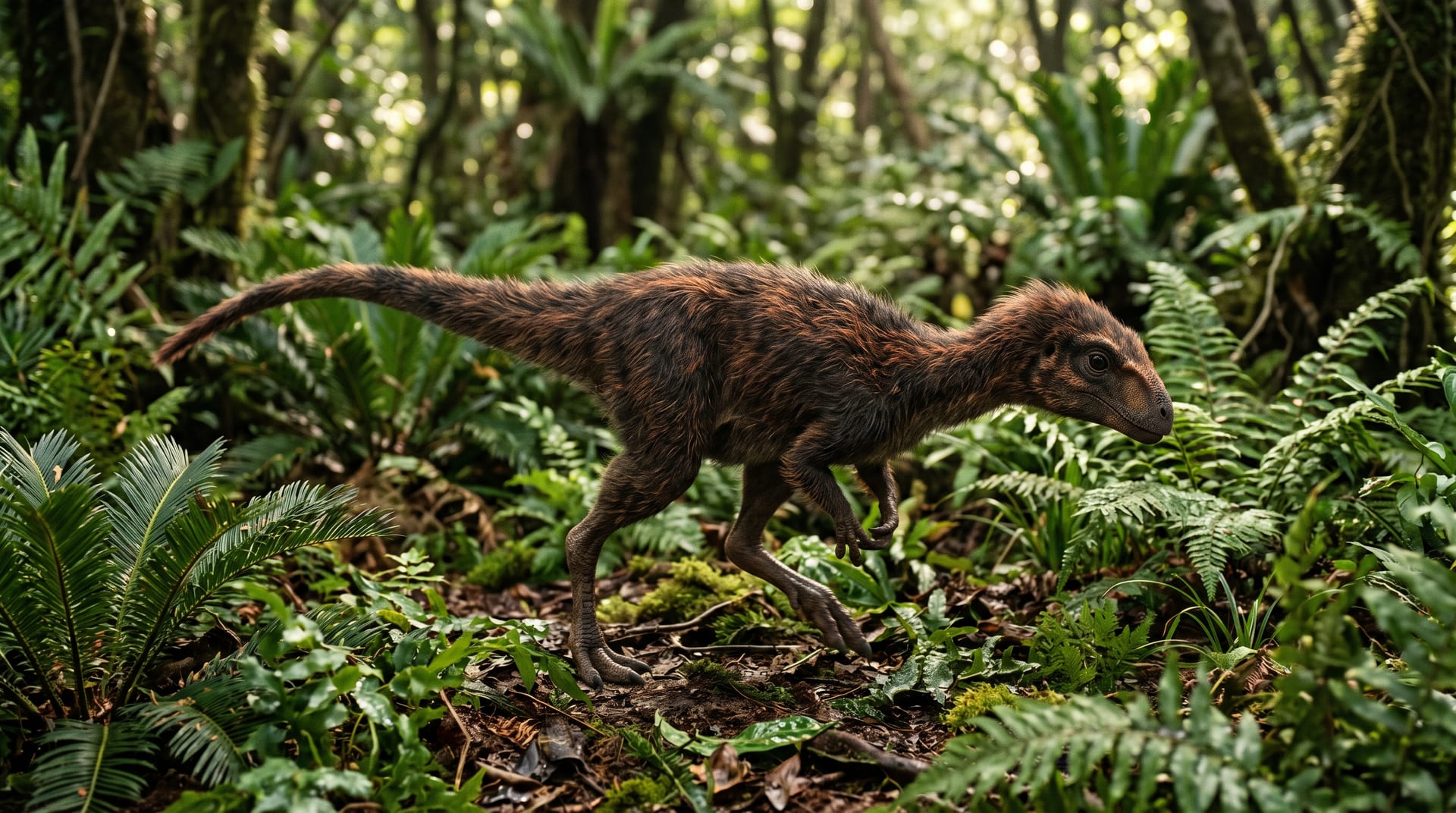
What did it look like? Thescelosaurids, the family it belongs to, were two-legged and may have had a coat of fuzzy hair-like filaments. Co-author Julia Clarke said the youngster might have looked a bit like a little lamb2.
What did Doolysaurus eat?
The evidence points to an omnivore. The scientists found over 40 pebbles among the bones, from 2 to 10 mm across. These are gastroliths, or stomach stones: herbivorous and omnivorous dinosaurs swallowed pebbles to grind food in their digestive tract. The size and shape of the stones suggest that it likely fed on plants and small animals including insects2.
The paper quantifies that estimate. The stones weigh at a minimum 30.7 g in total, roughly 0.37% of the total body mass. They are subrounded, resembling those in Haya and Psittacosaurus, a shape that suggests it likely had a less powerful muscular gastric mill than that of modern granivorous birds. The authors also warn that caution is required4 when stomach stones are used to work out the diets of extinct dinosaurs, because living birds vary so much in how they use them.
The scans revealed parts of its skull, including teeth2, and the authors give an estimated tooth count of 17 dentary teeth in the lower jaw, with two replacement teeth4 preserved.
When and where did Doolysaurus live?
Doolysaurus is dated to the mid-Cretaceous, about 113 million to 94 million years ago1. The Paleobiology Database places it in the Albian to Cenomanian stages, 113.2 to 93.9 million years ago5. The paper’s authors date the rock it came from a little more narrowly, to the Albian–early Cenomanian, ~113–97 Ma4.
Its fossil comes from the Ilseongsan Formation of Aphae Island (Aphaedo), which lies off the southwestern coast of South Korea2. The age of that rock has been argued over: one study first estimated its age at 77–83 Ma, but a later study re-dated a tuff layer above it to 97.55 ± 0.62 Ma4, which makes the formation much older.
The rocks around Doolysaurus are interpreted as floodplain deposits. The same site also preserves a large, well-preserved theropod egg nest, made by an oviraptorosaur. Korea’s dinosaur fossil record is exceptionally rich in trackways and eggs, yet skeletal remains are exceedingly rare4.
How was Doolysaurus discovered?
The fossil was found in 2023 by co-author Hyemin Jo. It was a partial skeleton entombed in hard rock, and the team had to excavate the rock as a block with the bones inside. A preparator will need several years to free the bones by hand, but the team scanned the block with micro-CT at the University of Texas at Austin2 instead.
Gastroliths at the surface of the rock led the scientists to scan the block for more bones. At first the team saw some leg bones preserved and some vertebrae2, and the scans then revealed parts of the skull, making it the first Korean dinosaur fossil found with portions of its skull1. The specimen, KDRC-SA-V001, is housed at the Korea Dinosaur Research Center, Chonnam National University4 in Gwangju.
The paper naming it, by Jongyun Jung, Minguk Kim, Hyemin Jo and Julia A. Clarke, was published in Fossil Record on March 19, 2026. The genus name honors “Dooly the Little Dinosaur”, a Korean cartoon baby dinosaur created by Soo-Jung Kim in 1983, plus the Greek sauros, meaning “lizard”4. Lead author Jung said the specimen is also a juvenile or ‘baby’, which made the name a good fit. The species name huhmini honours the Korean paleontologist Min Huh, who founded the Korean Dinosaur Research Center and has studied Korean dinosaurs for more than 30 years2.
What kind of animal was Doolysaurus?
Researchers classify Doolysaurus as a thescelosaurid, a type of bipedal dinosaur that lived in East Asia and North America1. The paper calls it a new early-diverging neornithischian species. It is the second early-diverging neornithischian taxon described from Korea4, after Koreanosaurus.
In one analysis, the relationships within the family are unresolved; Doolysaurus forms part of a large polytomy. Other analyses show it has closer affinities to North American taxa such as Parksosaurus, Fona, and Thescelosaurus than to East Asian relatives such as Haya and Jeholosaurus. The authors suggest that the split between its subfamilies Thescelosaurinae and Orodrominae may have occurred in Asia, followed by dispersal into North America4.
Similar dinosaurs
- Koreanosaurus: the other early-diverging neornithischian from Korea, found in the younger Seonso Conglomerate (81 Ma) of Boseong. It has a well-developed accessory condyle4 on the top of the shin bone, which Doolysaurus lacks.
- Haya: an Asian relative whose stomach stones are subrounded like those of Doolysaurus. Its teeth carry a triangular apicobasal ridge4, which the teeth of Doolysaurus lack.
- Thescelosaurus: a North American relative with approximately 20 dentary teeth, more than the 17 estimated for Doolysaurus. As of the 2026 paper, clustered stomach stones have not been reported in any North American thescelosaurid taxa4.