Contents
Mosasaurus was a giant marine reptile, not a dinosaur, that hunted the seas during the Campanian and Maastrichtian, about 82.7 to 66 million years ago2. Its fossils turn up from Canada to islands off Antarctica, and the biggest individuals are estimated anywhere from 11 to 12 metres to 17 or 18 metres long1, depending on the specimen and method.
How big was Mosasaurus?
Length estimates for M. hoffmanni, the largest species, disagree sharply because they work backward from a partial skull or jaw rather than a complete skeleton. The Natural History Museum puts the largest M. hoffmanni at 17 to 18 metres, though it notes other researchers favour 11 to 12 metres. Working from a large lower jaw found near Penza, Russia, Grigoriev (2014) calculated a maximum length of about 17.1 metres, working partly from plaster casts, since some original Penza bones were lost3; the result is still close to Lingham-Soliar’s 1995 estimate of 17.6 metres from jaw proportions. Revisiting that same Penza jaw with an updated skull-to-body ratio, Gayford and colleagues (2024) instead scaled it down to about 12 metres4. Smaller species measured less: the Natural History Museum gives M. missouriensis around 8 to 10 metres, and a near-complete skeleton of that species measured 6.5 metres2. An adult Mosasaurus is thought to have weighed around 10 tonnes1.
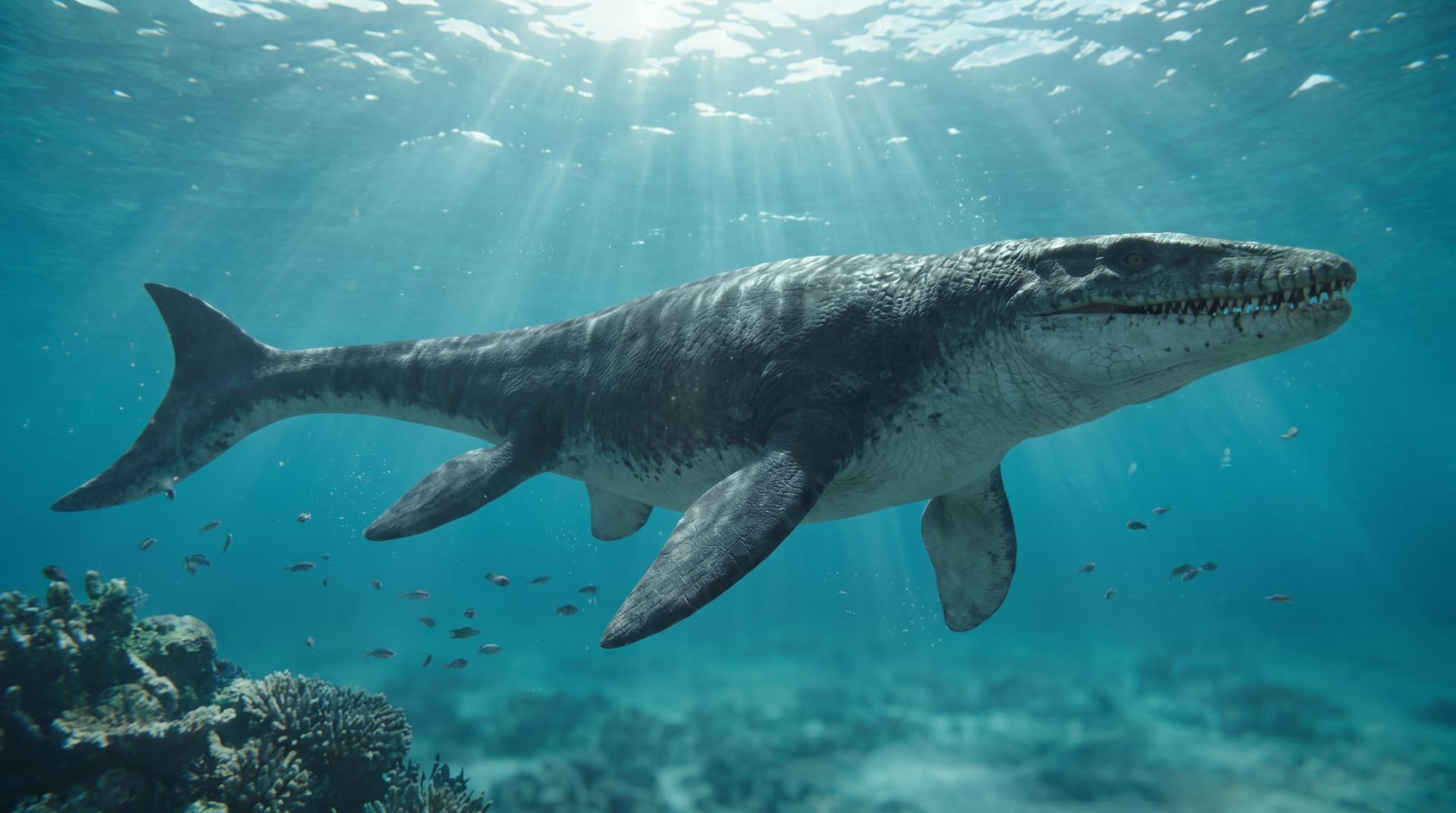
Four limbs shaped into paddles steered the animal underwater, a build shared across mosasaurs, while its tail, which bent downward into a fin-like fluke, did the swimming; the Natural History Museum notes that earlier, more primitive mosasaurs swam more like an eel1. Large eyes suited an ambush hunter working near the surface2.
What did Mosasaurus eat?
Mosasaurus was a carnivore with curved, pointed teeth built for grabbing fish, squid and sharks, with a prey list that stretched to cephalopods, seabirds, sea turtles and other mosasaurs. A mosasaur’s jaw joint let the group tackle outsized prey, even plesiosaurs and other mosasaurs1. The fossils carry the proof for Mosasaurus itself: bite marks scar the shell of the giant sea turtle Allopleuron hoffmanni, and other finds record healed jaw fractures from fights, including attacks between two Mosasaurus. It shared its hunting grounds with other giant mosasaurs including Prognathodon and Tylosaurus, and one fossil even records a Tylosaurus attacking a Mosasaurus2.
When and where did Mosasaurus live?
Mosasaurus lived through the Campanian and Maastrichtian, about 82.7 to 66 million years ago, one of the last marine reptiles before the end-Cretaceous extinction. The Paleobiology Database’s own fossil-occurrence record for the genus spans an even wider window, from the Cenomanian to the Danian5. The Natural History Museum traces its fossils from Canada to islands off Antarctica, and the fuller list of continents runs to North America, South America, Europe, Africa and Western Asia too. One of the largest specimens on record, the Penza jaw used by Grigoriev, comes from Maastrichtian-age rock in Russia, the first unequivocal record of M. hoffmanni from Russia3. The type species, M. hoffmanni, comes from limestone quarries near Maastricht1 in the Netherlands, while M. missouriensis was named from a snout fragment near the Missouri’s Big Bend, South Dakota. Unusually for a reptile, it was likely one of the only squamates able to keep a constant body temperature independent of the water around it2.
How was Mosasaurus discovered?
The Natural History Museum dates the first Mosasaurus fossil, a skull from a Maastricht quarry, to 17661; another account instead places that find, and a second skull, in 1764 and 1778. Either way, the skulls were at first mistaken for a whale, an identification naturalist Petrus Camper published in 1786, until the find became famous enough that French revolutionary troops looted it in 1794. By 1800 the naturalist Adriaan Gilles Camper had concluded it was instead a marine reptile sharing affinities with monitor lizards2, a view the anatomist Georges Cuvier confirmed by 1808.
The genus name Mosasaurus, from the Latin for the Meuse and the Greek for lizard, was coined in a book published by James Parkinson in 1822, in a section usually credited to William Daniel Conybeare. The Paleobiology Database credits the name to Parkinson, 1822, as first publisher5, while other sources credit Conybeare with coining the name itself. The species name came in 1829, when Gideon Mantell added hoffmanni2 in honour of Johann Leonard Hoffmann, who had first drawn attention to the second Maastricht skull.
What kind of animal was Mosasaurus?
Mosasaurus was not a dinosaur. The Natural History Museum classes it, like all mosasaurs, as a squamate, the reptile group that also contains snakes and lizards1. Mosasaurus is the type genus of the family Mosasauridae, placed with the genera Eremiasaurus, Plotosaurus and Moanasaurus in the tribe Mosasaurini within the subfamily Mosasaurinae. Exactly which living reptiles it is closest to is still debated, monitor lizards and snakes both proposed as its nearest relatives2.
Similar marine reptiles
- Tylosaurus: another giant mosasaur that shared the same seas and competed with Mosasaurus for prey2, the rivalry violent enough that fossils record one genus attacking the other.
- Prognathodon: a mosasaur whose tail is known from soft-tissue fossils to have had a two-lobed shape2 like the one inferred for Mosasaurus, and another large predator Mosasaurus shared its hunting grounds with.
- Plotosaurus: a mosasaur placed in the same tribe, Mosasaurini2, as Mosasaurus.