Contents
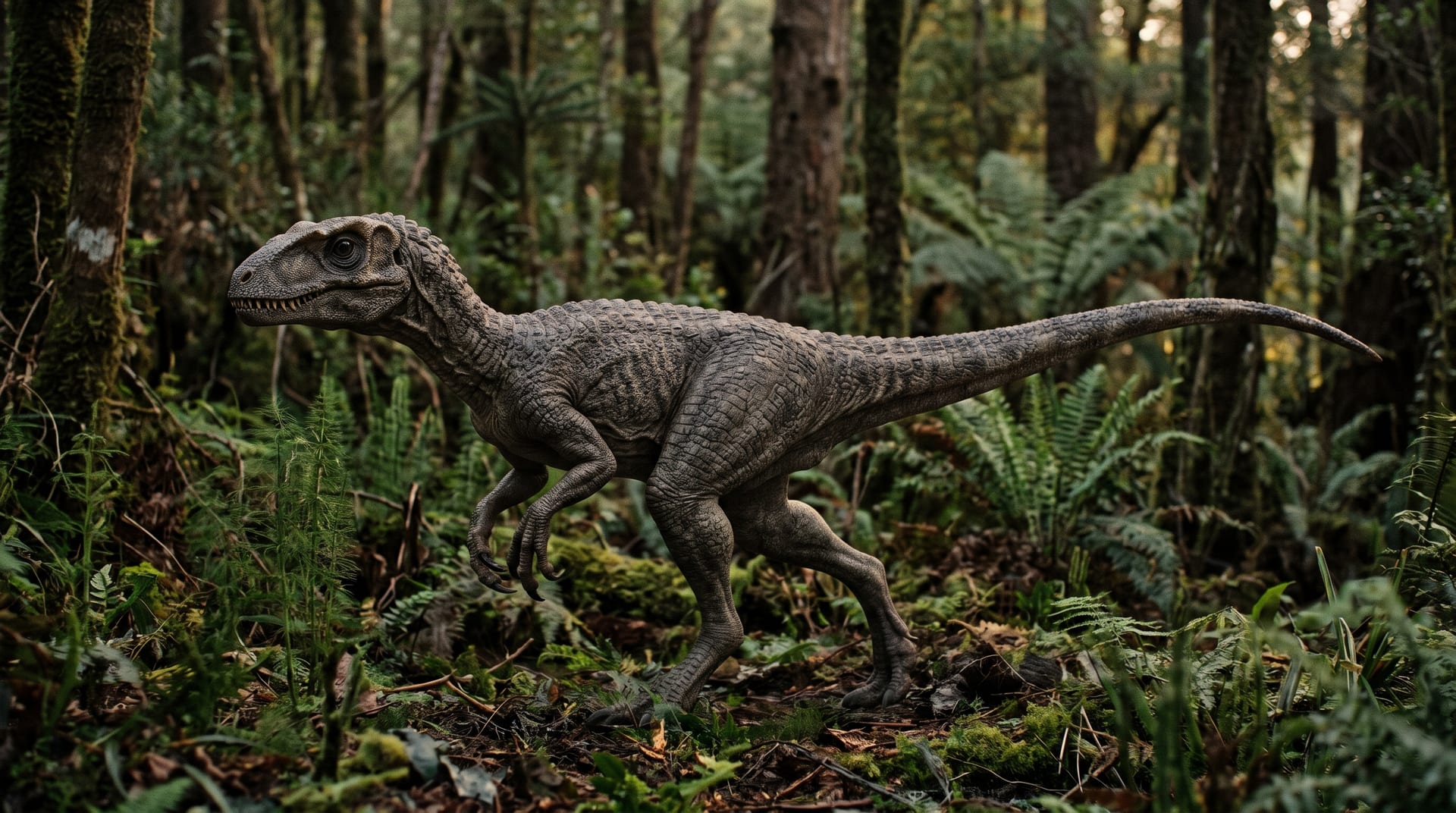
Ptychotherates was a carnivorous herrerasaurian dinosaur whose skull was found in northern New Mexico, in the United States. It lived around 201 million years ago, in the Rhaetian stage of the latest Triassic, and only its skull is known: it measures about 22 centimetres long. The genus has a single species, Ptychotherates bucculentus2, which offers rare insight into a poorly understood moment in dinosaur history1.
How big was Ptychotherates?
Nobody knows yet. The only fossil is a partial skull2, so there is no skeleton to measure. The skull itself is about 22 cm (9 inches) long and suggests a dinosaur with a relatively tall, narrow head1.
The cheekbone, or jugal, is unusually tall, deeper than in any other Triassic dinosaur2. The describers say the skull shows massive cheekbones, a wide braincase, and probably a short, deep snout, and that it was the first time these characteristics had been seen in early dinosaurs1.
What did Ptychotherates eat?
Ptychotherates ate meat. It belongs to Herrerasauria, one of the earliest-evolving families of carnivorous dinosaurs1, and its name refers in part to the likely carnivorous behavior of the animal2.
When and where did Ptychotherates live?
The Paleobiology Database dates its one occurrence to the Rhaetian, 205.7 to 201.4 million years ago3, the latest stage of the Triassic. The skull was found in the Coelophysis Quarry in northern New Mexico1, at Ghost Ranch, in rocks of the Chinle Formation. That quarry preserves a mass burial of animals from the same time2, most of them Coelophysis bauri.
Dinosaurs originated in the Carnian stage, 237 to 227 million years ago, and later split into three lineages that survived into the Jurassic: Ornithischia, Theropoda and Sauropodomorpha. Nearly all of the earliest dinosaur remains come from the high-latitude southern part of Pangea, today Brazil, Argentina, Zimbabwe and India. The lower latitudes, the American Southwest included, have few, if any, diagnostic dinosaur remains1 of the same age.
Scientists had believed that by the latest Triassic the earliest carnivorous dinosaur lineages had already disappeared, replaced by more advanced theropods. Ptychotherates suggests that some of these groups persisted much longer than expected, at least in the low latitudes of Pangea. Its rocks may date to right before the great extinction, and no other members of its family were seen again, which possibly suggests that this dinosaur group went extinct at the end of the Triassic. Srivastava says this means the extinction may have wiped out some long-standing dinosaur lineages themselves, not just the competitors of dinosaurs. Because no herrerasaurians have been found anywhere else this late, the American Southwest may have been where they survived the longest1.
How was Ptychotherates discovered?
The skull was found in 1982 in the Coelophysis Quarry. It is kept at the Carnegie Museum of Natural History in Pittsburgh as specimen CM 31368: a nearly complete, albeit somewhat disarticulated, skull2, with a complete braincase and much of the skull roof1.
Virginia Tech palaeontologists Simba Srivastava and Sterling Nesbitt named it in 20263, in a paper in the journal Papers in Palaeontology1. Nesbitt had already led the team that described Tawa in 20094, and was one of the four authors who named Daemonosaurus in 20115.
The name Ptychotherates joins the Greek ptycho, fold, and therates, hunter. It alludes to the challenge of rearticulating the disarticulated holotype skull. The species name bucculentus is Latin for with full cheeks2, after its unusually tall cheekbone.
What kind of animal was Ptychotherates?
The describers place Ptychotherates as a new taxon of saurischian dinosaur. Within that group it belongs to Herrerasauria and is closely related to Tawa hallae and Chindesaurus bryansmalli1.
Together they form a newly defined clade, Morphoraptora, whose members show a mix of features seen in both more primitive dinosaurs and later theropods. The describers call it a clade known exclusively from the Upper Triassic1 of the southwestern United States. To test the relationships, they added Ptychotherates to two independent phylogenetic matrices, from Ezcurra and colleagues (2023) and Griffin and colleagues (2022). Both put Chindesaurus, Daemonosaurus and Tawa in that clade beside Ptychotherates. The name Morphoraptora means form robber, or more loosely bodysnatcher2, for how much these animals resemble theropods without being part of that group.
Similar dinosaurs
- Tawa: a close relative, also from Ghost Ranch, but known from fossils of at least seven other individuals besides its holotype, and older, at about 215–213 million years. Adults are estimated at 2.5 m long and 15 kg, and compared with Herrerasaurus it had a relatively slender build4.
- Chindesaurus: a morphoraptoran from Petrified Forest National Park in Arizona, known from a skeleton that mainly consists of vertebrae, limb bones, and hip fragments. It was a bipedal carnivore, approximately as large as a wolf. Bryan Small found the skeleton, nicknamed Gertie, in 19846.
- Daemonosaurus: another skull from the Coelophysis Quarry at Ghost Ranch, set apart by its large, fang-like teeth and short skull. Hans-Dieter Sues, who named it, put its length at around 1.5 m from the proportions of related theropods. Apart from a few vertebrae5, no bones behind the skull are preserved.