Contents
Ankylosaurus was a heavily armoured, plant-eating dinosaur that lived in what is now Canada and the United States during the Late Cretaceous, 68 to 66 million years ago. It grew to about 8 metres long and 8,000 kilograms, covered in bony plates, and carried a heavy club on the end of its tail that it likely swung at attacking predators1.
How big was Ankylosaurus?
The Natural History Museum gives a typical length of about 8 metres and a weight of about 8,000 kilograms1, but no complete skeleton of Ankylosaurus has ever been found, so every figure is scaled up from partial remains: the smallest known skull implies an animal around 5.4 metres long, the largest, at 64.5 centimetres, one closer to 6.25 metres. A 2017 skull-scaling study estimated 7.56 to 9.99 metres and about 7,950 kilograms for the largest known skull, CMN 8880, and 6.02 to 7.95 metres and about 4,780 kilograms for the smaller AMNH 5214; judging the larger figure too long, the same study suggested 8 metres instead2, matching the museum’s own estimate.
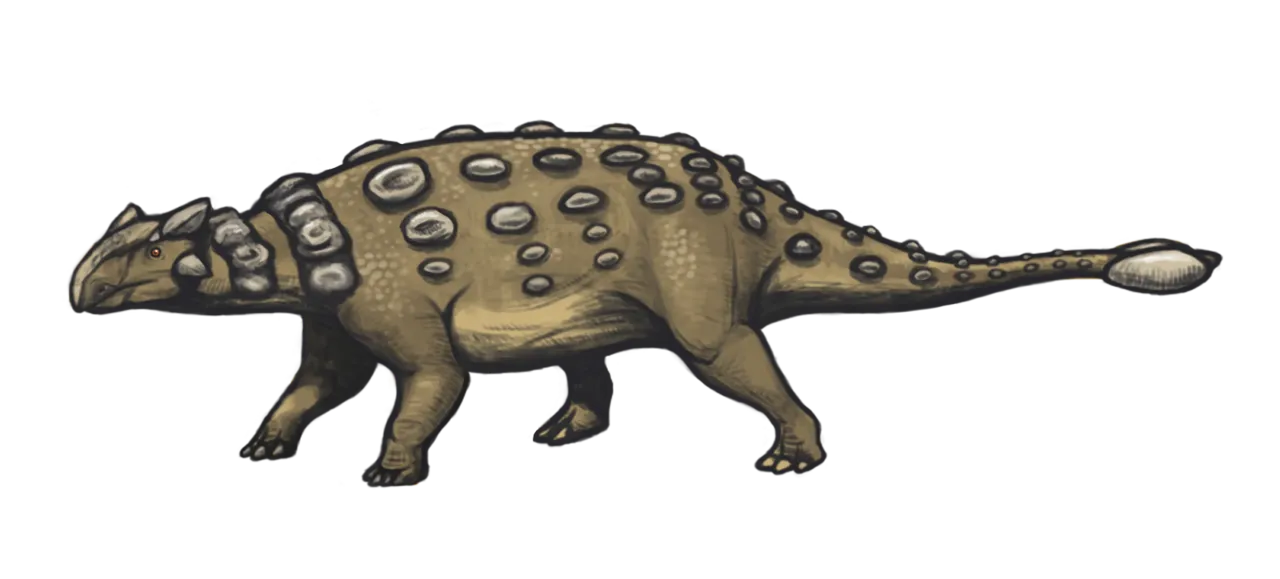
Its skull was low and triangular, wider than it was long, with a broad beak and four horns: a pair pointing backward from the squamosal bones and a lower pair pointing backward and down from the jugal bones. Unlike every other known ankylosaurid, its nostrils faced downward and outward2, opening into unusually large, complex nasal passages whose purpose is still debated.
The body was covered in bony plates called osteoderms, up to 35.5 centimetres long and set in rows across the back, with a ring of fused armour protecting the neck and smaller plates over the flanks and hips. At the end of the tail sat its best-known feature: a heavy club, known from a single specimen measuring 60 by 49 by 19 centimetres2, built from two large plates fused to the last tail vertebrae. A biomechanical study of ankylosaurid tail clubs found they could swing through about 100 degrees laterally, and that the largest clubs studied could generate forces over 14,000 newtons, enough to break bone on impact; the same study could not say whether the clubs defended against predators or fought other ankylosaurs3. Not every armoured dinosaur had one: relatives such as Nodosaurus and Polacanthus had no tail club at all1.
What did Ankylosaurus eat?
Ankylosaurus ate plants, including ferns, shrubs and fruit, and the museum estimates it needed around 60 kilograms of vegetation a day to sustain its bulk. Its teeth were small and leaf-shaped with smooth sides, set in jaws built for low, non-selective browsing on whatever low-growing vegetation was on hand, instead of picking out particular plants. A 2023 study of ankylosaurid jaws found that North American genera like Ankylosaurus had jaws with low mechanical advantage, a different chewing style from their nodosaurid relatives. It may also have dug for roots with its front limbs1. Some researchers have suggested Ankylosaurus could have eaten fruit, for which its small, cusp-like teeth and the shape of its beak seem well suited; the low rate of tooth replacement typical of ankylosaurs2 has likewise led some to suggest it may have been partly omnivorous, though that is not settled.
When and where did Ankylosaurus live?
Ankylosaurus lived at the very end of the Late Cretaceous, about 68 to 66 million years ago; the Paleobiology Database’s recorded occurrences for the genus span the Campanian to the Maastrichtian4. Its fossils come from Canada and the United States1, including the Hell Creek, Lance, Ferris, Scollard and Frenchman formations. The climate across that range was warm, subtropical to temperate and monsoonal, with occasional tropical storms. Ankylosaurus fossils are rare, which has led some researchers to suggest the animal preferred upland habitats over the coastal lowlands that are better sampled by fossil hunters, and that it did not share the same ground as the contemporary nodosaur Edmontonia. It lived alongside the dinosaurs Tyrannosaurus, Triceratops and Edmontosaurus, among others known from the same formations2.
How was Ankylosaurus discovered?
Barnum Brown of the American Museum of Natural History found the first Ankylosaurus bones in 1906 in the Hell Creek Formation in Montana, and named and described the genus in 19084. That holotype specimen, catalogued as AMNH 5895, included part of a skull, two teeth and over thirty osteoderms, but not the tail club: that came from a second specimen, found in 1910 and still the only known example of a complete Ankylosaurus club. Only a handful of incomplete specimens are known in total2, and no complete skeleton has ever been recovered.
The name Ankylosaurus comes from Greek words meaning “fused” or “bent” and “lizard”, a reference to the fused bone of its armour. The type species, Ankylosaurus magniventris2, adds the Latin for “great belly”, describing its broad body.
What kind of animal was Ankylosaurus?
Ankylosaurus was a large armoured dinosaur and the genus that gives its name to the whole group of armoured dinosaurs, Ankylosauria, within which it belongs to the family Ankylosauridae1. Its closest known relatives are Anodontosaurus and Euoplocephalus2, both North American ankylosaurids; Euoplocephalus was smaller and lived somewhat earlier5 in the Late Cretaceous.
Ankylosaurus in popular culture
Ankylosaurus is treated as the archetypal armoured dinosaur in popular culture, including appearances in the Jurassic Park franchise, even though palaeontologists have criticised the way those films portray its abilities. Older reconstructions, including a life-sized model shown at the 1964 New York World’s Fair2, commonly gave it a dragging tail, oversized spikes and a squatting posture that later finds no longer support.
Similar dinosaurs
- Euoplocephalus: another North American ankylosaurid with a bony tail club, but smaller at 7 metres long and about 2,000 kilograms, and older, living 76 to 70 million years ago; like Ankylosaurus, it ate plant material5.
- Edmontonia: a nodosaurid, meaning it carried spikes and plating but no tail club, and was smaller, at 4 metres long, also a plant-eater6.
- Stegosaurus: an earlier armoured dinosaur from the USA, 9 metres long and from the Late Jurassic7, with tall back plates and tail spikes in place of a solid club.
- Nodosaurus and Polacanthus: armoured relatives that, like Edmontonia, had no tail club at all1.