Contents
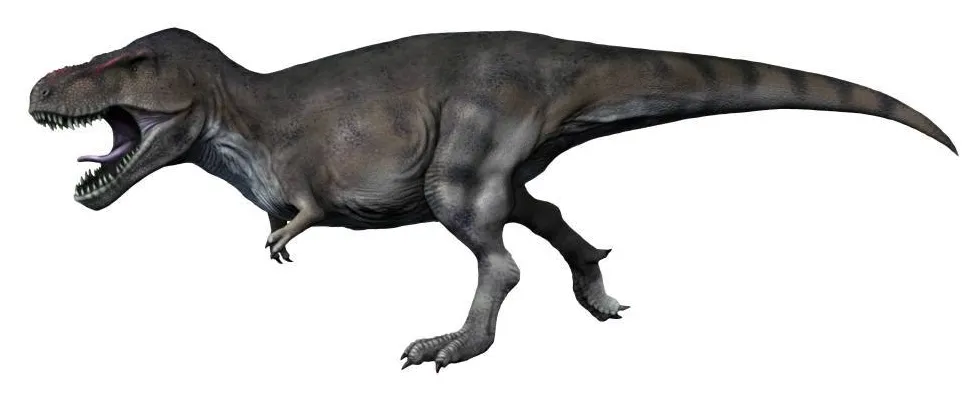
Tyrannosaurus rex, usually shortened to T. rex, was a giant meat-eating dinosaur that lived in what is now the United States and Canada at the end of the Late Cretaceous, 68 to 66 million years ago. Adults were normally about 12 metres long and stood 3.5 to 4 metres tall at the hips, which makes it one of the largest land carnivores of all time. It is the best-known member of the family Tyrannosauridae, and T. rex is currently the only species of Tyrannosaurus that most scientists accept.
How big was Tyrannosaurus rex?
Size varied from one animal to the next. The two largest specimens, Sue and Scotty, weighed over 8,000 kilograms and were almost 13 metres long when they were alive, but most T. rex were probably smaller. A normal adult probably weighed 5,000 to 7,000 kilograms. Weight estimates depend on the method: for Sue, the most recent studies give a maximum body mass of about 8.4 to 9.2 tonnes, and a calculation from the thickness of the thigh bone put Scotty at 8.87 tonnes, the largest known specimen.
The head alone was huge. Some of the biggest skulls are over 1.5 metres long, longer than a person is tall. The arms were the opposite. They were short compared with the powerful hind limbs, but unusually strong for their size, with two clawed fingers on each hand. Scientists still debate what they were for: getting up after a fall, holding food while young, or gripping a partner during mating.
How fast was it? An adult had an estimated top speed of around 22 kilometres per hour, and younger animals may have been quicker.
What did Tyrannosaurus rex eat?
T. rex ate other animals, dinosaurs included. It had 60 saw-edged teeth, the largest up to 20 centimetres long, and its jaws gave it the strongest bite of any known land animal, three to five times more powerful than a lion’s and strong enough to crunch through bone. The evidence is in the fossils: its tooth marks have been found on bones of Triceratops and Edmontosaurus, and pieces of bone turn up in its fossilised dung.
Was it a hunter or a scavenger? Probably both. As by far the largest carnivore in its environment it was most likely an apex predator, taking duck-billed hadrosaurs, horned and armoured dinosaurs and possibly sauropods, and like most large carnivores it would also scavenge when it could. A large part of its brain handled smell, which would have helped it find live prey and carcasses over long distances. It probably tore up carcasses with sideways shakes of the head, the way crocodiles do.
Tyrannosaurs also fought each other: some Tyrannosaurus bones carry bite marks from other tyrannosaurs. Whether Tyrannosaurus hunted in packs is not known.
When and where did Tyrannosaurus rex live?
T. rex lived in the Late Cretaceous, 68 to 66 million years ago, and its fossils come from Canada and the USA. That puts it in the Maastrichtian, the last stage of the Cretaceous.
Several notable Tyrannosaurus skeletons come from the Hell Creek Formation. In the Maastrichtian that area had a warm and humid climate, with flowering plants and trees such as dawn redwood. T. rex shared it with the horned dinosaurs Triceratops, Torosaurus and Leptoceratops, among others.
How was Tyrannosaurus rex discovered?
The name almost turned out differently. In 1892 Edward Drinker Cope named some of the first known bones Manospondylus gigas, thinking they came from a Triceratops-like dinosaur. Barnum Brown of the American Museum of Natural History then found the first partial skeleton of T. rex in eastern Wyoming in 1900 and a second in the Hell Creek Formation of Montana in 1902. Henry Fairfield Osborn named the species Tyrannosaurus rex in 1905. When scientists later realised the two names covered one animal, Tyrannosaurus rex stayed because most scientists preferred it, even though the first name would normally take priority.
The name means “tyrant lizard”, and with rex added, “tyrant lizard king”.
The most famous skeleton is Sue. Sue Hendrickson found it in the Hell Creek Formation on 12 August 1990; about 85 percent complete, it is the most complete and largest Tyrannosaurus skeleton known. After a court case over who owned it, the Field Museum bought it at auction for 7.6 million dollars, and the mounted skeleton went on show on 17 May 2000. Studies of its bones show that Sue reached full size at 19 and died at about 28.
What kind of animal was Tyrannosaurus rex?
T. rex was a large theropod, the group of mostly meat-eating dinosaurs that walked on two legs. Within the theropods it belongs to the tyrannosauroids, the family Tyrannosauridae and the subfamily Tyrannosaurinae.
Did T. rex have feathers? Many theropods did, but there is no direct evidence for feathers on T. rex: preserved skin of Tyrannosaurus and its close relatives shows scales. Its relative Yutyrannus was feathered, but it lived in a cold climate, while T. rex lived somewhere warm and humid.
Tyrannosaurus rex in popular culture
No dinosaur is better known. Tyrannosaurus is the most widely known dinosaur in popular culture and the only one most people know by its full scientific name, and paleontologist David Hone writes that films such as Jurassic Park and King Kong would not have been the same without it.
Similar dinosaurs
- Tarbosaurus: its closest relative. The Asian Tarbosaurus bataar is very closely related to Tyrannosaurus and has sometimes been treated as a species of the same genus.
- Daspletosaurus: a North American member of the same subfamily, occasionally merged with Tyrannosaurus.
- Yutyrannus: a large tyrannosaur that did have feathers.
- Giganotosaurus: another giant theropod, but from a different continent and tens of millions of years earlier.