Contents
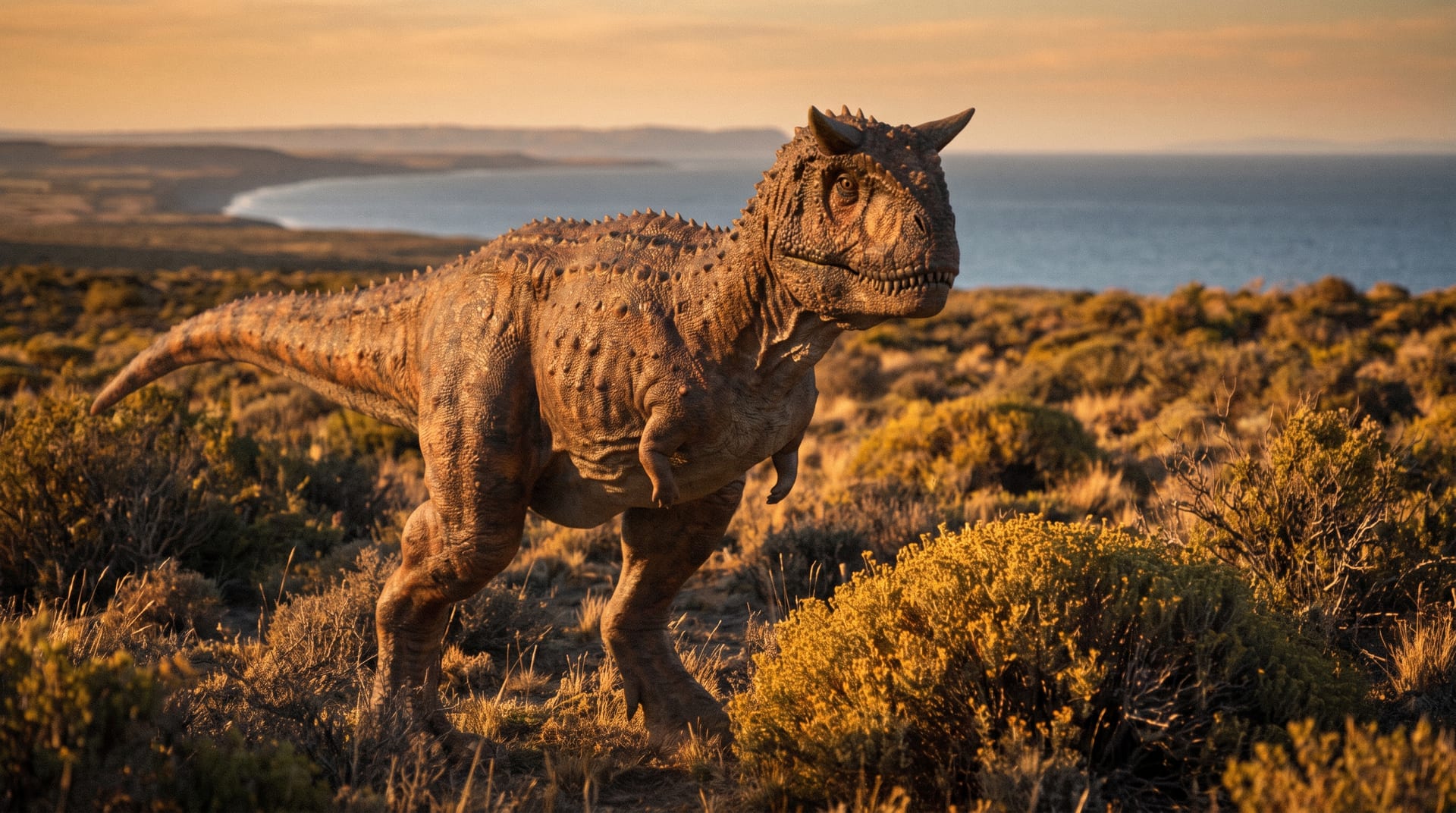
Carnotaurus was a horned, meat-eating dinosaur that lived in what is now Argentina during the Late Cretaceous, and grew to about 8 metres long. Its most striking features were two horns on top of its head and very small arms. Among the abelisaurs, it is the only one known to have two horns1.
How big was Carnotaurus?
The only known skeleton suggests an animal around 8 metres long, though it is missing its tail and lower legs1, which leaves the true length of a full animal uncertain. Its mass has been estimated at 1,350, 2,100 and 1,306 to 1,743 kilograms2.
Its head was narrow when seen from the front and had an unusually short snout for a large theropod. The two thick, cone-shaped horns above its eyes measured about 15 centimetres long2 and were probably covered in a longer sheath of keratin in life. The purpose of the horns is not settled, with fighting, hunting, courtship and species recognition all proposed1.
The arms were the most unusual part of its body: proportionally shorter than those of any other known large carnivorous dinosaur, with a forearm only a quarter the length of the upper arm and fingers that were fused together and may have lacked claws2. The Natural History Museum describes them as vestigial leftovers from longer-armed ancestors, with little remaining function1.
The same skeleton preserves patches of fossil skin, making Carnotaurus the first theropod dinosaur found with substantial skin impressions. The Natural History Museum confirms the fossil preserves scales across much of its body1; in detail, the skin shows small, non-overlapping polygonal scales approximately 5 to 12 millimetres across, with larger bumps running along the neck, back and tail2 and no sign of feathers.
Studies in 1998 and 1999 presumed it was a swift runner, arguing that its thigh bone was adapted to withstand high bending moments while running; its running would have been better than a human’s, though not nearly as good as an ostrich’s. A 2011 study of its tail argued it could have been one of the fastest large theropods2.
What did Carnotaurus eat?
Carnotaurus was a meat-eater that most likely hunted large sauropod dinosaurs sharing its environment. Teeth of related abelisaurs have been found with sauropod remains. Unlike most carnivorous dinosaurs, its lower jaw was more flexible, which may have let it open its mouth unusually wide, snake-like1, to swallow large chunks of meat.
Estimates of its bite force disagree. Researchers in 2005 calculated a bite roughly twice as strong as an American alligator’s, while later studies put the force at 3,341 to 3,392 newtons at the front of the jaws, rising to 7,172 newtons2 further back.
When and where did Carnotaurus live?
Carnotaurus lived during the Late Cretaceous, about 72 to 66 million years ago3, and its only known fossil comes from Argentina, from the La Colonia Formation in Chubut Province. Its fossils occur in Late Cretaceous rocks that may have formed from the deposits of estuaries or tidal flats. Vertebrates collected from the formation include lungfish, turtles, plesiosaurs, crocodiles, dinosaurs, lizards, snakes and mammals2. The Natural History Museum notes it would have co-existed with unnamed ankylosaurs and hadrosaurs1 in the same area.
How was Carnotaurus discovered?
The only skeleton of Carnotaurus ever found was unearthed in 1984 by an expedition led by Argentine palaeontologist José Bonaparte, on a ranch called Pocho Sastre in Chubut Province. The bones were encased in a large hematite concretion, which made the fossil difficult to prepare. Bonaparte named the genus and species in 19853, with a full description following in 19902.
The name Carnotaurus comes from the Latin carno (“flesh”) and taurus (“bull”), meaning “meat-eating bull”, a reference to its horns. The species name, Carnotaurus sastrei1, honours Angel Sastre, the ranch owner on whose land the skeleton was found2.
Carnotaurus is known from a single well-preserved skeleton2. Nobody has found its tail or lower legs, so its full size takes some guesswork1.
What kind of animal was Carnotaurus?
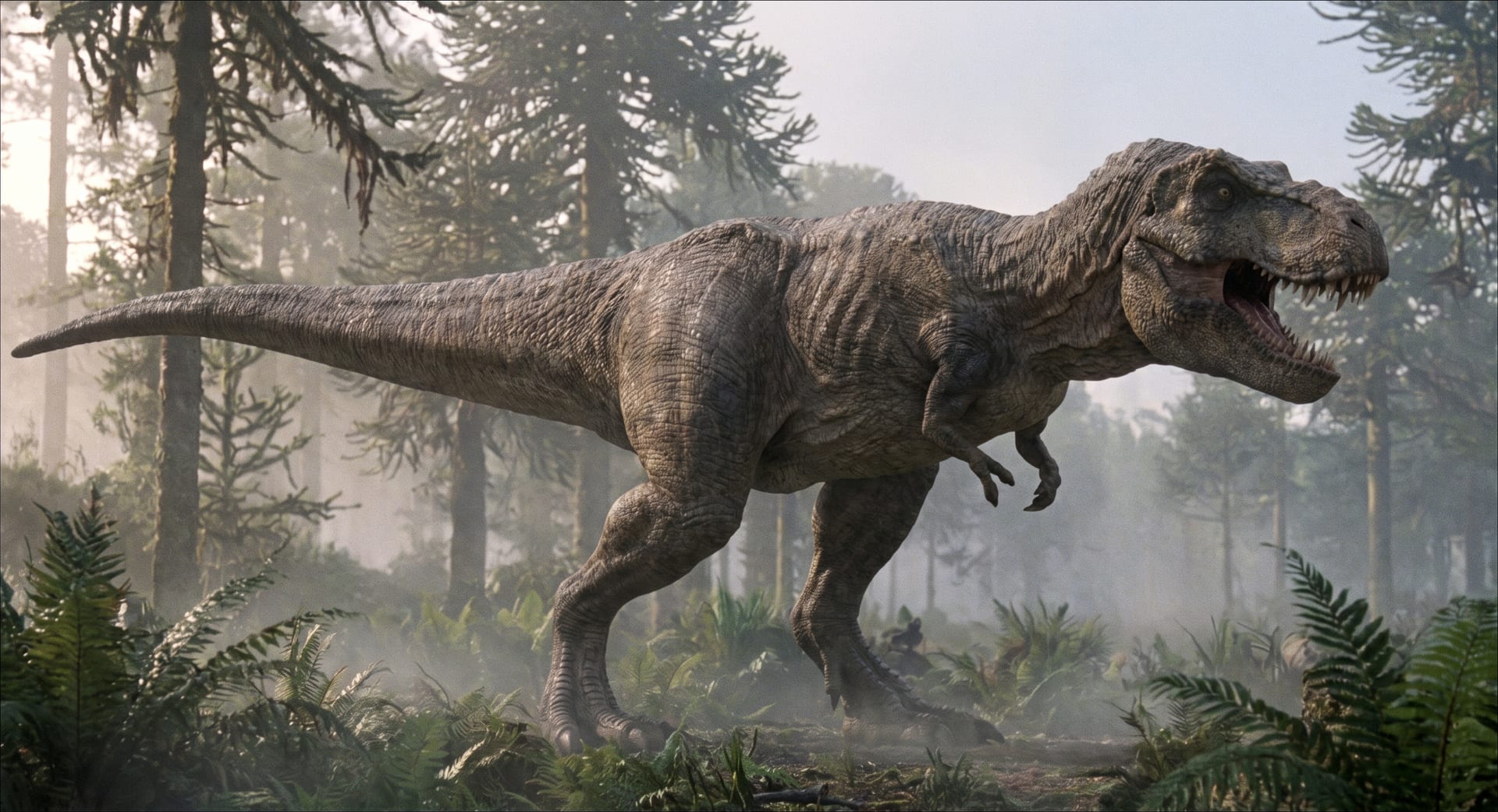
Carnotaurus was a large theropod belonging to the Abelisauridae, a family of large carnivorous dinosaurs found only on the ancient southern supercontinent Gondwana2. Carnotaurus and Tyrannosaurus belong to two different groups, ceratosaurs and coelurosaurs, and weren’t very closely related; these groups might have been evolving apart for more than 100 million years. Tyrannosaurus and its relatives had more powerful jaws and teeth than abelisaurs and longer arms with two-fingered hands, while abelisaurs had four fingers on each hand; tyrannosaurs could also grow much larger1.
Within Abelisauridae, Carnotaurus is considered one of the most derived, or most specialised, members of the family. Its closest relatives may be Aucasaurus or Majungasaurus, though its exact position is still debated; a separate group, Brachyrostra, was proposed in 2009 to include Carnotaurus but exclude Majungasaurus2.
Similar dinosaurs
- Majungasaurus: another abelisaurid, but from Madagascar rather than Argentina2, and possibly one of Carnotaurus’s closer relatives.
- Aucasaurus: possibly Carnotaurus’s nearest relative2, but smaller, from the Neuquén Basin, with low ridges instead of horns4 above each eye.
- Giganotosaurus: another large South American carnivore, but from an earlier part of the Cretaceous and a different family entirely5.