Contents
Spinosaurus was a huge, fish-eating dinosaur that lived in what is now Egypt and Morocco in the Late Cretaceous, 99 to 94 million years ago. It is best known for the 1.5-metre-high sail of spines on its back and for longer than any other carnivorous dinosaur known to science, with one recent estimate putting a large adult at about 14 metres long and 7,400 kilograms.
How big was Spinosaurus?
Size estimates for Spinosaurus have shifted more than for almost any other dinosaur, because the original fossils were destroyed and later studies have worked from different, partial skeletons. Early reconstructions by von Huene in 1926 and Glut in 1982 put it at about 15 metres long and over 6 tonnes, while Gregory Paul’s 1988 estimate kept the 15-metre length but lowered the weight to about 4 tonnes. After new Moroccan material was described, Dal Sasso and colleagues calculated 16 to 18 metres and 7 to 9 tonnes in 2005, and Ibrahim’s team argued for over 15 metres in 2014 from a composite skeleton. A 2022 study by Sereno and colleagues went the other way, arguing that the 2014 composite had been reconstructed with its body proportions enlarged by 10 to 30 percent, and recalculated a maximum length of about 14 metres and a maximum mass of about 7.4 tonnes, the figures used here.
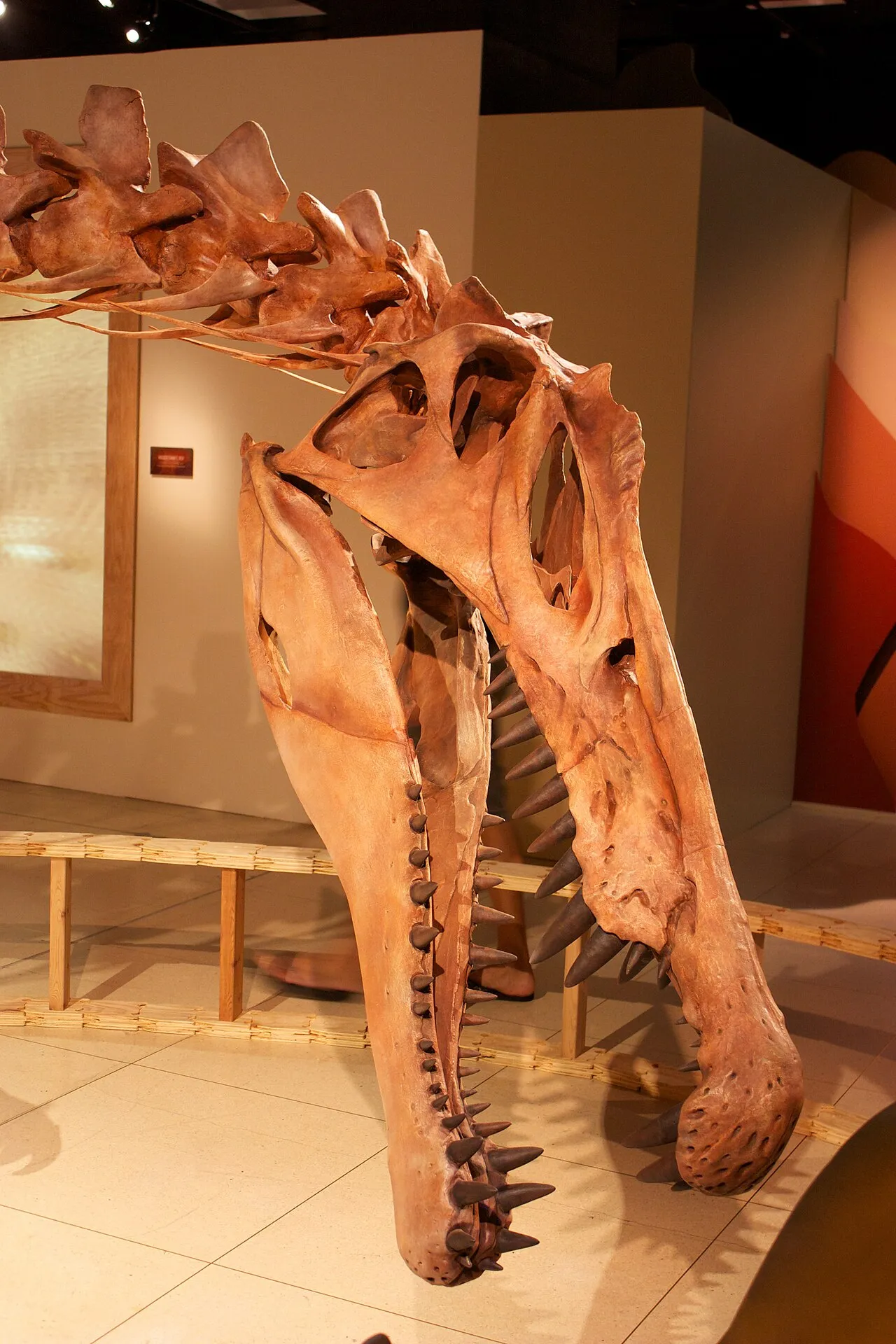
Whatever the exact length, Spinosaurus had unusually short legs for such a large theropod, a long, low skull, and a wide, paddle-like tail that was deep and narrow, with a fin-like shape comparable to the tails of newts and crocodilians. An adult skull has been estimated at about 1.75 metres long by one study and about 1.6 metres by another; the skull of the much younger Moroccan specimen used to define the species today measured only about 1.12 metres.
What did Spinosaurus eat?
Spinosaurus was a carnivore that ate mainly fish and possibly also other dinosaurs. Its narrow snout and a distinctive notch near the front of the jaws were well suited to grabbing slippery prey, and its teeth were smooth and cone-shaped rather than the blade-like, serrated teeth of most meat-eating dinosaurs, a shape that holds onto fish rather than slicing flesh. A 2022 bite-force study estimated a bite of about 4,829 newtons at the front of the jaw and 11,936 newtons further back, closer to a fast, snapping bite than the slow, crushing bite of a typical large theropod. Its close relative Baryonyx backs up the fish-eating picture: fish scales and the bones of a young Iguanodon have been found in its stomach contents, suggesting spinosaurids took whatever prey, fish or otherwise, they could catch.
When and where did Spinosaurus live?
Spinosaurus lived in the Late Cretaceous, 99 to 94 million years ago, with fossils known from Egypt and Morocco, placing it in the Cenomanian stage. The bones used to define the genus came from the Bahariya Formation of Egypt, and the specimen now used to define the species in detail came from Morocco.
Chemical clues back up a life spent largely in or near water. A 2010 study of oxygen isotope ratios in the tooth enamel of Spinosaurus pointed to a semiaquatic lifestyle, and a 2022 study of bone density found that Spinosaurus and Baryonyx had unusually dense bones of the kind that let modern diving animals control their buoyancy and pursue prey underwater. How far it took to the water is debated: a 2018 study found that its tail could generate about eight times as much forward thrust as the tails of land-living theropods, consistent with active swimming, while more recent studies from 2024 argue instead for a wading, heron-like hunting style rather than underwater pursuit.
How was Spinosaurus discovered?
The first Spinosaurus remains were teeth, found by the French geologist Fernand Foureau in Algeria in 1898. The bones that gave the dinosaur its name were collected by the fossil hunter Richard Markgraf in the Bahariya Formation of Egypt in 1912, and the German palaeontologist Ernst Stromer formally named and described Spinosaurus in 1915. The name means “spine lizard”, after the tall spines of its sail.
Those original bones no longer exist. They were kept in Munich, and in April 1944 they were destroyed when Allied bombing hit the museum that housed them, leaving scientists for decades with only Stromer’s drawings and descriptions of very incomplete remains. The modern picture of Spinosaurus rests on new material found much later: a partial skeleton from Morocco, acquired by researchers in 2008 and 2009 and proposed as a new reference specimen for the species in 2014.
What kind of animal was Spinosaurus?
Spinosaurus was a large theropod, the group of mostly meat-eating, two-legged dinosaurs that also includes Tyrannosaurus. It is the type genus of the family Spinosauridae, placed in the subfamily Spinosaurinae and the tribe Spinosaurini. Its closest relatives among the spinosaurids include Baryonyx and Suchomimus, also long-snouted, fish-eating theropods, as well as Irritator; some other named spinosaurids from the same region and time, such as Sigilmassasaurus, may turn out to be the same animal as Spinosaurus under a different name.
The sail on its back remains one of the most debated features of any dinosaur. Proposed explanations include regulating body temperature, signalling to mates or rivals, and storing fat, while one study compared it to the dorsal fin of a sailfish, used to herd schools of fish. Stromer himself thought the spines might have differed in size between males and females, but no single explanation has won out.
Spinosaurus in popular culture
Spinosaurus reached a wide audience as the villain of Jurassic Park III (2001), in which it kills and is shown fighting a Tyrannosaurus, a scene that fuelled lasting arguments among fans and palaeontologists over which dinosaur would really have won. The film’s success is part of why later discoveries about the animal’s size and semiaquatic life drew so much public attention.
Similar dinosaurs
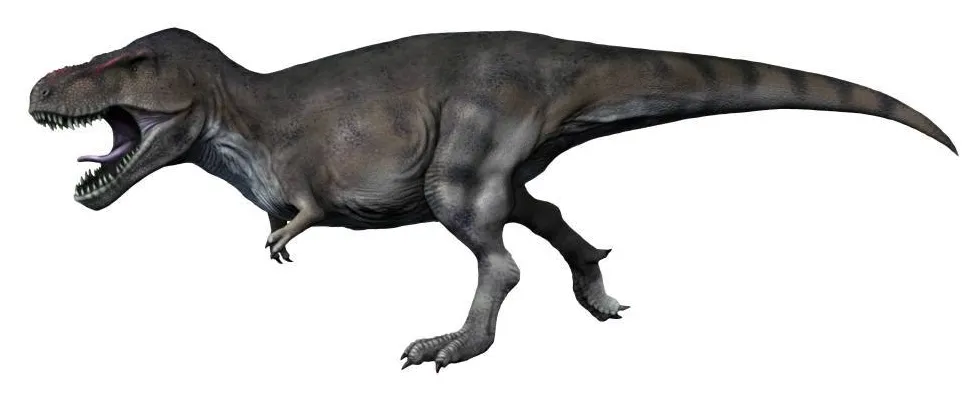
- Tyrannosaurus: another giant theropod, but a land-based hunter with long legs and a deep bite, rather than Spinosaurus’s short legs and fish-trapping jaws.
- Baryonyx: a smaller spinosaurid relative with a similar long snout, known to have eaten fish and young Iguanodon.
- Suchomimus: another long-snouted spinosaurid, close to Spinosaurus and Baryonyx in build and diet.
- Irritator: a spinosaurid from Brazil, also fish-eating, from roughly the same part of the Cretaceous.