Contents
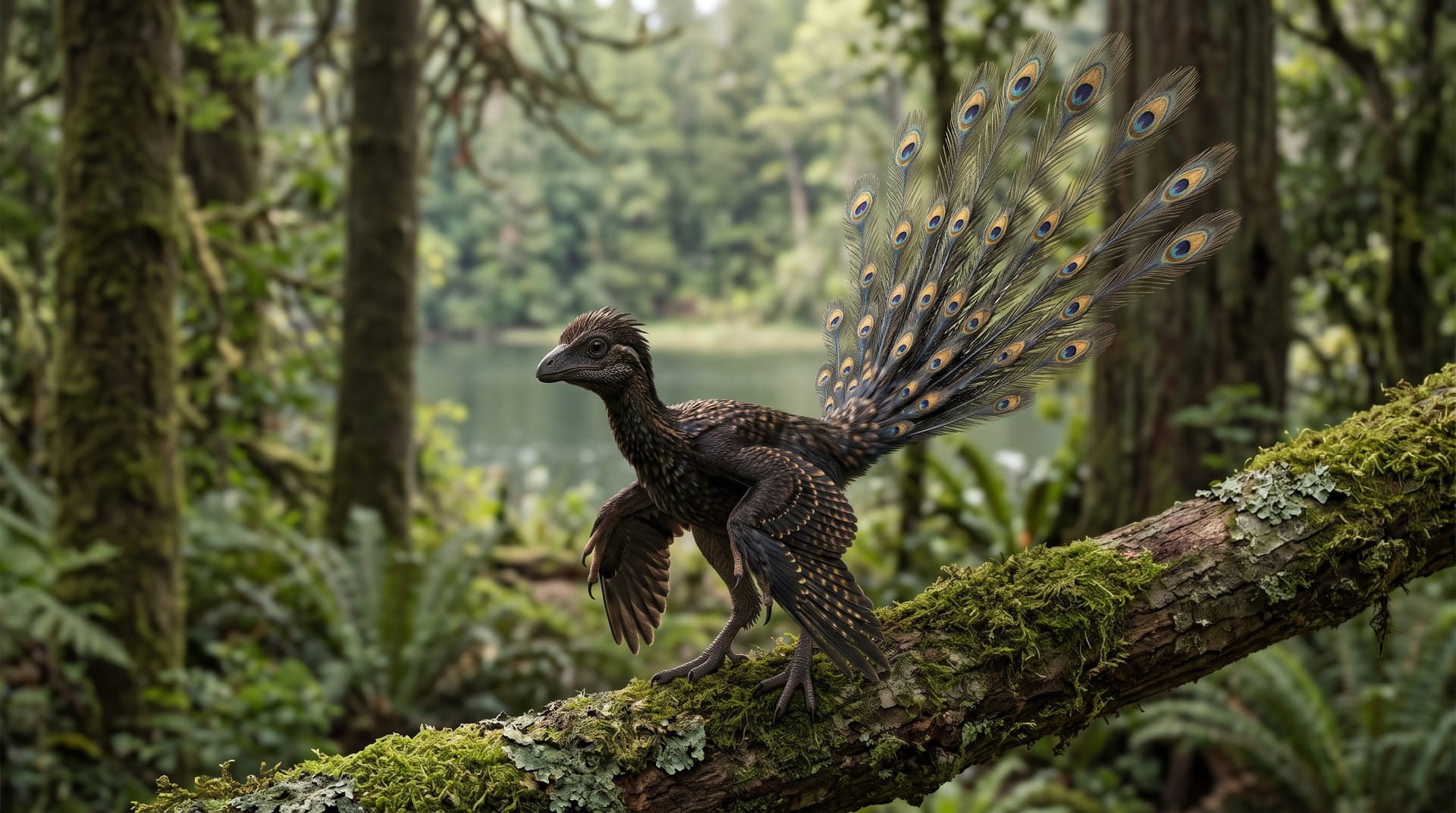
Changzhousaurus was a feathered dinosaur from the Early Cretaceous of northern China, known from a fossil found in the Jiufotang Formation of western Liaoning. It lived in the Aptian age, 121.4 to 113.2 million years ago2, and its only known skeleton is 34 centimetres long, one of the smallest non-avialan theropods known3. Its plumage is what sets it apart: it is the first early pennaraptoran known with both large feathers on its feet and highly elongated tail feathers, and those tail feathers bear a superficial resemblance to the tail plumes of peacocks1.
How big was Changzhousaurus?
The one known individual may not have been fully grown: its bones suggest it was not a juvenile, but not yet fully mature3 when it died. For comparison, the Natural History Museum gives the feathered dromaeosaur Microraptor a length of around 77 centimetres, about the size of a crow4.
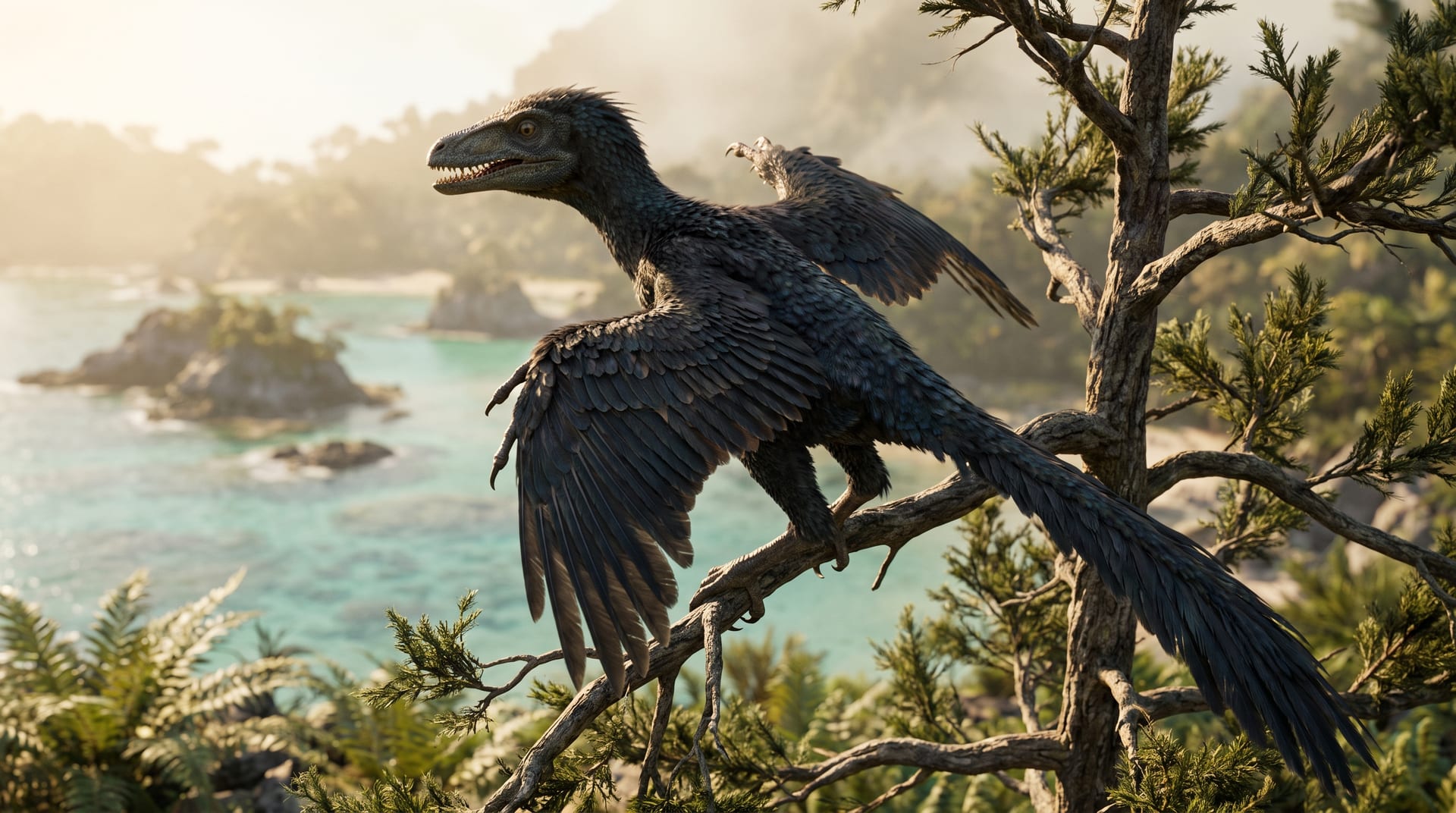
Its wing feathers form the proportionally largest feathered wings among non-avialan pennaraptorans, even though its bony forelimbs were relatively short. Xu Xing, who described it, calls this a decoupling of forelimb skeletal length and feathered wing surface area1. The longest primary feathers on the forelimb were around 12 centimetres long3.
It had wings on its hindlimbs as well, with feathers up to 60 millimetres long on the metatarsals. The tail ended in a fan of about 16 long feathers3, and these elongated tail feathers are substantially more abundant than in other early pennaraptorans1.
What did Changzhousaurus eat?
The upper jaw held four premaxillary and around fifteen maxillary teeth, all unserrated. The lower jaw likely bore around 20 teeth: those at the front were slender, close together and slightly curved, without serrations, while those at the back were more robust, widely spaced and more strongly curved, with serrated rear edges3.
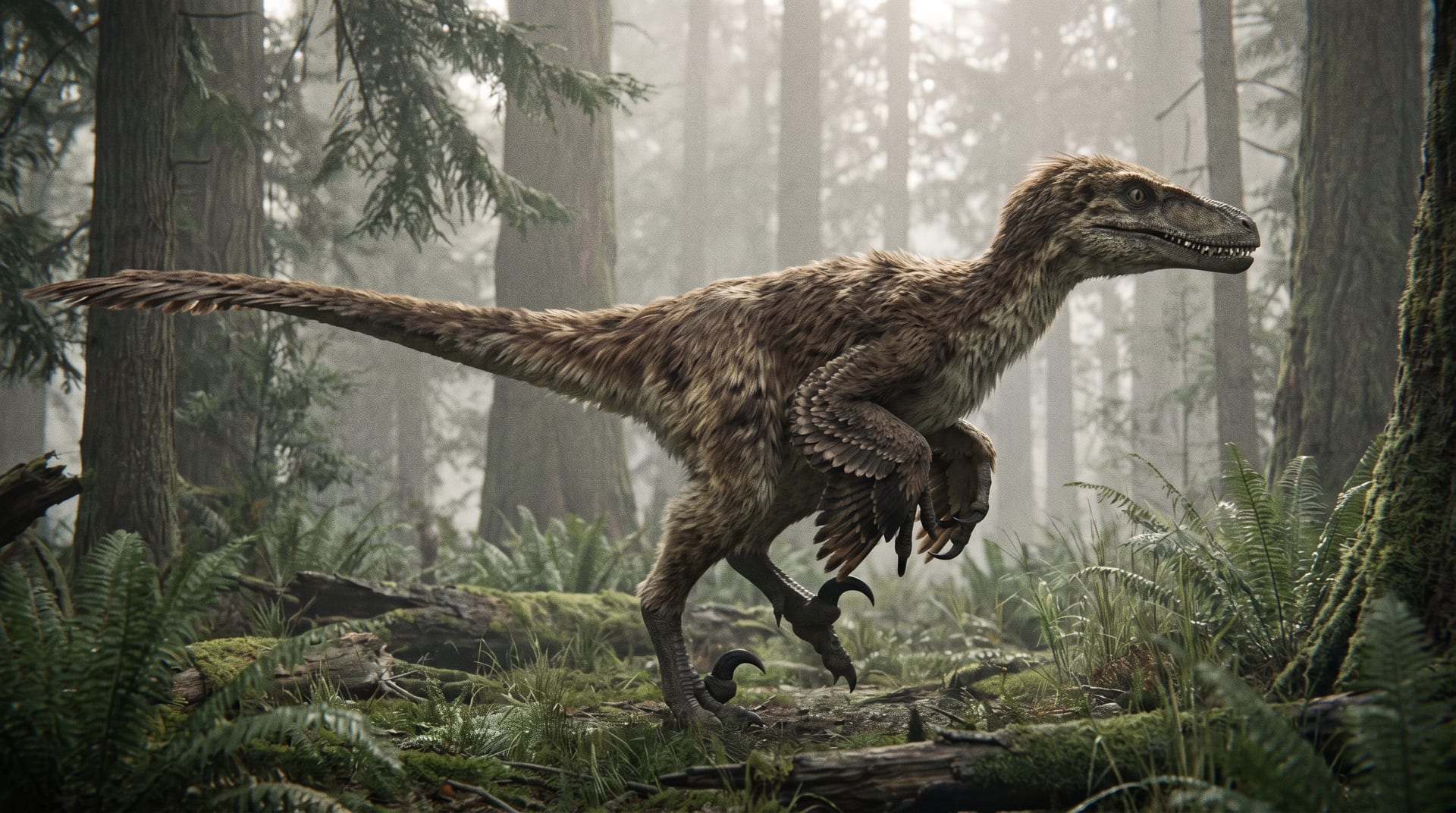
The hand claws are strongly curved, and the second toe of the foot bears the enlarged claw typical of dromaeosaurids and troodontids. Keratin sheaths are preserved around the claws: the enlarged second-toe claw is 7.5 millimetres long, with the sheath adding another 4.53.
Microraptor, a carnivorous small theropod from Early Cretaceous China, has been found with mammal bones, bird remains and fish scales in its stomach4.
When and where did Changzhousaurus live?
Changzhousaurus lived in the Early Cretaceous1. The Paleobiology Database places its single known occurrence in the Aptian, 121.4 to 113.2 million years ago2.
Its fossil comes from the Lower Cretaceous Jiufotang Formation of western Liaoning, China1, at outcrops in Lamadong, Jianchang County3. Microraptor also lived in China in the Early Cretaceous, 120 million years ago4.
In the 2026 paper, Xu lists how to infer the aerial behavior and habitat ecology1 of early pennaraptorans among the issues this fossil raises.
How was Changzhousaurus discovered?
The fossil is preserved on two opposing slabs, prepared by Ding Xiaoqin. It shows a nearly complete, articulated skeleton surrounded by traces of extensive plumage. The original is kept at the Lande Museum of Natural History as LDNHMF 2026A and 2026B, and casts of both slabs are at the Institute of Vertebrate Paleontology and Paleoanthropology3.
Xu Xing named Changzhousaurus in 20262, in a paper in the journal Vertebrata PalAsiatica. Xu works at the Institute of Vertebrate Paleontology and Paleoanthropology, Chinese Academy of Sciences1. The only species is Changzhousaurus sinensis3.
The name means “Changzhou lizard”. It combines Changzhou, a city in Jiangsu Province, with the Ancient Greek sauros, lizard, and was chosen in gratitude to the Changzhou Municipal Government for its support of dinosaur paleontology and science promotion. The species name sinensis means Chinese, after the fossil’s country of origin3.
What kind of animal was Changzhousaurus?
Changzhousaurus was a pennaraptoran dinosaur, and early pennaraptoran fossils have shed light on the origin of birds. Xu considers it likely an early-diverging deinonychosaurian1, the group that unites dromaeosaurids and troodontids, a grouping not supported by all analyses3.
Its exact place is hard to pin down. It shows a combination of derived features observed across distinct pennaraptoran lineages1: features of the maxilla and foot fit troodontids such as Mei long, while features of the dentary, coracoid and ilium are closer to dromaeosaurids. Xu did not perform a phylogenetic analysis3 in the 2026 description, noting a mosaic of conflicting traits that makes such analyses difficult.
The tail was short. It had 22 caudal vertebrae, short compared to other pennaraptorans3. Xu also uses the fossil to raise the question of how to define feathers and birds1.
Similar dinosaurs
- Microraptor: another small Chinese dinosaur with wings on its legs as well as its arms, but longer, at around 77 centimetres4. The arrangement of the longest leg feathers in Changzhousaurus is more similar to microraptorines than anchiornithids3.
- Archaeopteryx: a feathered paravian that lived in the Late Jurassic, 149–145 million years ago, in Germany, and was 0.5 metres long5. Some neck and tail vertebrae of Changzhousaurus show derived conditions seen in Archaeopteryx3.
- Anchiornis: a dinosaur that may sit further back on the bird branch5 of the family tree; its largest known specimen is about 62 centimetres long4.