Contents
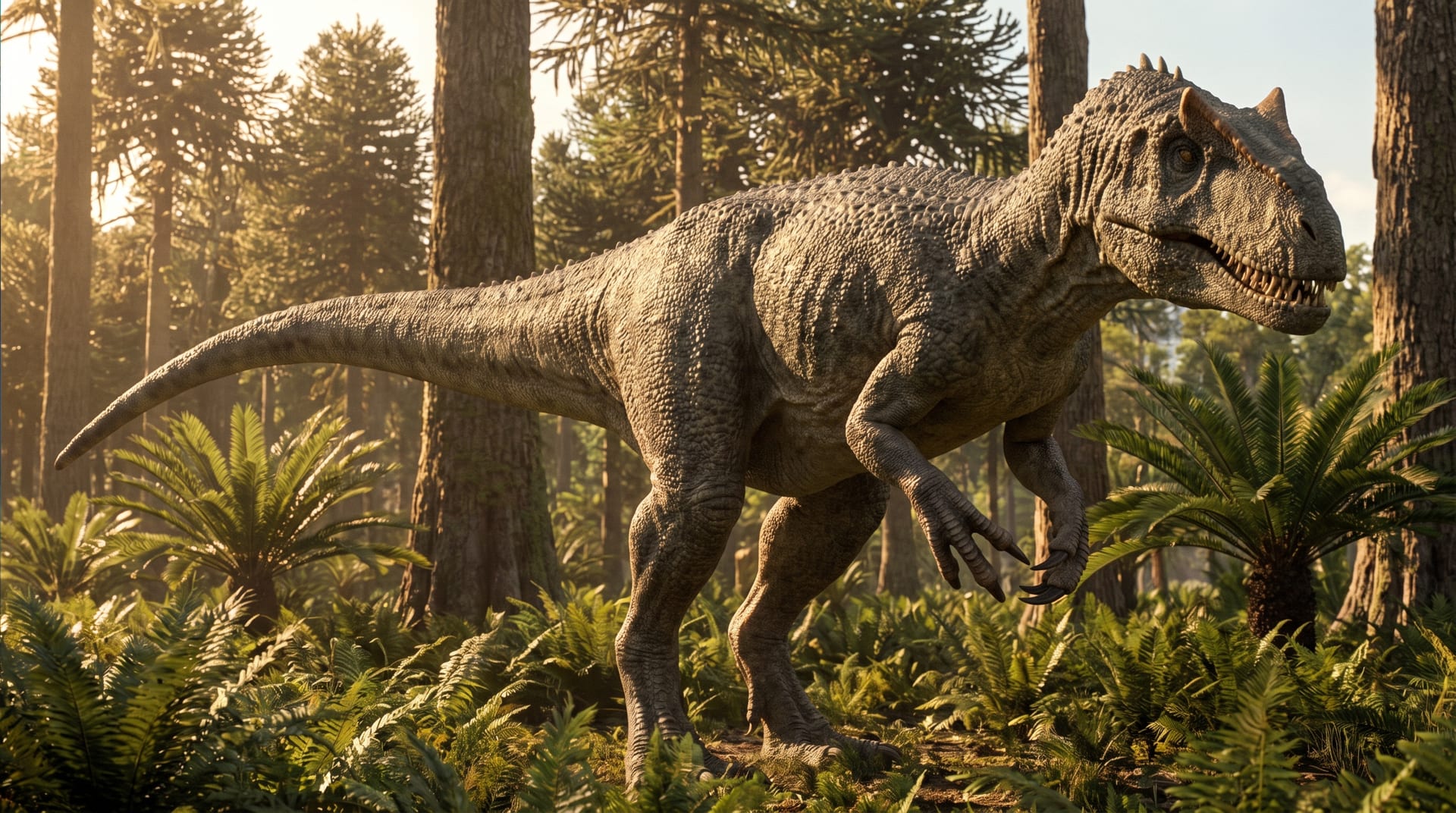
Dilophosaurus was a large meat-eating dinosaur that lived in what is now Arizona, in the United States, during the Early Jurassic, roughly 195 to 184 million years ago. The largest known skeleton measured about 7 metres long and weighed around 400 kilograms. Its name means “two-crested lizard”1, for the pair of crests2 that ran along the top of its skull.
How big was Dilophosaurus?
Size estimates vary with the specimen. The holotype skeleton was about 6.03 metres long and weighed roughly 283 kilograms, while the largest known individual reached about 7 metres and 400 kilograms2; the Natural History Museum rounds this largest figure to 7.0 metres and 400 kilograms1 as its single figure for the genus.
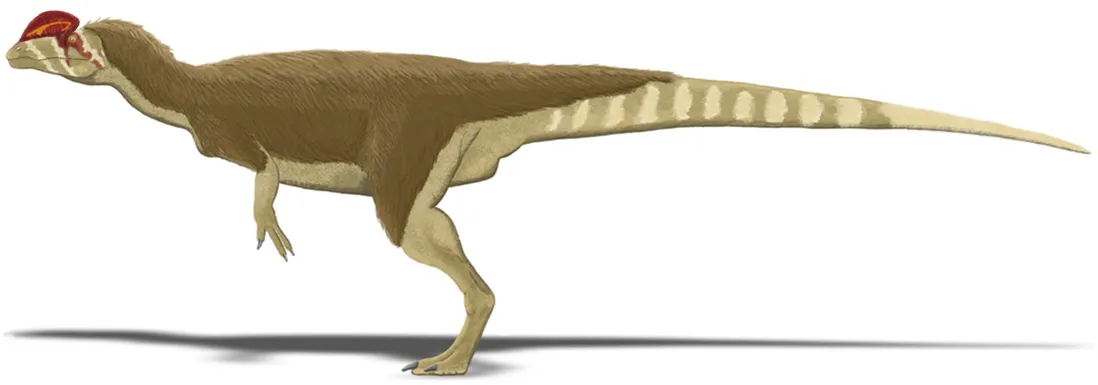
Its best-known feature was the pair of crests2 running along the skull roof, made of hard keratin. The crests were too weak to have been used in fighting, so researchers think they were more likely a visual display for recognising other Dilophosaurus or attracting mates1.
What did Dilophosaurus eat?
Dilophosaurus was a carnivore, with sharp, curved teeth and a small gap in the upper tooth row near the snout tip1, created by a notch in the jawbone. A 2005 study using beam theory on the jaw found that bite force dropped off quickly toward the back of the mouth2, which suggests the front teeth were used to grab and hold smaller prey while the mouth’s middle teeth did more of the cutting.
Despite that, the Natural History Museum notes that Dilophosaurus had stronger jaws than first thought and was probably an active hunter, not a scavenger, with a light build suited to chasing down prey. Likely meals included smaller animals, fish, and possibly other dinosaurs such as Sarahsaurus1. Some more recent analysis instead points to it as an apex predator in its ecosystem, capable of taking larger animals2, so the two readings of the same fossil jaw material do not fully agree on how Dilophosaurus fed.
When and where did Dilophosaurus live?
Dilophosaurus lived in the Early Jurassic. The Natural History Museum gives a single figure of around 184 million years ago, narrowed by other sources to the Sinemurian to Toarcian stages, about 195 to 184 million years ago2; the Paleobiology Database instead lists its known occurrences across a wider span, from the Hettangian to the Pliensbachian, with its earliest recorded occurrence dated to about 201.4 million years ago, the broadest range any of these sources give. Its fossils come from the Kayenta Formation in Arizona, USA4, where it lived in a desert environment crossed by rivers1. As of 2026, the Paleobiology Database records 14 separate fossil occurrences3 for the genus.
How was Dilophosaurus discovered?
The first partial skeletons were found between 1940 and 1942 in northern Arizona, after a Navajo man, Jesse Williams, showed the expedition his fossil find, leading paleontologist Charles L. Camp to three skeletons at the site. Samuel P. Welles initially named the bones Megalosaurus wetherilli in 1954, not yet recognising them as belonging to a new genus of their own. A larger skeleton found in 1964 showed the paired head crests clearly, and in 1970 Welles erected the new genus Dilophosaurus3 for it, a name that means “two-crested lizard”1. More specimens followed: bones found in 1978 and labelled only as a large theropod were identified in 2001 by paleontologist Robert Gay as at least three further Dilophosaurus, including the youngest known individual, an infant2.
The type species is Dilophosaurus wetherilli1, the species name it still carried from Welles’s original 1954 description under the genus Megalosaurus.
What kind of animal was Dilophosaurus?
Dilophosaurus was a large theropod, within Dinosauria, Saurischia, Theropoda and Neotheropoda1. Where it sits more precisely has shifted over time: it has at various points been classified as a coelophysoid, a ceratosaur, or a member of a separate family, Dilophosauridae, a grouping once used for several other large crested or lightly built early theropods. A 2020 phylogenetic analysis found no support for that family and instead placed Dilophosaurus as the sister group to Averostra, more closely related to later theropods than the earlier crested theropod Cryolophosaurus2.
Whether Dilophosaurus carried feathers is unresolved: some disputed fossil footprints have been read as evidence of feathers, but the matter is not settled1.
Dilophosaurus in popular culture
Dilophosaurus is widely known from its role in the Jurassic Park films, which gave it fictional abilities to spit venom and expand a neck frill, and showed it smaller than the real animal2. The crests themselves were covered in hard keratin, not an inflatable frill1, unlike the film version.
Similar dinosaurs
- Cryolophosaurus: another crested Early Jurassic theropod, sometimes considered a close relative, though the 2020 analysis that removed Dilophosaurus from its own family placed it as more derived than Cryolophosaurus2.
- Sinosaurus: a Chinese theropod originally described as a species of Dilophosaurus, Dilophosaurus sinensis, before being reclassified into its own genus2.
- Zupaysaurus: a theropod that some analyses group closely together with Dilophosaurus2.
- Dracovenator: a South African theropod that has been proposed as a close relative of Dilophosaurus2.