Contents
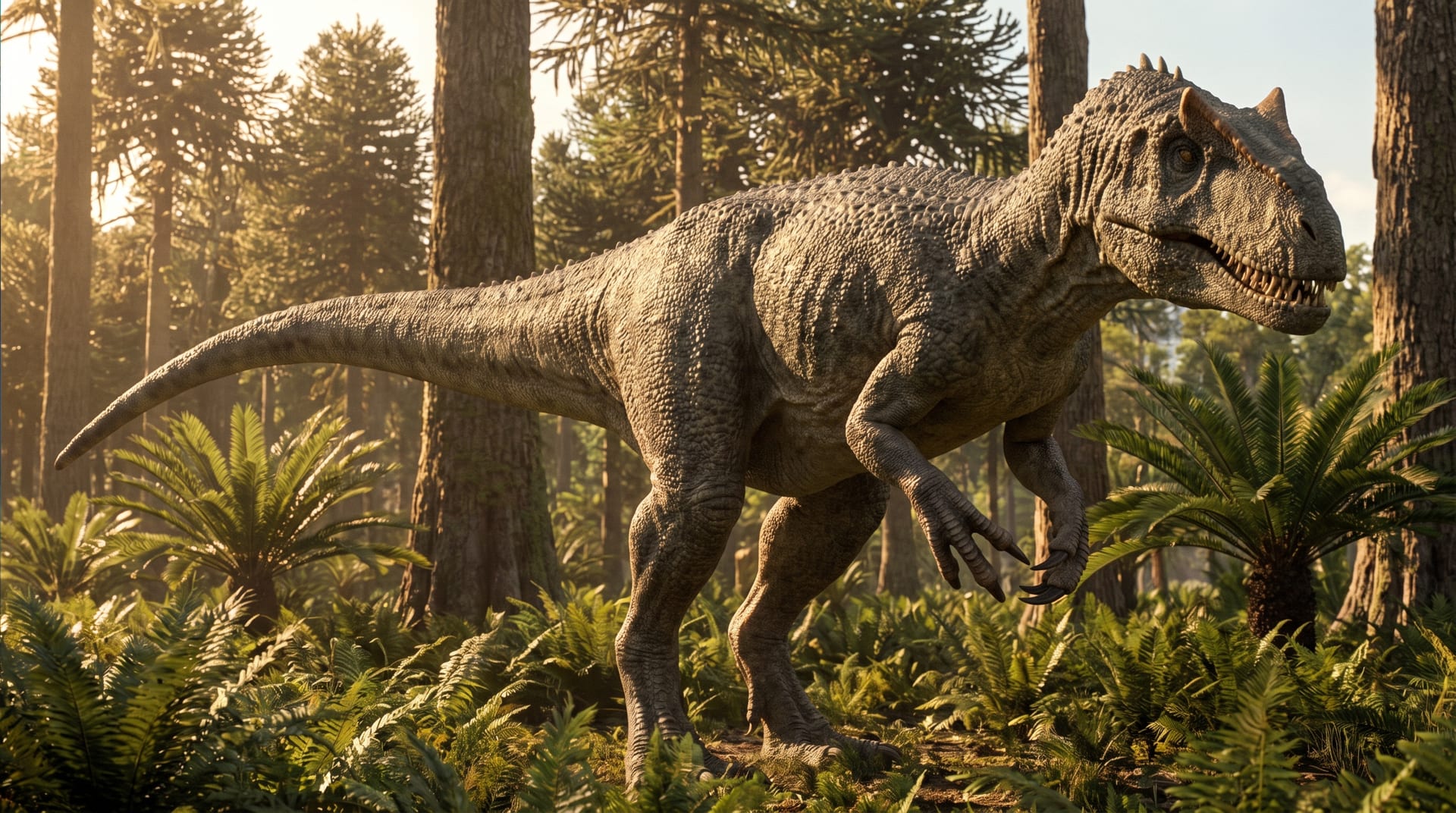
Giganotosaurus was a giant meat-eating theropod dinosaur that lived in what is today Argentina, with a redating of its rock formations placing it in the early Albian, about 111 to 106 million years ago2, in the Early Cretaceous. Most estimates put an adult at around 13 metres long1, making it one of the longest carnivorous dinosaurs known.
How big was Giganotosaurus?
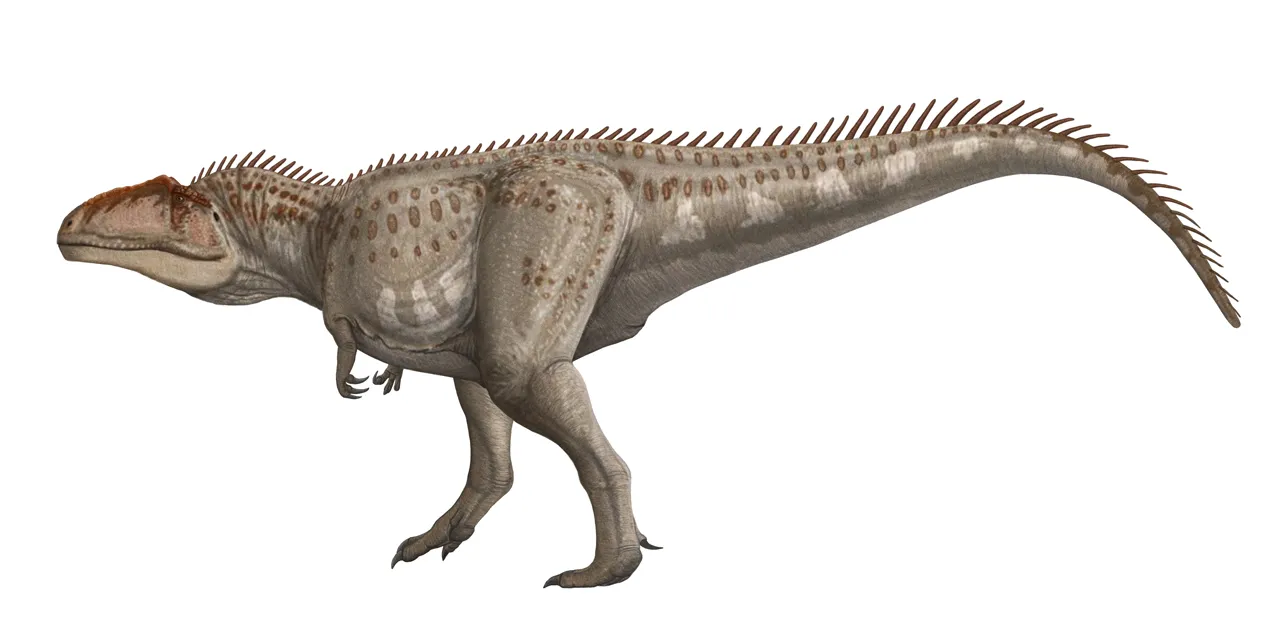
No complete skeleton of Giganotosaurus has ever been found, so its size comes from estimates built on an incomplete holotype. Length estimates converge on 12 to 13 metres, and weight estimates have shifted with each new reconstruction: a published range runs from 4.2 to 13.8 tonnes, while the Natural History Museum gives a single figure of 13,800 kilograms, at the top of that range. The skull alone measured 1.53 to 1.8 metres long2 on the holotype, and its teeth were long, blade-like and serrated, built for slicing flesh instead of crushing bone. Like other large theropods, it walked on two legs1.
A 2001 study calculated an upper running-speed limit of 50 kilometres per hour, but a later, 2017 biomechanical study concluded that an adult’s skeleton would only have allowed a walking gait2, not running.
What did Giganotosaurus eat?
Giganotosaurus was a carnivore and apex predator within its ecosystem, hunting with long, blade-like, serrated teeth built for slicing rather than crushing. A 2005 study of its bite found adaptations for capturing and bringing down prey by delivering powerful bites, matching the Natural History Museum’s description of very strong jaws1, though the bite itself was weaker than Tyrannosaurus rex’s2 and grew weaker further back along the tooth row.
The Natural History Museum says it is unclear whether it hunted sauropods cooperatively, or instead scavenged1; other research points to juvenile sauropods as likely prey. The group-hunting idea is fed by a close relative: a bonebed of the related Mapusaurus held multiple individuals of different ages, which led paleontologist Rodolfo Coria to suggest in 2006 that large theropods like these may have hunted in groups2, an advantage against sauropods this size; the idea remains debated.
When and where did Giganotosaurus live?
Every known fossil of Giganotosaurus comes from Argentina’s Neuquén Province, in Patagonia, from the Candeleros and Huincul Formations. Its age has recently been revised. The Natural History Museum’s dino directory gives the Late Cretaceous, 100 to 95 million years ago, with the species going extinct around 98 million years ago1 on that older, Cenomanian-based chronology, but a 2026 redating study by Maniel and colleagues, cited on its Albian age and formation, places the maximum depositional age of the Candeleros and Huincul Formations in the early Albian, about 111 and 106 million years ago2 respectively, pushing Giganotosaurus back into the Early Cretaceous. The Paleobiology Database’s own occurrence record lists four fossil occurrences spanning 113.2 to 106.3 million years ago3, close to that revised range.
It shared its world with the sauropods Andesaurus and Limaysaurus, the theropod Ekrixinatosaurus and the dromaeosaur Buitreraptor, alongside crocodyliforms, turtles, frogs and pterosaurs. Oxygen-isotope studies of its bones found patterns similar to those of Tyrannosaurus2, suggesting a metabolism between that of a reptile and a mammal, capable of rapid growth.
How was Giganotosaurus discovered?
Amateur fossil hunter Rubén Carolini found the first bone, a lower leg bone, in 1993 while driving a dune buggy through badlands near Villa El Chocón, Neuquén Province. Specialists from the National University of Comahue excavated it2, in a dig funded by science writer Don Lessem after he saw photographs of the bone. Palaeontologists Rodolfo Coria and Leonardo Salgado announced the find in 1994 and formally named it Giganotosaurus carolinii in 19953, the species name honouring Carolini. The genus name means “giant southern lizard”, pronounced1 “gig-an-oh-toe-SORE-us”.
The holotype skeleton is unusually complete for such a large theropod: it preserves almost 70 percent of the skeleton, including most of the backbone, the shoulder and hip girdles and both thigh bones, though its skull was found scattered across about 10 square metres and had to be reconstructed. A second, larger specimen is known only from a single jawbone, collected in 1988 and described in 1998, about 8 percent bigger than the holotype2 — the basis for the higher end of the genus’s size estimates.
What kind of animal was Giganotosaurus?
Giganotosaurus was a large theropod, part of the lineage running from Dinosauria through Saurischia and Theropoda to the family Carcharodontosauridae. It is one of the most completely known members of that family, whose other members include Carcharodontosaurus from Africa and the South American Mapusaurus and Tyrannotitan. It was possibly about as long as Carcharodontosaurus1, though no complete skeleton of either genus has been found. A latex cast of its brain cavity showed a shape similar to that of Carcharodontosaurus, but larger, with a volume of 275 millilitres2.
Similar dinosaurs
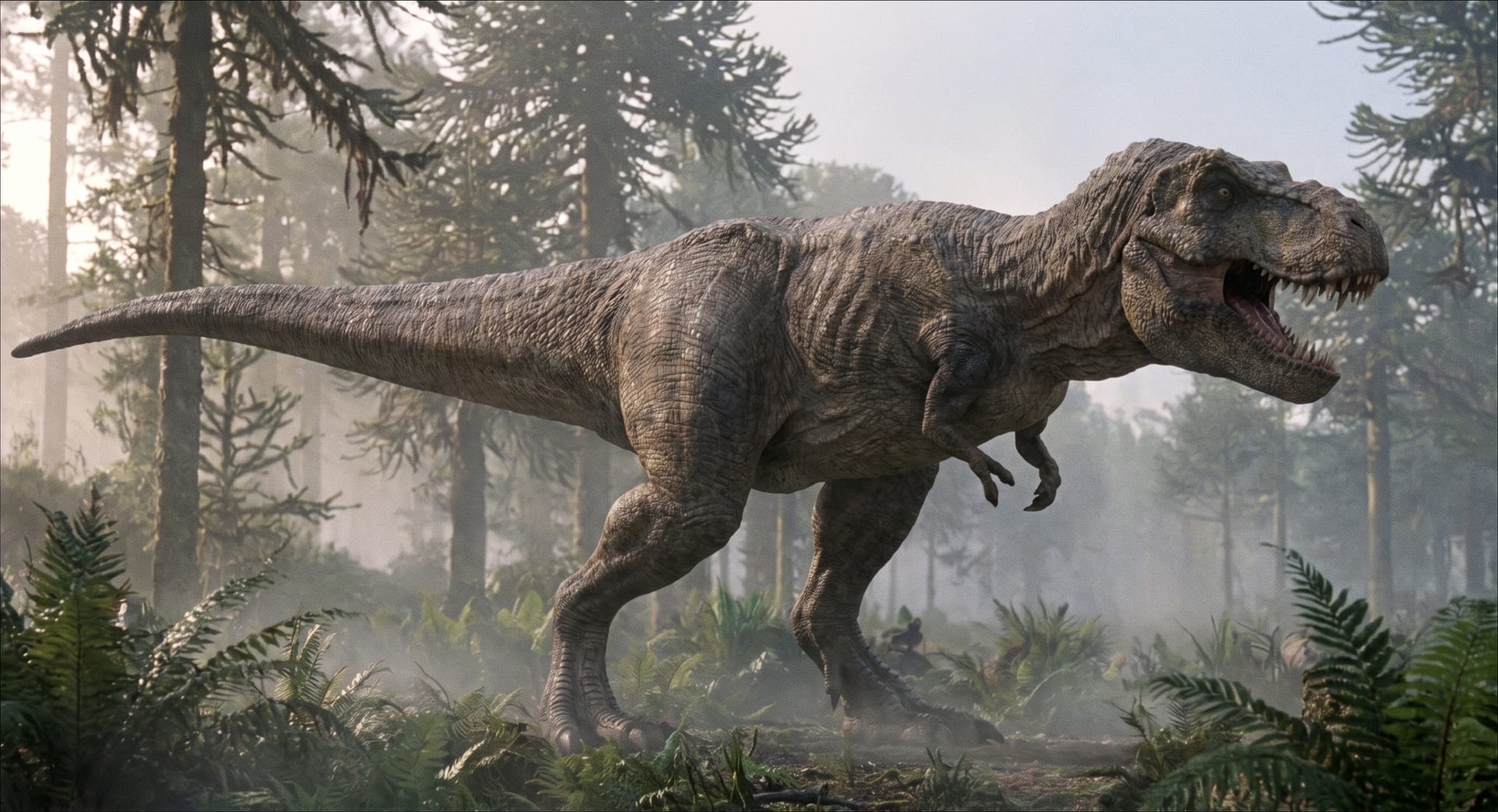
- Tyrannosaurus: Giganotosaurus was probably longer but more lightly built than the bulkier, heavier Tyrannosaurus rex1, and the two lived on different continents, tens of millions of years apart.
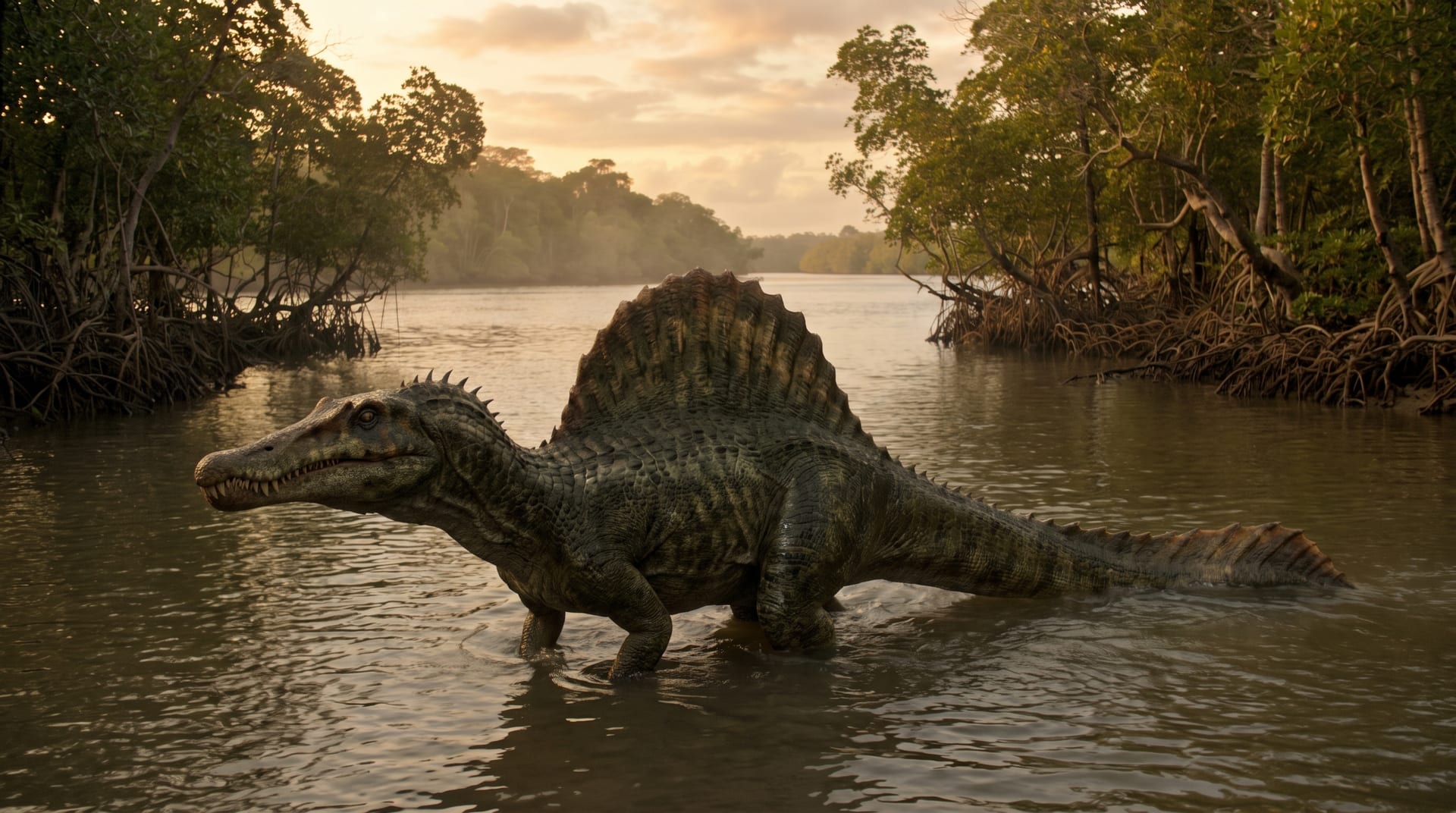
- Spinosaurus: at 14 metres long, Spinosaurus was longer than Giganotosaurus’s estimated 13 metres1.
- Mapusaurus: a close South American relative in the same family, known from a bonebed of multiple individuals2 of different ages that has fuelled debate over whether these giant theropods hunted in groups.
- Carcharodontosaurus: the African member of the same family, Carcharodontosauridae1, whose brain cavity was smaller than Giganotosaurus’s2.