Contents
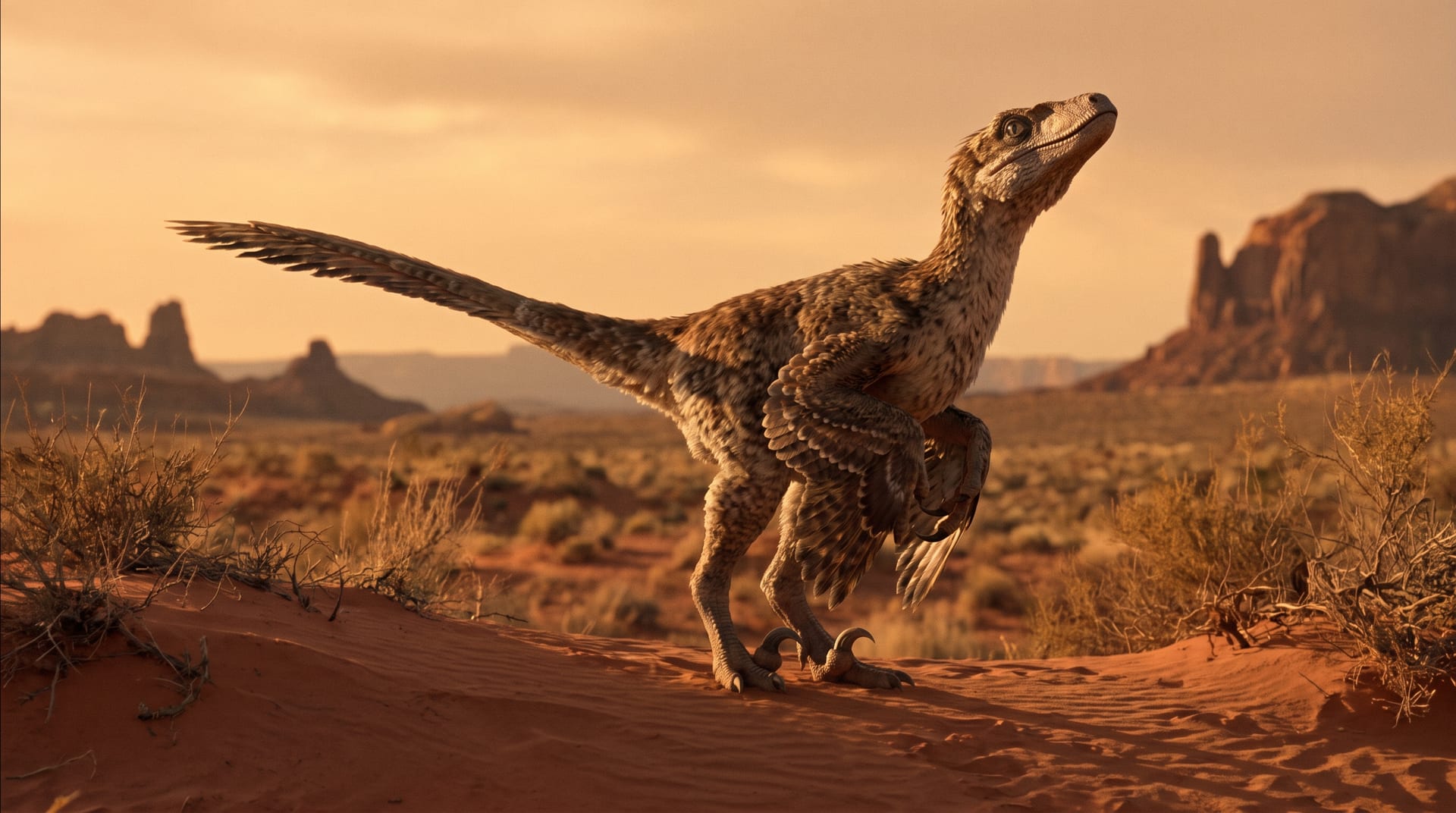
Archaeopteryx was a small, feathered theropod that lived in what is now Germany during the Late Jurassic, 149 to 145 million years ago. About 0.5 metres long and roughly the size of a magpie, it had sharp teeth, a long bony tail and broad feathered wings1, a mix of reptile and bird features that seemed to confirm Darwin’s theory of evolution2 to many readers when it was found, just two years after he published it.
How big was Archaeopteryx?
Archaeopteryx grew to about 0.5 metres long, close to the size of a magpie. The Natural History Museum gives no weight estimate, but other estimates put its body mass at 500 to 1,000 grams, in the same range as a raven, and give it a wingspan of about 70 centimetres2. Unlike living birds, it kept sharp teeth and a long, bony tail, alongside broad feathered wings1.
Whether those wings could manage powered flight is, as of 2026, still an unresolved question. Archaeopteryx had asymmetrical flight feathers, a wing shape found in flying birds, but the Natural History Museum states plainly that it is not known whether it could fly fully or only glide1. One specimen, found near the town of Thermopolis, lacked the reversed toe that every modern bird uses to grip a branch2, which suggests it spent more time walking on the ground or climbing tree trunks than perching.
Colour has also been studied. Microscope work on the isolated 1861 feather, published in 2011, calculated a 95 percent likelihood that the feather was black, with heavier pigment near the tip; a 2020 study confirmed it was entirely matte black2, though the colour pattern of the rest of its plumage is still unknown.
What did Archaeopteryx eat?
Archaeopteryx was a carnivore, with many small, cone-shaped teeth rather than the flat beak of a modern bird. It most likely hunted small reptiles, mammals or insects. It got around on two legs and by flying, and was probably active by day, sleeping at night like most birds1.
When and where did Archaeopteryx live?
Archaeopteryx lived in the Late Jurassic, 149 to 145 million years ago, in what is now Germany. Every known fossil comes from the limestone quarries near Solnhofen in Bavaria, where the Natural History Museum describes the environment at the time as a lagoon surrounded by sub-tropical islands1. The Paleobiology Database’s own occurrence record places its fossils within the Tithonian stage3 of the Late Jurassic, the end of the time range the Natural History Museum gives.
How was Archaeopteryx discovered?
The first Archaeopteryx fossil ever found was a single feather, unearthed near Solnhofen and described by Christian Erich Hermann von Meyer in 18613, who named the type species Archaeopteryx lithographica. The genus name comes from Ancient Greek words meaning ancient wing1. That founding feather later caused problems of its own: in 2019 researchers argued it may not even belong to Archaeopteryx2, reopening a question that is still unsettled.
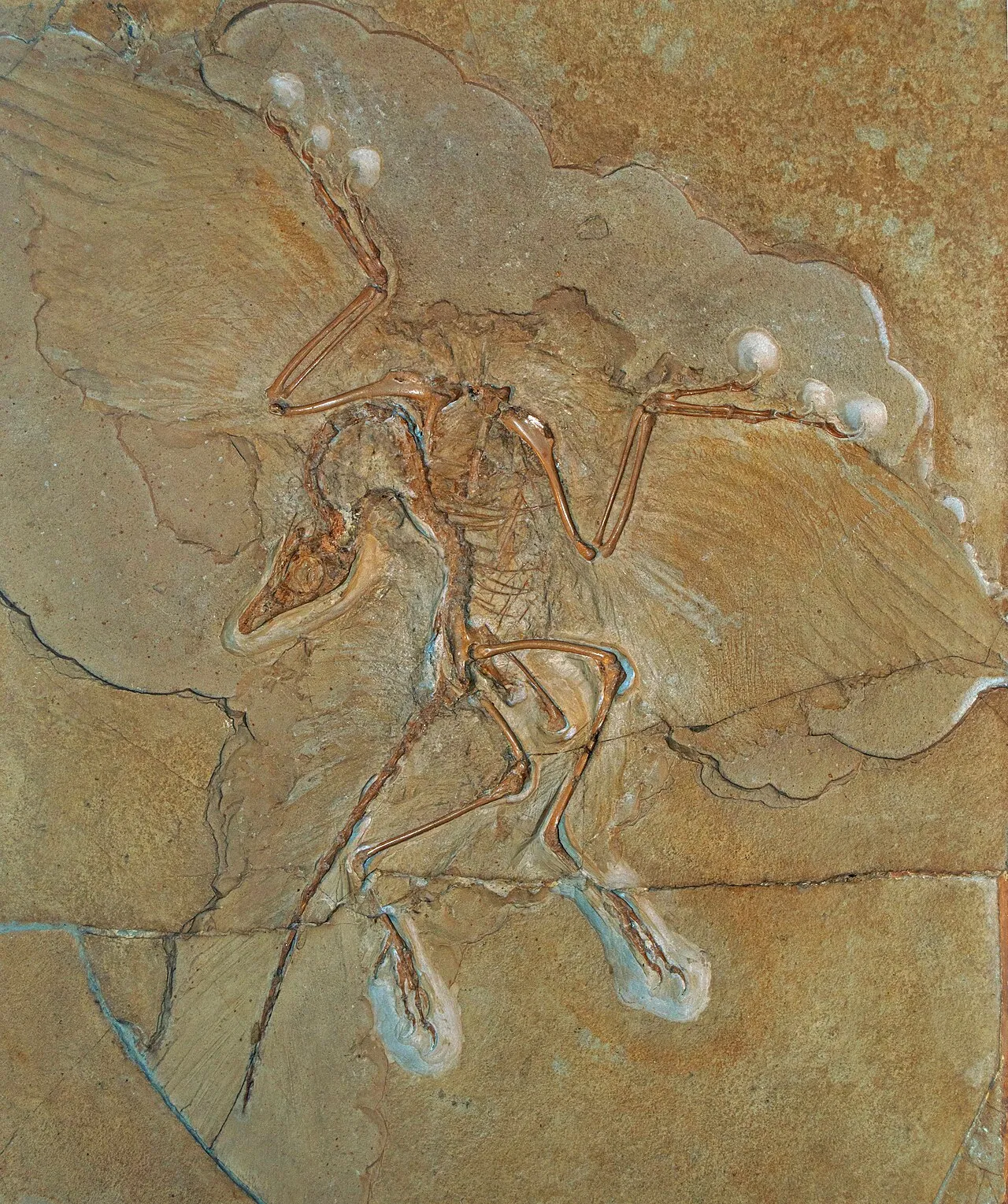
A first complete skeleton followed quickly. The Natural History Museum acquired it in 18621, and it is still known today as the London specimen. A far more complete skeleton, with its skull intact, was found in 1874 or 1875 and became known as the Berlin specimen, its purchase financed by the industrialist Ernst Werner von Siemens. More skeletons turned up over the following century and a half, each from the same Solnhofen deposits, until fourteen Archaeopteryx fossils were known, including the Munich, Eichstätt, Maxberg, Haarlem, Solnhofen, Daiting and Thermopolis specimens, plus a Chicago specimen put on public display by the Field Museum in 2024. That specimen preserved tertial feathers2, a type of inner flight feather, never seen before on any Archaeopteryx fossil.
The timing of the first discovery mattered as much as the fossil itself. It came just two years after Charles Darwin’s 1859 book, On the Origin of Species, and the mix of reptile and bird features seemed to confirm his theory of evolution to many readers at the time. Darwin himself later wrote of “that strange bird, the Archaeopteryx, with a long lizard-like tail”2 found in the Solnhofen slates.
What kind of animal was Archaeopteryx?
The Natural History Museum classifies Archaeopteryx as a small theropod1, within Dinosauria, placing it in its own family, Archaeopterygidae, inside the group Paraves that also contains the ancestors of modern birds. Whether it should be called a dinosaur or a bird is still argued over: some researchers call it the most primitive known bird, while others classify it as a non-avian dinosaur just outside true birds. As of 2026, newer phylogenetic studies have gone further still, proposing that Archaeopteryx actually belongs with the deinonychosaurs, the group that contains the dromaeosaurids and troodontids2, not with the lineage leading to birds, a placement that remains disputed.
Similar dinosaurs
- Velociraptor: a dromaeosaurid, a group some studies place close to Archaeopteryx under the deinonychosaur hypothesis. It was also a feathered carnivore, but much larger, at 1.8 metres long against Archaeopteryx’s 0.5 metres1, and it lived tens of millions of years later, in the Late Cretaceous4.
- Compsognathus: another small, two-legged carnivorous theropod from the same Late Jurassic time as Archaeopteryx, found in nearby France and Germany. It was somewhat larger, at about 0.7 metres long5, and unlike Archaeopteryx it had no feathers described from its fossils.