Contents
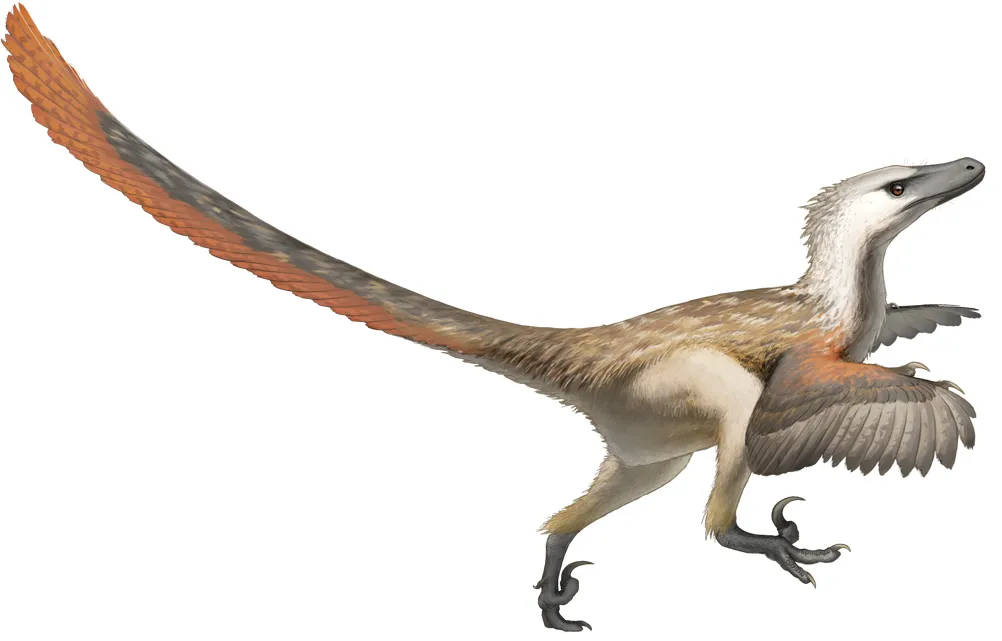
Velociraptor was a small, fast, feathered carnivore that lived in Mongolia and China in the Late Cretaceous, about 75 to 70 million years ago. It was about 1.8 metres long and weighed around 7 kilograms, roughly the size of a turkey, and is best known today for a film version that was far larger than the real animal.
How big was Velociraptor?
Estimates vary with the specimen. The Natural History Museum gives a single estimate of 1.8 metres long and 7 kilograms, while the English Wikipedia article gives a range of 1.5 to 2.07 metres long and 14.1 to 19.7 kilograms, based on a wider set of specimens, standing around 0.5 metres tall at the hip. Neither figure is averaged here; the lower and higher estimates come from different sources looking at different bones. Some estimates put the largest individuals at up to 2.5 metres long and 28 kilograms.
Velociraptor carried a large, sickle-shaped claw on the second toe of each foot, which could grow more than 6.5 centimetres long along its outer edge, with a rounded, not especially sharp inner edge. A 2007 study reported six evenly spaced quill knobs on the forearm bone of one specimen, bumps where large feathers anchor in living birds, and estimated 14 such knobs were originally present; the Natural History Museum describes the animal as carrying a fine, feather-like covering. Quill knobs like these are almost never found in flightless birds today, which is one reason researchers think the ancestors of dromaeosaurids like Velociraptor could fly, even though Velociraptor itself could not.
What did Velociraptor eat?
Velociraptor was a meat-eater with lots of sharp, pointed teeth. A 2022 study estimated its bite force at about 304 newtons, weaker than the bite of the larger dromaeosaurs Dromaeosaurus (885 newtons) and Deinonychus (706 newtons); a 2024 study of how well the skull resisted bite stress suggested the species leaned more toward scavenging than active, powerful killing.
The best evidence for what it actually ate, and how, comes from two fossil finds. The famous “Fighting Dinosaurs” specimen, discovered in 1971 by a Polish-Mongolian expedition, preserves a Velociraptor locked together with a Protoceratops, its sickle claw apparently driven into the other animal’s throat while the Protoceratops has the raptor’s forelimb clamped in its beak; researchers now think a collapsing sand dune or sandstorm buried the pair quickly during the struggle. Separately, in 2010 researchers found shed Velociraptor teeth next to a tooth-marked Protoceratops jawbone, evidence of the raptor feeding on an already-dead carcass. A 2012 find went further: a Velociraptor was discovered with a pterosaur bone in its stomach that showed no sign of digestion, suggesting the animal died, probably from a broken rib, soon after scavenging the pterosaur.
Studies of the inner ear suggest it could hear a wide range of frequencies and may have hunted at night, based on comparisons of its eye structure with Protoceratops and living animals.
When and where did Velociraptor live?
Velociraptor lived in the Late Cretaceous, in the Campanian stage, with the Natural History Museum dating its fossils to 74 to 70 million years ago and the English Wikipedia article giving a close range of about 75 to 71 million years ago; both ranges are given here rather than averaged. Its fossils come from Mongolia, with further specimens, including a second named species, found in China.
Most Mongolian specimens come from the Djadochta Formation, a semi-arid landscape of sand dunes and occasional streams at the time, where Velociraptor lived alongside Protoceratops, the egg-thief dinosaur Oviraptor, the armoured Pinacosaurus and the fellow dromaeosaur Saurornithoides. Chinese specimens come from the Bayan Mandahu Formation, which has a broadly similar set of animals but with some different species, including the dromaeosaur Linheraptor.
How was Velociraptor discovered?
The first specimen, a crushed but complete skull along with a claw and finger bones, was found on 11 August 1923 by Peter Kaisen during an American Museum of Natural History expedition to the Flaming Cliffs of the Gobi Desert, Mongolia. Henry Fairfield Osborn formally named it Velociraptor mongoliensis in 1924, a name that combines the Latin words for “swift” and “robber”; he had briefly used an earlier, informal name, “Ovoraptor djadochtari,” in the press before the formal description.
Further specimens were scarce for decades because Cold War politics kept North American teams out of Mongolia, so it was Polish-Mongolian expeditions that recovered the most important finds, including the Fighting Dinosaurs specimen in 1971, now a Mongolian national treasure that has been loaned to the American Museum of Natural History. From 1988 a Chinese-Canadian team found remains in northern China, and from 1990 joint Mongolian-American expeditions returned to Mongolia and recovered several well-preserved skeletons. A second species, V. osmolskae, was named in 2008 from jaw and skull bones found in China, honouring the Polish palaeontologist Halszka Osmólska.
What kind of animal was Velociraptor?
Velociraptor was a small theropod, a member of the family Dromaeosauridae within Theropoda, and more precisely of the subfamily Velociraptorinae within the derived dromaeosaur group Eudromaeosauria. When Osborn first described it in 1924 he placed it in Megalosauridae, at the time a catch-all family for carnivorous dinosaurs, before it was later recognised as a dromaeosaurid. It was smaller than most of its dromaeosaur relatives; the related velociraptorines Linheraptor, Tsaagan, Adasaurus and Shri are grouped with it, while Deinonychus and Dromaeosaurus, discussed below, were larger relatives in the wider family.
Velociraptor in popular culture
Velociraptor is probably the dinosaur genus most familiar to the general public, almost entirely because of the Jurassic Park films. The film animals, however, are not really modelled on it: author Michael Crichton based the novel’s “velociraptors” on Deinonychus after meeting its discoverer, the palaeontologist John Ostrom, at Yale, and chose the name “Velociraptor” because he found it more dramatic; Ostrom himself said the novel’s animal was based on Deinonychus in almost every detail. That is also why the film versions are about 2 metres long and 90 kilograms, far bigger than a real Velociraptor; the Natural History Museum notes that the films recreated Velociraptor at roughly twice its actual size, and that soon after the first film’s release an even larger relative, Utahraptor, was discovered. Later films kept the scaled-up, mostly featherless look of the original even as evidence for feathers grew; Jurassic Park III gave one animal quill-like structures for continuity, and the Jurassic World films largely kept the classic design.
Similar dinosaurs
- Deinonychus: a larger dromaeosaur from North America, about 2 metres long and around 90 kilograms, and the real-world model for the “velociraptors” of the Jurassic Park films.
- Utahraptor: a much larger North American dromaeosaur, closer in size to the Jurassic Park film animals than the real Velociraptor is.
- Dromaeosaurus: the dromaeosaurid the family is named after, and a more powerful biter than Velociraptor.
- Microraptor: a much smaller, feathered dromaeosaur from China with confirmed wing-like feathers.