Contents
Therizinosaurus was a giant plant-eating theropod dinosaur, best known for the three-fingered hands on each arm, tipped with claws about 50 centimetres long, thought to be the longest of any land animal ever. It lived in what is now Mongolia1 during the Late Cretaceous, roughly 72 to 66 million years ago2, and walked on two legs at a length of about 9 to 10 metres3.
How big was Therizinosaurus?
Only some arm, leg and rib bones are known from Therizinosaurus, so full-body reconstructions lean heavily on closer relatives. The Natural History Museum gives a single figure of 10 metres long1; a more recent estimate cited on its page puts it slightly shorter, at 9 to 10 metres long and 4 to 5 metres tall3.
Palaeontologist Philip Currie has called the lack of a complete skeleton the central problem: “we do not really have a legitimate skeleton” to work from. A smuggled skeleton that later surfaced suggests the animal was no larger than the tyrannosaur Tarbosaurus, and researchers have put its claw-to-body ratio at 8.2 to 10 percent4.
Weight is even less settled. Gregory S. Paul proposed about 3 tonnes in 2010, later revised to 5 to 10 tonnes; working from different bones, Lindsay Zanno and Peter Makovicky instead proposed about 6.6 tonnes in 20133. On the claws themselves, palaeoartist Mark Witton has said he cannot think of any animal with longer ones4.
What did Therizinosaurus eat?
Therizinosaurus was herbivorous, unusual for a theropod, a group whose other members were mostly two-legged meat-eaters such as Tyrannosaurus, Allosaurus and Velociraptor. The Natural History Museum suggests it pulled vegetation toward itself1 with its claws, the way a modern anteater pulls apart a mound. A 2018 study examining its jaws found a reduced bite force suited to cropping plants, not tackling prey3.
Were the claws also weapons? The Natural History Museum is cautious: nobody knows if they were strong enough to fight off other dinosaurs, and they may instead have worked mainly as a threat display, making a predator think twice before attacking. Being a plant-eater did not necessarily make it placid: the museum points out that large modern herbivores such as elephants and rhinos can be dangerous too1, though fossil bones alone cannot reveal an extinct animal’s temperament.
When and where did Therizinosaurus live?
Every known Therizinosaurus fossil comes from Mongolia1, from the Nemegt Formation in the Gobi Desert, dated to the Maastrichtian stage, about 72.2 to 66 million years ago2. The formation preserved a landscape of large meandering rivers and conifer woodland3 under a relatively temperate, monsoonal climate.
Therizinosaurus shared that environment with the apex predator Tarbosaurus3, the huge ostrich-like Deinocheirus, the hadrosaur Saurolophus and titanosaurian sauropods such as Nemegtosaurus, alongside armoured ankylosaurs and smaller raptor-like dinosaurs.
How was Therizinosaurus discovered?
The first Therizinosaurus bones, three partial claws, were collected in 1948 by a Mongolian expedition organised by the USSR Academy of Sciences, at a site in the Nemegt Formation. Evgeny Maleev named the genus in 19542, and from the claws alone he reconstructed the animal as something closer to a giant, turtle-like reptile3, which is why its only named species is cheloniformis, “turtle-shaped”. The genus name itself means “scythe lizard”1, because its claws resemble a scythe’s long curved blade.
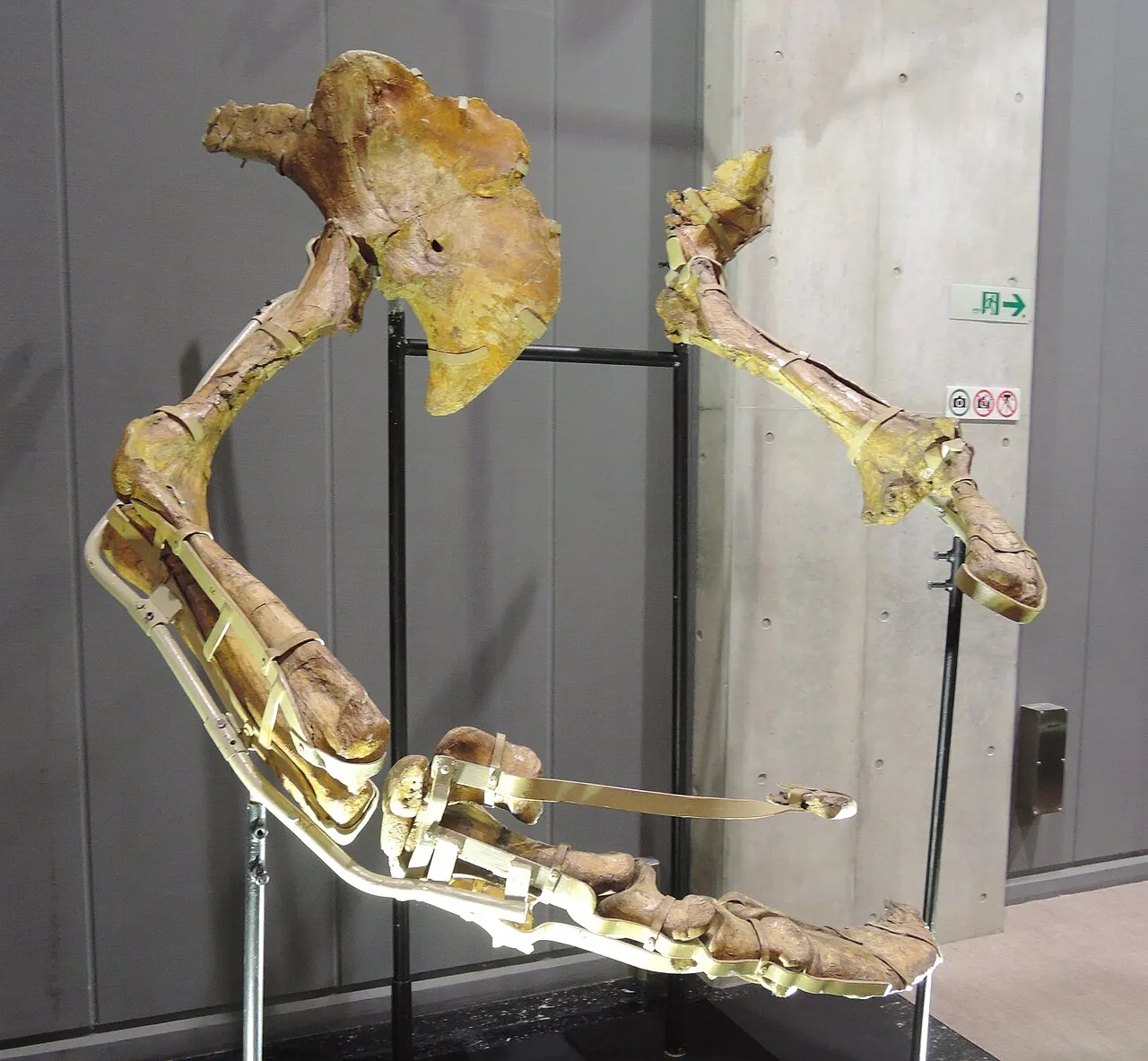
More bones followed over the next quarter-century: an upper claw in 19683, a fragmentary claw in 1972, and a nearly complete arm with a separate hindlimb in 1973. For a long time, the Natural History Museum notes, scientists weren’t sure whether to count it as a theropod at all: its long neck and heavy body led some to suspect a link to sauropods such as Diplodocus and Brachiosaurus instead. The question was only settled once fossil hunters found smaller relatives1 such as Alxasaurus, Erlikosaurus and Beipiaosaurus, whose more complete skeletons showed the whole group belonged on the theropod branch of the family tree.
What kind of animal was Therizinosaurus?
In the family Therizinosauridae, Therizinosaurus was a large theropod and is the largest known member of that family3. Within theropods its full classification runs Theropoda, Therizinosauroidea, Therizinosauridae1, placing it among the maniraptorans, the broader group of feathered theropods that also produced the ancestors of birds.
Because Therizinosaurus itself is known only from arm, leg and rib bones, much of what scientists know about the family comes from its more complete relatives: the small, feathered Beipiaosaurus from China confirmed the group’s theropod affinities, while Erlikosaurus’s far more complete skull revealed strong theropod features3 that the claws alone could not show.
Therizinosaurus in popular culture
Therizinosaurus appears as a blind creature in the film Jurassic World Dominion, prompting a question the Natural History Museum has had to answer directly: there is no reason to think it was normally blind1, though any individual animal could lose its sight to injury or disease during its life.
Similar dinosaurs
- Alxasaurus: a smaller, more completely known relative whose skeleton helped settle the decades-long debate1 over whether Therizinosaurus was a theropod at all.
- Erlikosaurus: known from a much more complete skull3 than Therizinosaurus, confirming the family’s theropod anatomy.
- Beipiaosaurus: a small, feathered therizinosaur from China whose discovery helped confirm the whole family were theropods1, unlike the turtle-like animal Maleev first imagined.
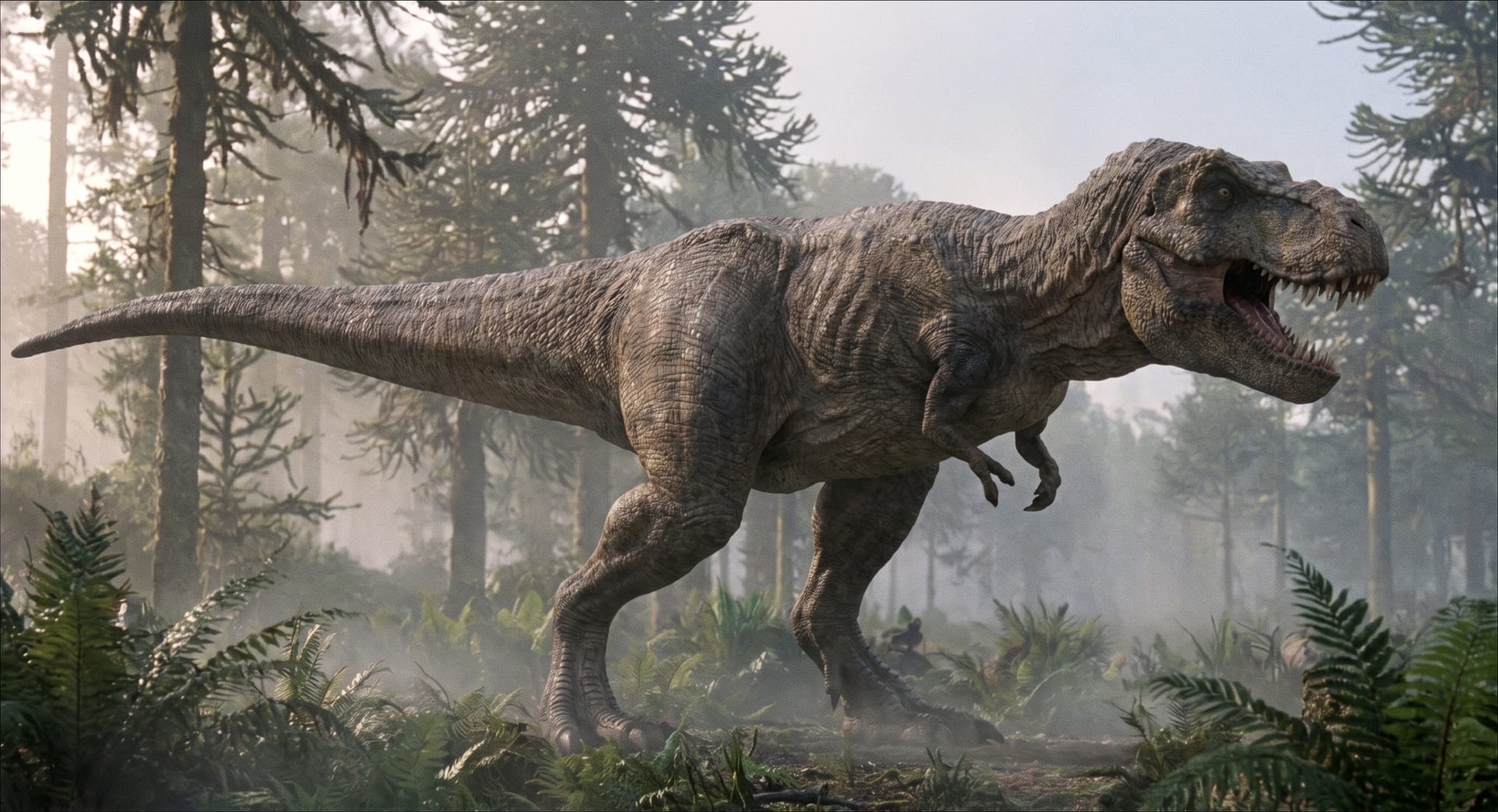
- Tyrannosaurus: a far more typical theropod, a two-legged meat-eater1 rather than a plant-eater, and known from much more complete skeletons.