Contents
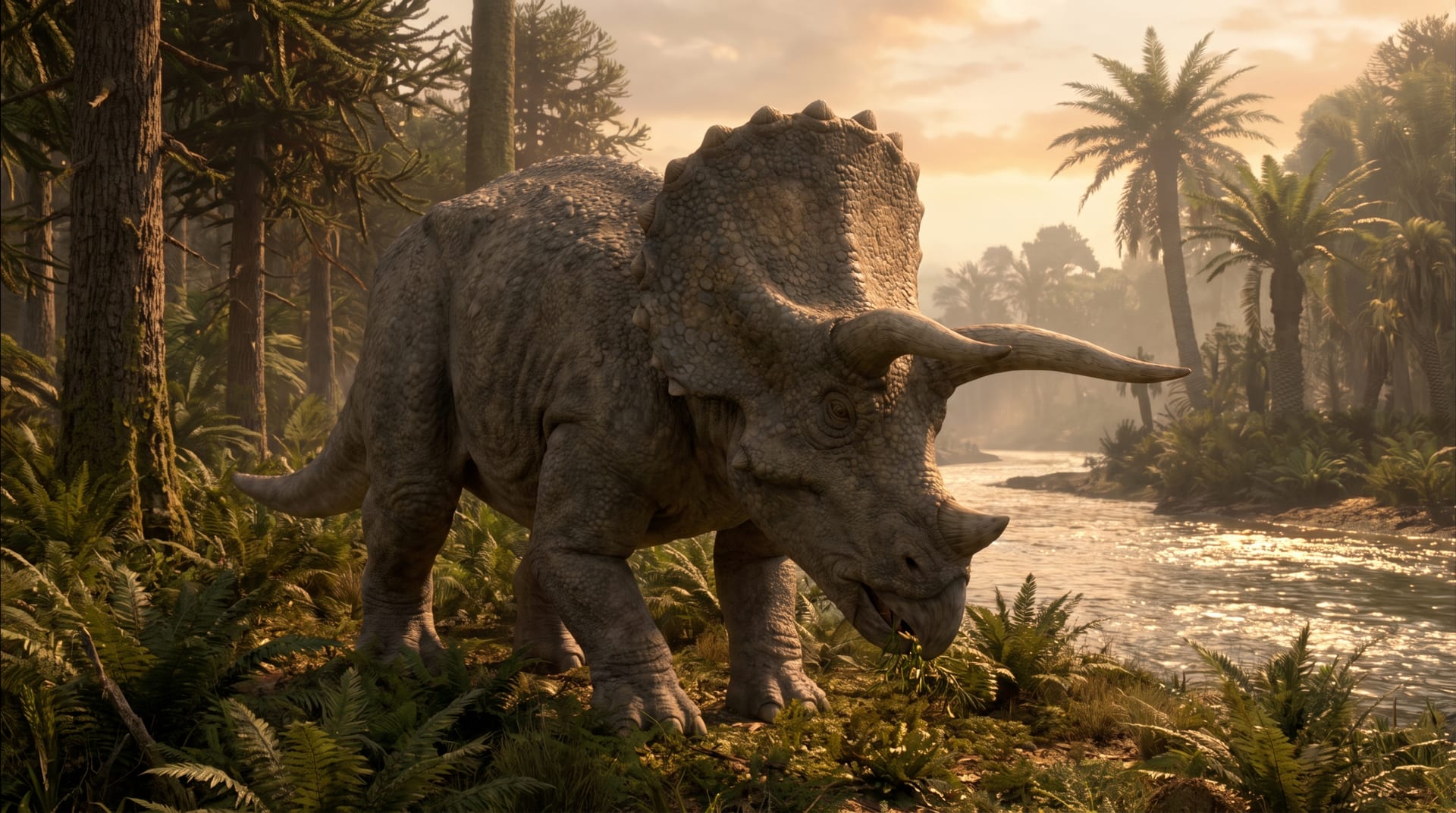
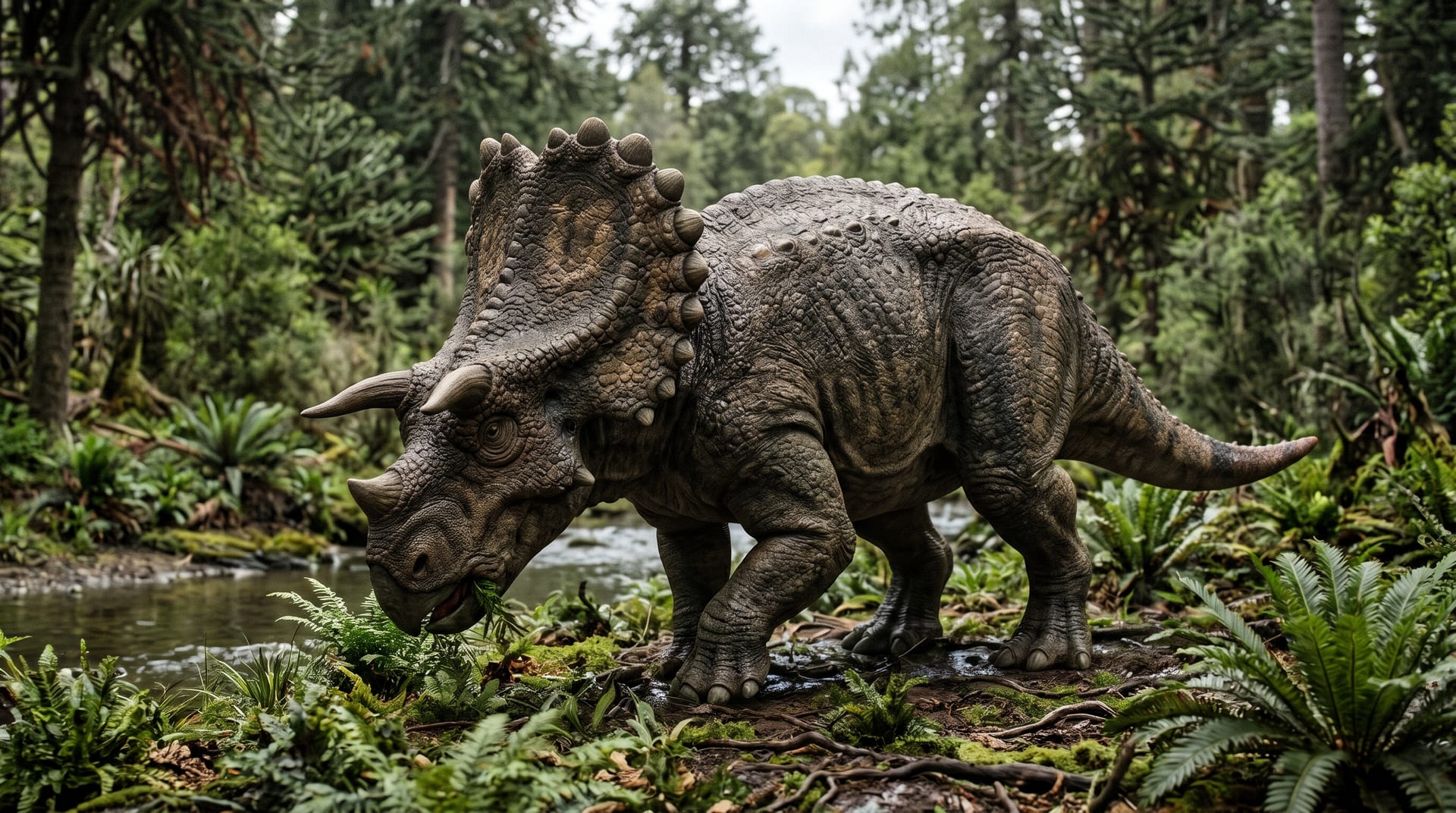
Cryptarcus was a horned dinosaur, a chasmosaurine, whose fossils come from the Dinosaur Park Formation of Alberta, Canada, and date to about 75 million years ago. Its only known skull is around 94 centimetres long2, and the rest of its skeleton remains unknown. The skull was once the holotype of Chasmosaurus russelli, until it was re-described as Cryptarcus russelli1 and given a genus of its own.
How big was Cryptarcus?
As of 2026, no part of its skeleton other than the skull is known. As a chasmosaurine ceratopsid it would have been a large, four-legged plant-eater2 with a massive skull.
Its frill was long for its head: the frill measures around 120% of the length of the rest of the skull. Seen from the front, the frill has a rectangular profile, like the frills of Pentaceratops, Utahceratops and Agujaceratops but unlike that of Chasmosaurus, which appears to widen towards the back2. Traits like horn size and frill shape can vary1 with growth or with how a fossil was preserved.
The horns are hard to judge. A short and broad-based nasal horn sat over the back of the nostril opening. The two horns over the eyes are preserved as small stumps in the holotype, which may be pathological, and they may have been quite long2 in life. Other chasmosaurs show signs of reabsorbing their horns with age.
What did Cryptarcus eat?
Cryptarcus was a herbivore. Chasmosaurs had large, narrow snouts ending in a large beak2, with series of slicing teeth behind the beak.
The front of the snout of the holotype is largely unpreserved, and the lower jaws are missing. Its broad jugal bone, behind the eye, would have covered the end of the upper toothrow as seen from the side, like Chasmosaurus2 but unlike most other chasmosaurs. During the re-examination the jugal turned out to have been restored during the original preparation1 in the late 1930s.
When and where did Cryptarcus live?
Cryptarcus lived in the Campanian age of the Late Cretaceous, about 75 million years ago2. The Paleobiology Database lists the species under its old name, Chasmosaurus russelli, with a range of 83.6 to 72.2 million years ago3.
Its fossils come from Alberta. The holotype quarry is at the Onefour Research Station, Alberta, and the specimen was found near that former station, southeast of Manyberries2. The sediments of the Dinosaur Park Formation record an overall transgression, changing from sandy to muddy to coaly layers, the coaly interval being the Lethbridge Coal Zone. The formation is overlain by the marine Bearpaw Formation4.
For a long time Chasmosaurus russelli was thought to come from the lower layers of the formation. Fieldwork at the original quarry, accessed in July 2012, showed that the holotype was recovered from the upper Dinosaur Park Formation4, not the lower part as previously supposed. The second specimen, a partial parietal bone, was found 5.7 kilometres east of the holotype quarry2 and slightly higher in the formation.
How was Cryptarcus discovered?
Palaeontologist Loris Shano Russell found the skull in 19362 while working for the Geological Survey of Canada. Most of it was preserved and fully articulated, but the front of the snout, the lower jaws, the right half of the frill and parts of the left side of the face were reconstructed with plaster.
In 1940 Charles Mortram Sternberg named it Chasmosaurus russelli in honour of Russell; the Paleobiology Database records the name as Sternberg 19403. For decades it was considered one of two species within the genus Chasmosaurus, alongside C. belli. In a 2016 study, the two species were told apart by a single character, the degree of embayment of the back edge of the frill, and specimens of both had overlapping stratigraphic intervals4. Palaeontologists had long suspected that something was unusual1 about the holotype.
In 2026, Robert B. Holmes, Jordan C. Mallon, Michael J. Ryan and David C. Evans re-examined the skull in a study in the Canadian Journal of Earth Sciences. They removed old plaster reconstructions and re-prepared the fossil, because earlier restoration had obscured anatomical details. They then established the genus Cryptarcus for it. The name means “hidden arch”1, a reference both to its hidden identity within Chasmosaurus and to the arch shape of its frill. Besides the holotype they kept one other specimen, a partial parietal found by Wendy Sloboda in 2013. A large isolated horn from the same area possibly represents C. russelli2, but it has none of the holotype’s diagnostic features.
What kind of animal was Cryptarcus?
Cryptarcus belongs to the family Ceratopsidae and the subfamily Chasmosaurinae. Two traits of its frill set it apart: the deep embayment on the back of the frill and the dome-shaped ornamentation2 along the edge of that embayment. The embayment gives the frill a distinctive M-shaped outline, and none of the Chasmosaurus specimens with a similar shape arch so extremely.
The small bony knobs on the frill are unusual too. Each squamosal carries eight episquamosals, with an especially large second one and a distinctly smaller eighth, an arrangement unique among chasmosaurs. Only three epiparietals2 are present, and the first two are oval, dome-shaped and prominently keeled.
Its closest relatives are uncertain. The 2026 study’s analyses did not agree on where it sits: some placed it closer to Chasmosaurus, others closer to Pentaceratops and Utahceratops from southern Laramidia, and a few could not resolve its position at all. Its anatomy mixes traits seen in Agujaceratops, Utahceratops and Pentaceratops, scattered in a pattern that does not line up cleanly with any one of them. That could mean a separate evolutionary lineage1 related to those southern genera, or just the independent evolution of similar features in distantly related animals.
Similar dinosaurs
- Chasmosaurus: the genus Cryptarcus was split from. It lived in Canada 76–74 million years ago5, but its frill appears to widen towards the back2, unlike the rectangular frill of Cryptarcus.
- Pentaceratops: a chasmosaurine found in the USA6. Its frill proportions are similar to those of Cryptarcus2, but its nasal horn sits fully over the nostril opening, not over the back of it.
- Utahceratops: a genus that Cryptarcus may be more closely related to than to Chasmosaurus, with its nasal horn fully behind the nostril opening2.
- Triceratops: a more derived ceratopsid whose nasal horn sits fully over the nostril opening2, like that of Pentaceratops.