Contents
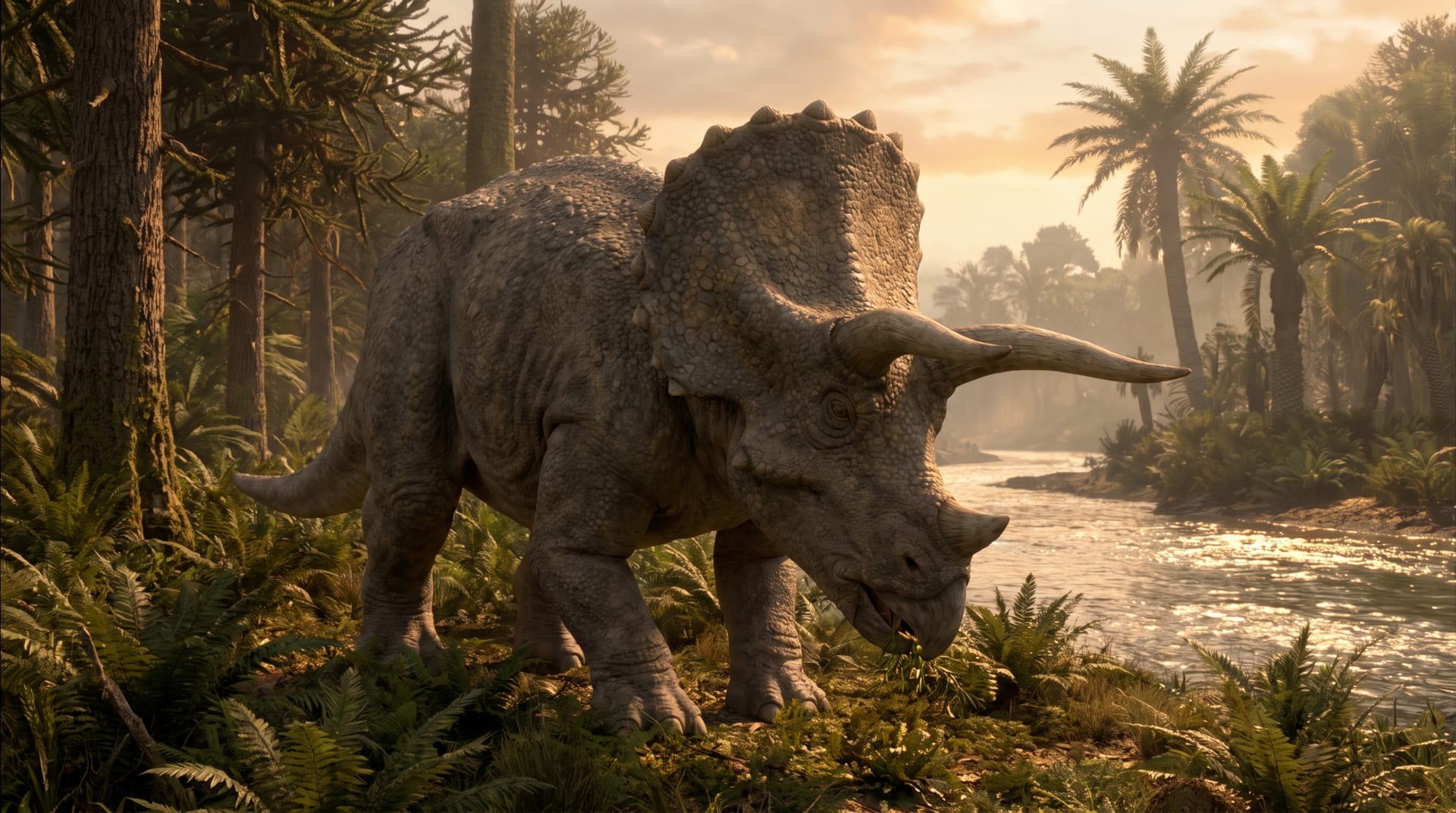
Triceratops was a large plant-eating dinosaur known for three horns and a wide bony frill on its skull. It lived in what is now the western United States at the very end of the Late Cretaceous, 68 to 66 million years ago, and grew to about 9 metres long1.
How big was Triceratops?
The Natural History Museum puts a full-grown Triceratops at 9 metres long and around 10,000 kilograms. Its skull alone carried two long brow horns and a shorter horn on the nose, and the bony frill behind the head could reach nearly a metre across. Skin impressions show it was covered in large, pebbled scales, and the horns themselves were sheathed in keratin1, the material of human hair and nails, not bare bone in life.
A 2006 study of 28 skulls, from 38 centimetres long up to full adult size, sorted growth into baby, juvenile, subadult and adult stages, during which the brow horns changed shape and the frill’s edge lost the small bony points young animals had. One well-studied adult, nicknamed “Big John”, is estimated to have lived around 60 years2.
What did Triceratops eat?
Triceratops was a plant-eater. A sharp, parrot-like beak at the front of the mouth clipped vegetation, while rows of grinding, shearing teeth further back cropped tough, low-growing plants such as palm fronds. It moved on four legs, and probably fed mostly on low-growing plants, though it could raise its head to reach slightly higher vegetation1.
When and where did Triceratops live?
Triceratops lived in the Late Cretaceous, 68 to 66 million years ago, right up to the end of the age of dinosaurs. Its fossils come from the western United States, including Montana, Wyoming, South Dakota and North Dakota1, and from Alberta in Canada2.
It shared that landscape with the plant-eating Edmontosaurus, which fed differently and so did not compete directly with it for food, and with Tyrannosaurus rex, its main predator: one Triceratops brow horn shows partially healed tooth marks from a tyrannosaur bite, evidence that at least one animal survived an attack. Triceratops fossils are unusually common in rocks of this age: a count in Montana’s Hell Creek Formation reported roughly 200 specimens2, which points to it being the dominant large herbivore of its time and place.
How was Triceratops discovered?
The first known remains, a pair of large brow horn cores attached to part of a skull roof, were found near Denver, Colorado, in spring 1887 by George Lyman Cannon. Othniel Charles Marsh, not yet aware that horned dinosaurs existed, described them as belonging to an unusually large bison. A more complete skull, found by fossil hunter John Bell Hatcher in Wyoming’s Lance Formation in 1888, turned out to have a third horn on the nose once it was fully prepared, and in 1889 Marsh renamed the animal Triceratops3, meaning “three-horned face”. The type species is Triceratops horridus2, named for the rough texture of the original skull bone, not for any fearsome quality.
Later finds added detail without changing the picture. “Lane”, a skeleton found on a Wyoming ranch in 2002, preserved a clay template of skin with scales up to 90 millimetres across, formed from a bacterial mat rather than fossilised skin itself. “Big John”, one of the largest skeletons known, measures about 8 metres long and 3 metres tall2 and carries a horn injury that healed during its life.
What kind of animal was Triceratops?
Triceratops was a ceratopsian, part of the family Ceratopsidae and the subfamily Chasmosaurinae1, the horned, frilled dinosaurs with two long brow horns. Of the roughly seventeen species once named within the genus, only T. horridus and T. prorsus are recognised as valid2; most of the others turned out to be individual variation within those two.
Whether Triceratops was even alone in its own genus is still argued. In 2010, researchers Scannella and Horner proposed that Torosaurus, a ceratopsid with a frill pierced by two large openings, was simply a fully grown Triceratops, its frill growing thin enough to perforate with age. Other palaeontologists, including Farke and Longrich, reject this, pointing to juvenile Torosaurus specimens2 that already show the distinct frill shape, which would not be expected if the openings only appeared in old age.
Why did Triceratops carry such a large frill and three horns at all? Early reconstructions treated them mainly as weapons. A study comparing skull injuries in Triceratops and the related ceratopsid Centrosaurus found that Triceratops had a significantly higher rate of frill lesions than Centrosaurus did, while the two genera showed similar injury rates elsewhere on the skull, a pattern the authors judged most consistent with horn wounds from other Triceratops4, not with predator attacks, so the frill likely doubled as armour in fights between rivals. The Natural History Museum adds that the frill and horns probably also served to attract mates and signal species identity. Unlike some other horned dinosaurs, Triceratops remains are usually found singly, not in herds1.
Similar dinosaurs
- Torosaurus: a chasmosaurine ceratopsid with a frill that is longer than Triceratops’s and perforated by two large openings; palaeontologists disagree on whether it is a separate genus2 or a fully grown Triceratops.
- Styracosaurus: a centrosaurine ceratopsid with a single large nose horn, no long brow horns and long spikes around its frill, the reverse of Triceratops’s two long brow horns and short nose horn. Unlike the usually solitary Triceratops, Styracosaurus shows evidence of living in herds5.
- Tyrannosaurus rex: not a relative but the large meat-eater that shared Triceratops’s world and, on the evidence of healed bite marks on a brow horn2, sometimes attacked it and lost.