Contents
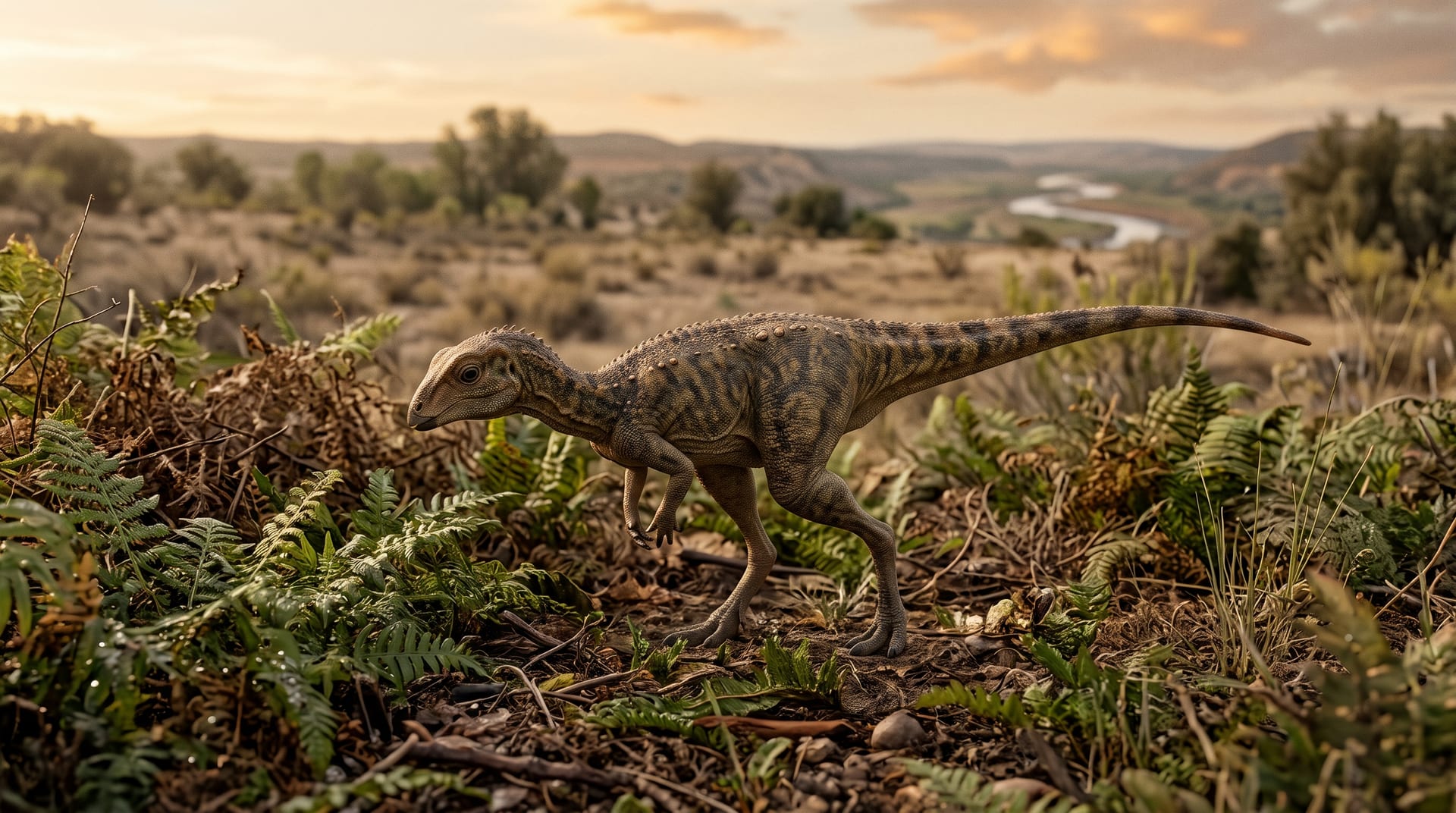
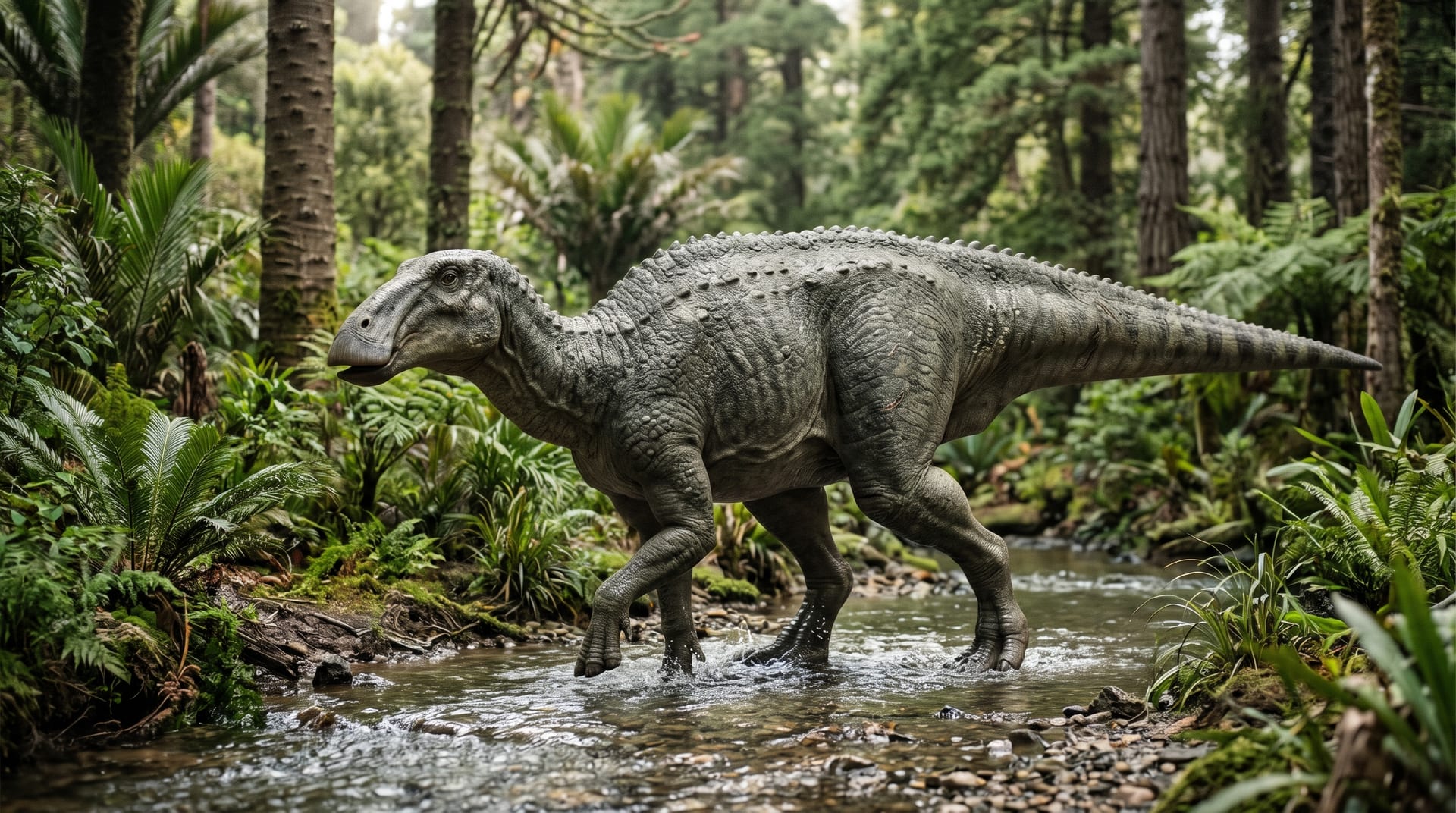
Haolong was a plant-eating iguanodontian dinosaur that lived in what is now northeastern China around 125 million years ago, during the Early Cretaceous. Its only known skeleton belongs to a youngster about 2.45 m long1, and its skin carried hollow spikes never before observed in dinosaurs. Its species, Haolong dongi, was described in Nature Ecology & Evolution on February 6, 20262.
How big was Haolong?
As of 2026, Haolong is known from a single specimen, the holotype AGM 16793, a nearly complete juvenile about 2.45 m (8.0 ft) long3. The paleontologists describe the find as a nearly complete skeleton1 of a previously unknown iguanodontian species.
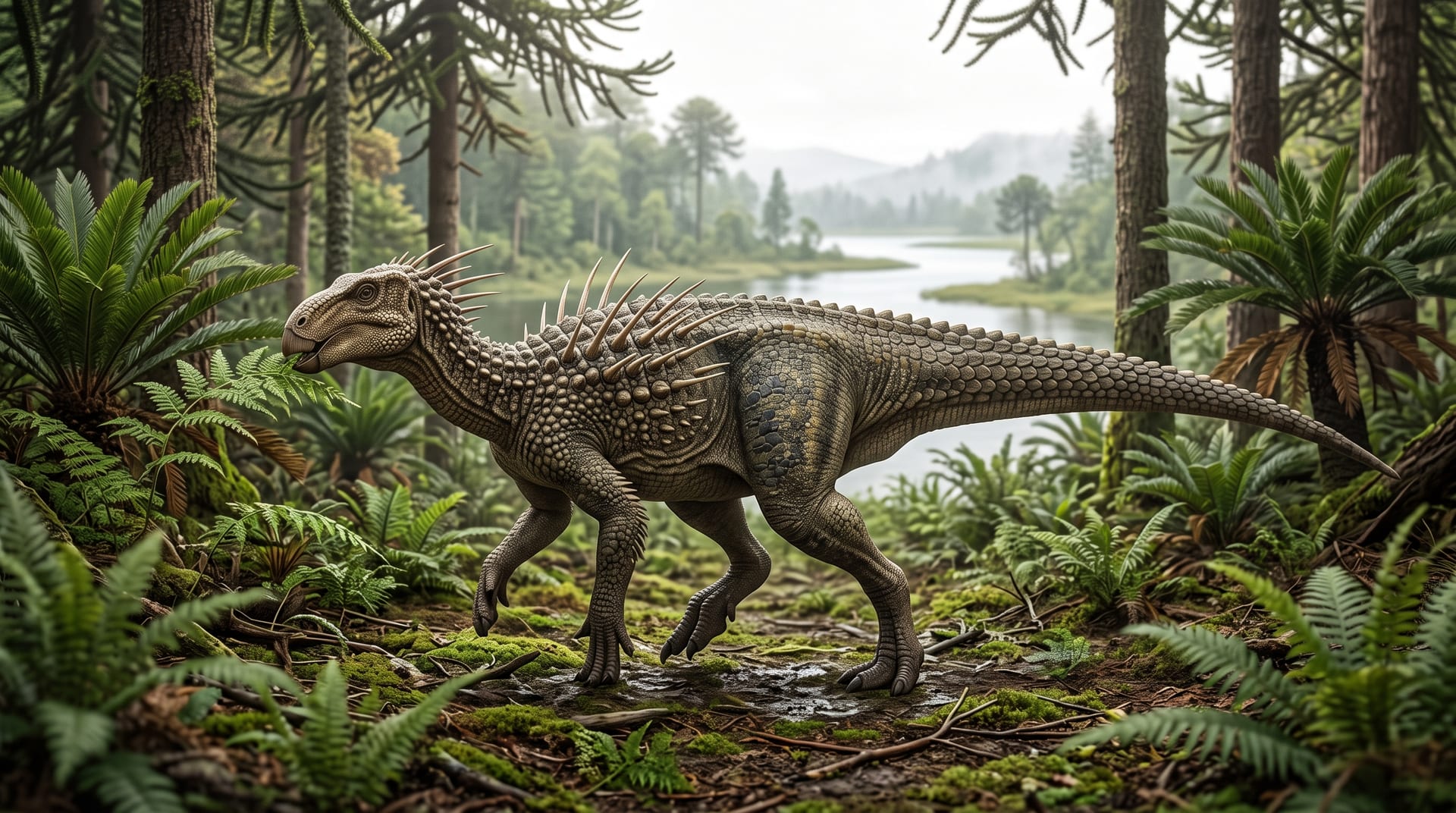
What sets the fossil apart is its skin. It shows overlapping scales on the tail and distinct tuberculate scales on the neck and thorax, patterns that differ markedly from previously described iguanodontians. Scattered among those scales are cutaneous spikes1, which covered a large part of the animal’s body2.
Under the microscope the spikes are hollow and cylindrical, built from a highly cornified outer layer over a multi-layered epidermis. Skin cells called keratinocytes are preserved down to their nuclei1, and each spike has a porous dermal pulp at its core. The researchers saw these skin cells, preserved for 125 million years2, using X-ray scans and high-resolution histological sections.
The spikes differ from the protofeathers found in some other dinosaurs and the scaly spines seen in modern lizards, which suggests an independent evolutionary origin. They have been compared to porcupine quills3. Their form and placement suggest they served primarily as a deterrent against predators1, though they might also have played roles in thermoregulation or sensory perception. Because the specimen is a juvenile, it remains to be determined2 whether adults had the spikes too.
What did Haolong eat?
Its diet was herbivorous. Haolong lived under the predation pressure of small carnivorous dinosaurs2, and its spikes are compared in their deterrent function to those of porcupines.
It belonged to a successful group of plant-eaters. Pascal Godefroit from the Institute of Natural Sciences in Brussels and his colleagues note that iguanodontians were the dominant herbivorous dinosaurs in most terrestrial ecosystems1 throughout the Cretaceous. A better-known member, Iguanodon, had chewing cheek teeth and a horny beak4.
When and where did Haolong live?
Haolong lived in the Early Cretaceous, around 125 million years ago1. The Paleobiology Database dates the genus to the Barremian stage, 125.77 to 121.4 million years ago5.
Its skeleton was recovered from the Yixian Formation1 of Liaoning, China3. This rock formation is known for its exquisitely preserved fossils, and its lake deposits interbedded with volcanic sediment point to a long-lived dynamic lake system punctuated by catastrophic volcanism6.
The plants around it were dominated by conifers related to species of subtropical and temperate upland forests today. Ferns, cycads and horsetails indicate a generally humid climate, broken up by dry seasons. Oxygen isotopes show an average yearly temperature of 10 degrees Celsius (50 °F)6 at that time. Haolong shared these rocks with relatives, Bolong and Jinzhousaurus, two other known Yixian Formation taxa3.
How was Haolong discovered?
The fossil comes from China, where paleontologists discovered a nearly complete skeleton1 with exceptionally detailed fossilized skin. The study’s authors examined it at the Anhui Geological Museum in Hefei, China2.
The genus was named by Huang et al. in 20265. The paper, by Jiandong Huang and colleagues, is titled “Cellular-level preservation of cutaneous spikes in an Early Cretaceous iguanodontian dinosaur” and appeared in Nature Ecology & Evolution on February 6, 20262.
The name Haolong comes from Mandarin Chinese and means “spiny dragon”3, after its spikes. The species name dongi honours Dong Zhiming, a pioneer of Chinese paleontology2.
What kind of animal was Haolong?
Classified as a type of iguanodontian, Haolong belonged to a major group of ornithopod dinosaurs. In evolutionary terms, iguanodontians sit between small, early bipedal ornithopods and the later, highly specialized duck-billed dinosaurs1, the hadrosaurs.
The 2026 study recovered it as an early-diverging member of the Hadrosauroidea. In that tree it branches after a European group of Brighstoneus, Cariocecus and Comptonatus, but before Bolong and Jinzhousaurus3 from the same rock formation.
Skin evidence from this group was thin before Haolong. Remarkable “mummies” from North America and Mongolia had shown the skin of the later duck-billed dinosaurs, with an often mosaic arrangement of tubercle-like and non-imbricating scales. For basal iguanodontians, only isolated patches of scaly imprints were known, in Tenontosaurus, Iguanodon and Mantellisaurus. The researchers say the find highlights the complexity of skin evolution in ornithischian dinosaurs1.
Similar dinosaurs
- Bolong: another iguanodontian from the Yixian Formation of Liaoning that lived about 125 million years ago. It was bigger, with an estimated length of 4 metres and a weight of 200 kilograms7. Before Haolong, no evidence had testified to the existence of such spines2 in any dinosaur.
- Jinzhousaurus: a large ornithopod from China that lived 127–121 million years ago8. It grew to about 7 metres9 long, far longer than the young Haolong skeleton.
- Iguanodon: a much larger relative from Belgium and England, 10.0 m long and 4,000 kg. Instead of skin spikes it had a large thumb spike4 on its hand.