Contents
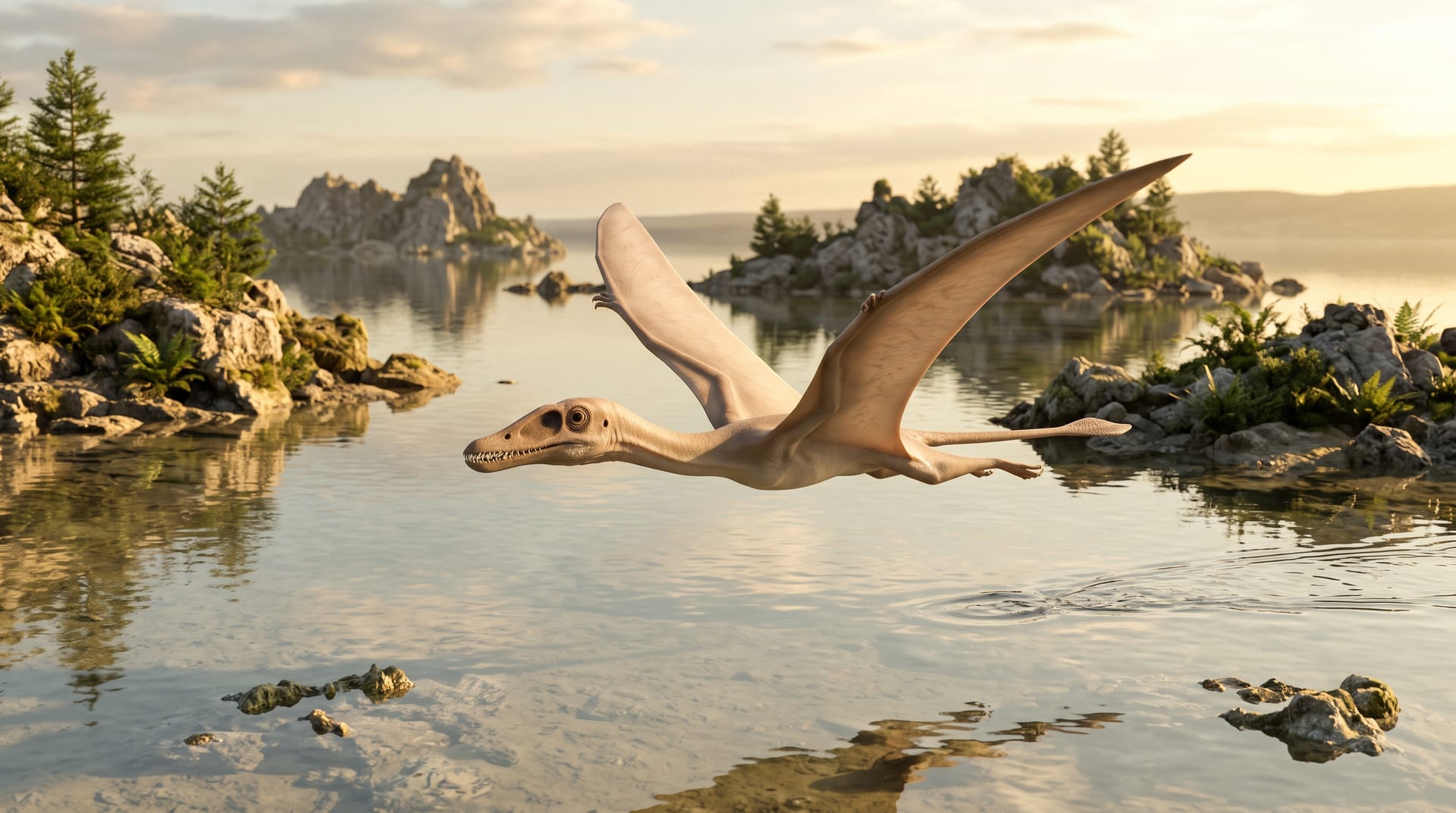
Laueropterus was an early pterosaur, a flying reptile, whose fossil is between 150 and 143 million years old, from the Late Jurassic. Its only known skeleton comes from the Mörnsheim Formation in Bavaria, Germany2, and it had a wingspan of roughly 1 m1.
The genus has one species, Laueropterus vitriolus, known from a partial skeleton and skull found in 2007 and named in 20262. It belongs to the monofenestratans, a group of early pterosaurs that mixes primitive and more advanced features1.
How big was Laueropterus?
Laueropterus had an estimated wingspan of around 1 metre. That made it one of the largest members of this transitional group yet found1. Its skull is around 20.5 cm long2.
It was smaller than Skiphosoura, from the same rocks and time, which had a wingspan of about 1.75 m2. The holotype of Skiphosoura has a wingspan of 1.75 metres but may not have been fully grown3. Another relative from the same rocks, Makrodactylus, had a wingspan of 0.6 metres. A third, the informally named “Rhamphodactylus”, had a 99.8 cm wingspan4.
The Laueropterus specimen was likely nearing skeletal maturity when it died2, judged from the fusion of several bones and its large size.
What did Laueropterus eat?
What Laueropterus ate is unknown: its 2026 description compares its teeth with those of a relative but names no food. Laueropterus shares the shape and spacing of the teeth2 with Skiphosoura, along with a robust lower jaw and thigh bone.
The two can still be told apart by the head. Laueropterus has a proportionally longer and shallower snout2 and a less obvious crest on the premaxilla, the bone at the tip of the upper jaw. A close-up of the teeth near the tip of the lower jaw5 appears in the published figures of the fossil.
Its longest teeth are eight mm long, and each half of the lower jaw holds seven teeth5.
In the relative Makrodactylus, the few teeth are well-spaced and thin and curved, similar to those of Skiphosoura and generally unlike the more numerous and conical teeth of the early monofenestratans described by Wang and colleagues in 2010. The same authors suggested that early monofenestratans may have been more terrestrial in their habits, while the Solnhofen region’s other early pterosaurs are dominated by fish-eating rhamphorhynchids6.
When and where did Laueropterus live?
Laueropterus lived in the Late Jurassic, in the Tithonian age2. The fossil is dated to between 150 and 143 million years ago1.
The skeleton was found in the Schaudiberg Quarry, near the town of Mühlheim in Bavaria, where the rocks belong to the Mörnsheim Formation. It shared this place and time with Makrodactylus, Skiphosoura and “Rhamphodactylus”2, all likely close relatives.
That cluster stands out. According to David Hone, hundreds of pterosaur fossils from the traditional Solnhofen beds have produced only one animal of this kind, Propterodactylus, while Mühlheim has yielded four among perhaps fewer than a dozen pterosaurs. Propterodactylus comes from the much older Painten locality1.
How was Laueropterus discovered?
The fossil was discovered around 2007 in the Schaudiberg quarry. It lies on a limestone slab of roughly 60 by 45 centimeters5, and it preserves much of the skull, jaws, vertebral column and wings1.
The specimen changed hands several times. It was sold to the collector Wolfgang Krauss, then to Günther Hoppe in Switzerland, who had it prepared, and then to Martin Görlich. The Lauer Foundation in Illinois obtained it in January 20242, and it is now catalogued there as specimen LF 6268.
The skeleton is flattened into two dimensions and no longer in anatomical articulation2. Even so, it is generally very well preserved and undistorted1, and thin bones such as the sternal plates show the outlines of the bones beneath them.
In 2026, David Hone described Laueropterus vitriolus2 as a new genus and species, with LF 6268 as the holotype. The paper appeared online on May 11 in the journal PeerJ. Hone is a reader in zoology at Queen Mary University of London1.
The name Laueropterus means “Lauer’s wing”. It honours René and Bruce Lauer for making Solnhofen fossils available to science, joined to the Greek pterus, “wing”. The species name vitriolus comes from the Latin vitriolum, sulphuric acid2, after the pitted surface of the fossil, which looks as if parts had been dissolved away.
What kind of animal was Laueropterus?
Laueropterus was not a dinosaur. It was a monofenestratan pterosaur2, from a group of early pterosaurs. Pterosaurs were the first vertebrates to achieve powered flight, appearing around 210 million years ago1.
Monofenestratans have a single opening combining the nostril and antorbital fenestra in a large skull. Laueropterus has that skull, but it also kept relatively short wing bones more typical of earlier forms1.
Hone did not include a phylogenetic analysis in the description. He concluded it could be placed in Monofenestrata from its large skull and fairly long neck vertebrae, and its short wing metacarpal and first wing-finger bone point to a position outside the Pterodactyloidea2, a more exclusive clade.
The early monofenestratans were first recognized in 2010. That year saw the naming of Darwinopterus, which showed intermediate features between the earlier non-pterodactyloids and the derived pterodactyloids. It had a large head and a long neck6 like the pterodactyloids, but kept the short wing metacarpal, long fifth toe and long tail of earlier pterosaurs. Laueropterus is the fourth non-pterodactyloid monofenestratan pterosaur from the Mühlheim locality1.
Similar pterosaurs
- Skiphosoura: larger, with a wingspan of 1.75 metres3; Laueropterus differs in its longer and shallower snout2.
- Makrodactylus: smaller than all other early monofenestratans4, with a wingspan of 0.6 metres, and only seven teeth each side of the upper jaw6.
- Propterodactylus: the only one of this group from the much older Painten locality1, and counted among the closest taxa to the pterodactyloids6.