Contents
Tylodorhynchus was an anhanguerid pterosaur from the Early Cretaceous Wessex Formation on the Isle of Wight, England. The genus is based on a single partial snout, but as an anhanguerid it would have been a large flying animal1.
How big was Tylodorhynchus?
The only known fossil is the partial snout numbered IWCMS 2014.82. As an anhanguerid, it would have had an elongate snout filled with long, protruding teeth. Like many other anhanguerids, it had an upright crest along the top of its snout, but only the front base of the crest is preserved1.
What did Tylodorhynchus eat?
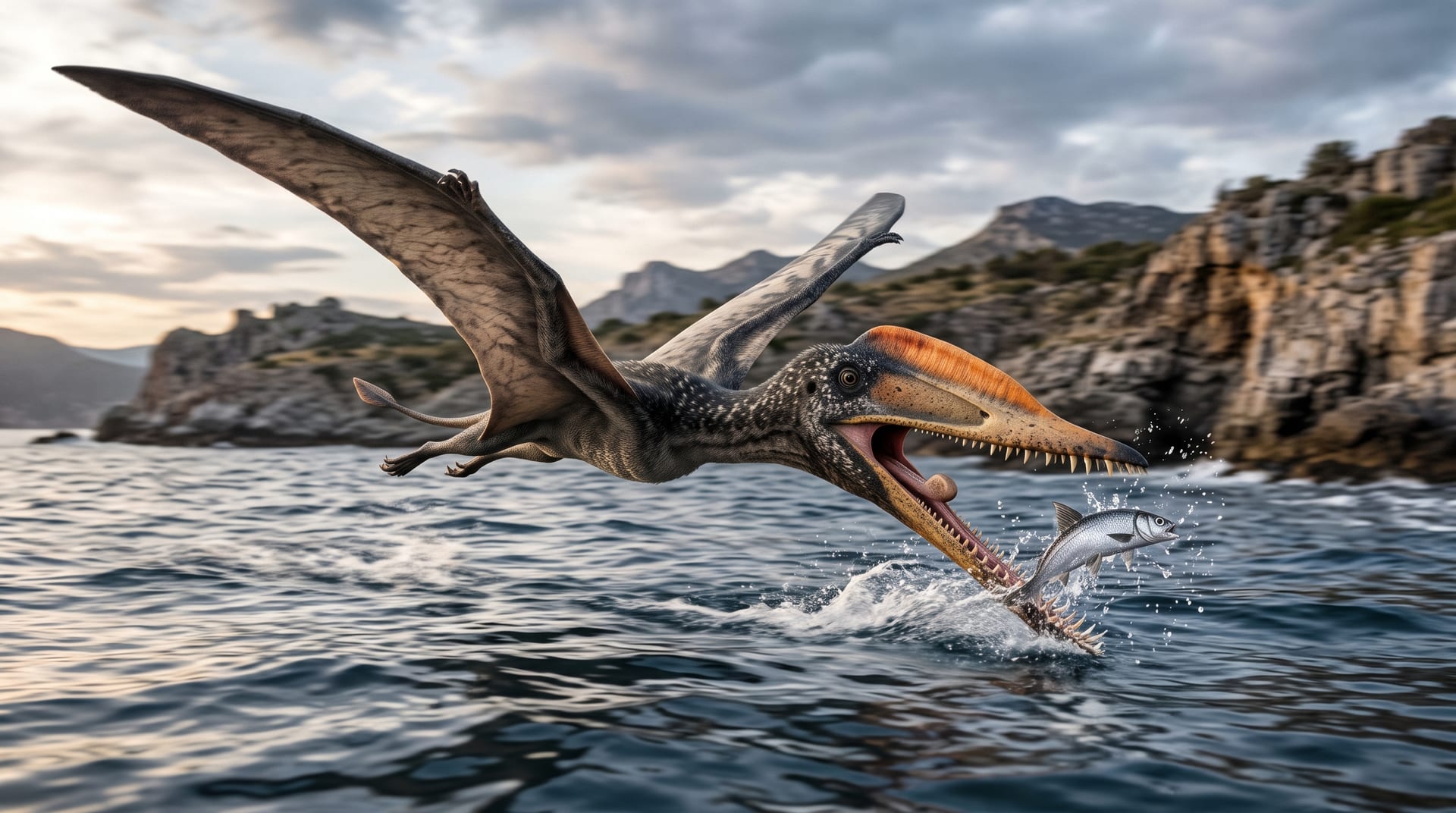
Its family, the Anhangueridae, is generally considered to have eaten fish, mainly because its members seem to have been suited for flight over marine settings; most anhanguerids are known from lagoonal, coastal and marine deposits2. Not every study agrees for its relatives: one study placed the related Coloborhynchus among the carnivorous pterosaurs rather than the fish-eaters3.
The jaw tip of Tylodorhynchus shows how its front teeth sat. Its first pair of teeth pointed forwards from the flat front of the upper jaw and sat lower than in other coloborhynchines, while the second pair pointed somewhat outwards1.
When and where did Tylodorhynchus live?
Tylodorhynchus lived in the Barremian stage of the Early Cretaceous. The Paleobiology Database dates its only record to the Barremian, 125.77 to 121.4 million years ago4. The snout comes from the Wessex Formation and was found at Sudmour Point on the southwest coast of the Isle of Wight1. That formation was laid down on a floodplain within a narrow, east–west valley, in a climate considered to be semi-arid5.
How was Tylodorhynchus discovered?
Will Thurbin found the specimen in 2014 and donated it to the Dinosaur Isle museum. In 2015, David Martill tentatively assigned it to Coloborhynchus1, as the first of that genus from the Isle of Wight.
In a 2020 review of the coloborhynchine pterosaurs, Borja Holgado and Rodrigo V. Pêgas named it as a new species, Uktenadactylus rodriguesae6. The name honours palaeontologist Taissa Rodrigues1 for her work on anhanguerian pterosaurs.
Pêgas and Holgado then re-examined the snout in a paper published online in Historical Biology in April 20267. They found its likeness to Uktenadactylus more superficial than previously thought, and that U. wadleighi was more closely related to Nicorhynchus than to “U.” rodriguesae. So they gave it a new genus, Tylodorhynchus. The name joins Greek words for “callused” and “beak”, after the callus-like projection on the palate1.
What kind of animal was Tylodorhynchus?
Tylodorhynchus was a pterosaur, one of the flying reptiles. Pterosaurs are often called “flying dinosaurs”, but dinosaurs are defined in a way that excludes the pterosaurs8, so it was not a dinosaur. The 2026 analysis placed it in the subfamily Coloborhynchinae of the family Anhangueridae1.
In coloborhynchines, the end of the snout was boxy, and the upper jaw ended in a flat, blunt front surface called the deltoid facet. Tylodorhynchus differs from the others in a large knob between its second pair of teeth, a small blunt bump at the base of the crest and its low first pair of teeth1. The 2020 review found that coloborhynchines were much more diverse than previously thought and suggested they were the oldest recorded lineage of Anhangueridae6.