Contents
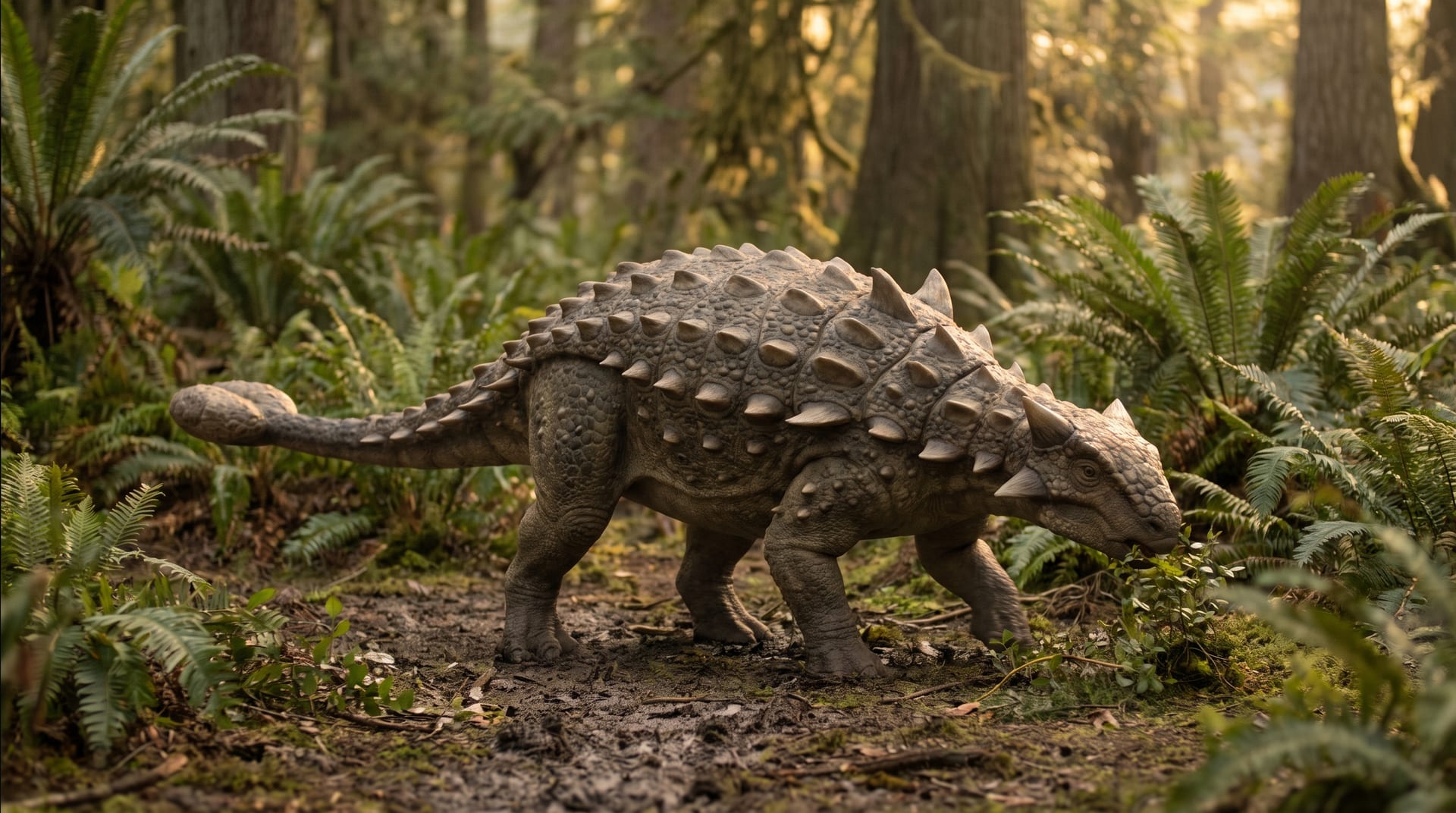
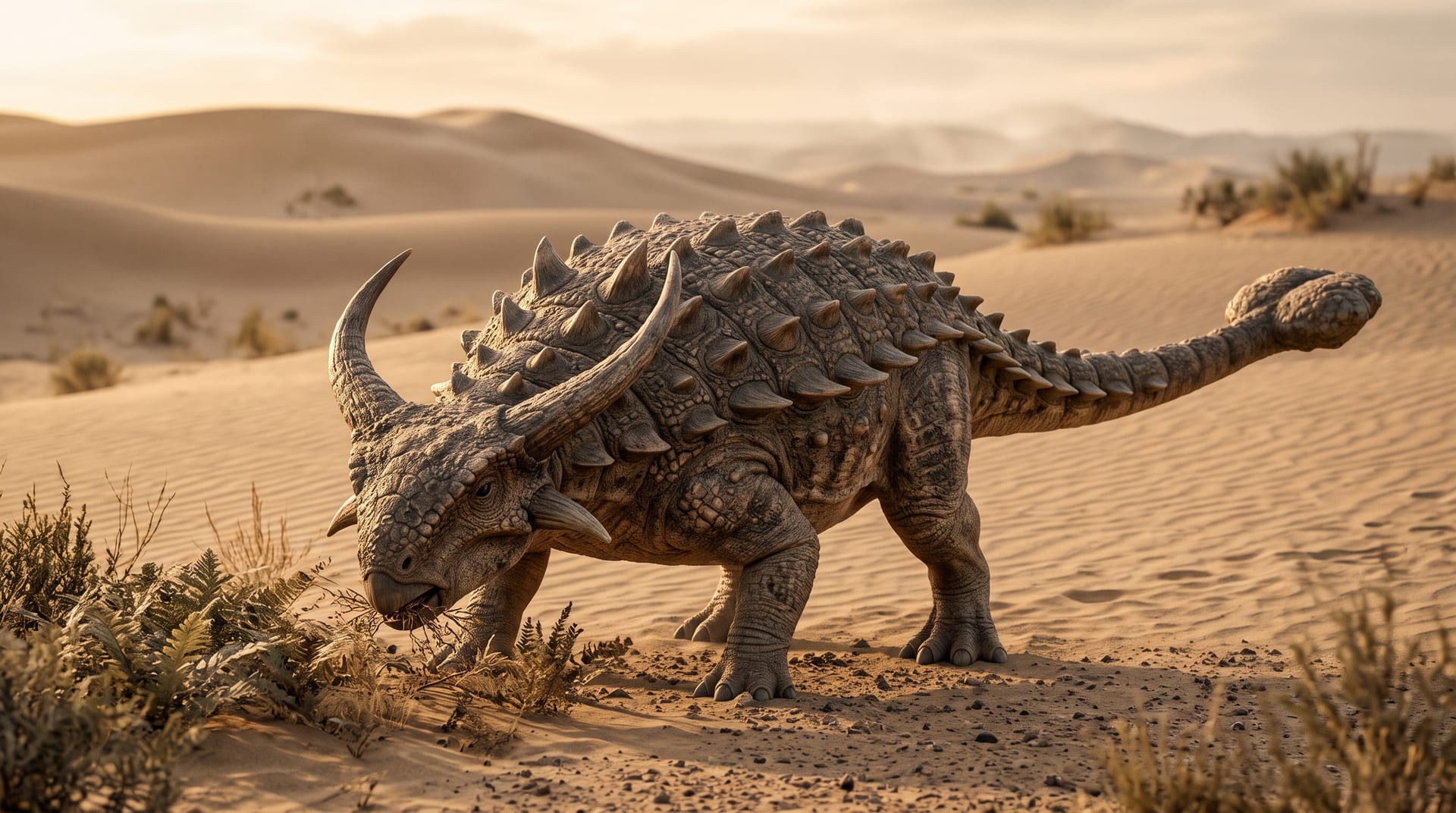
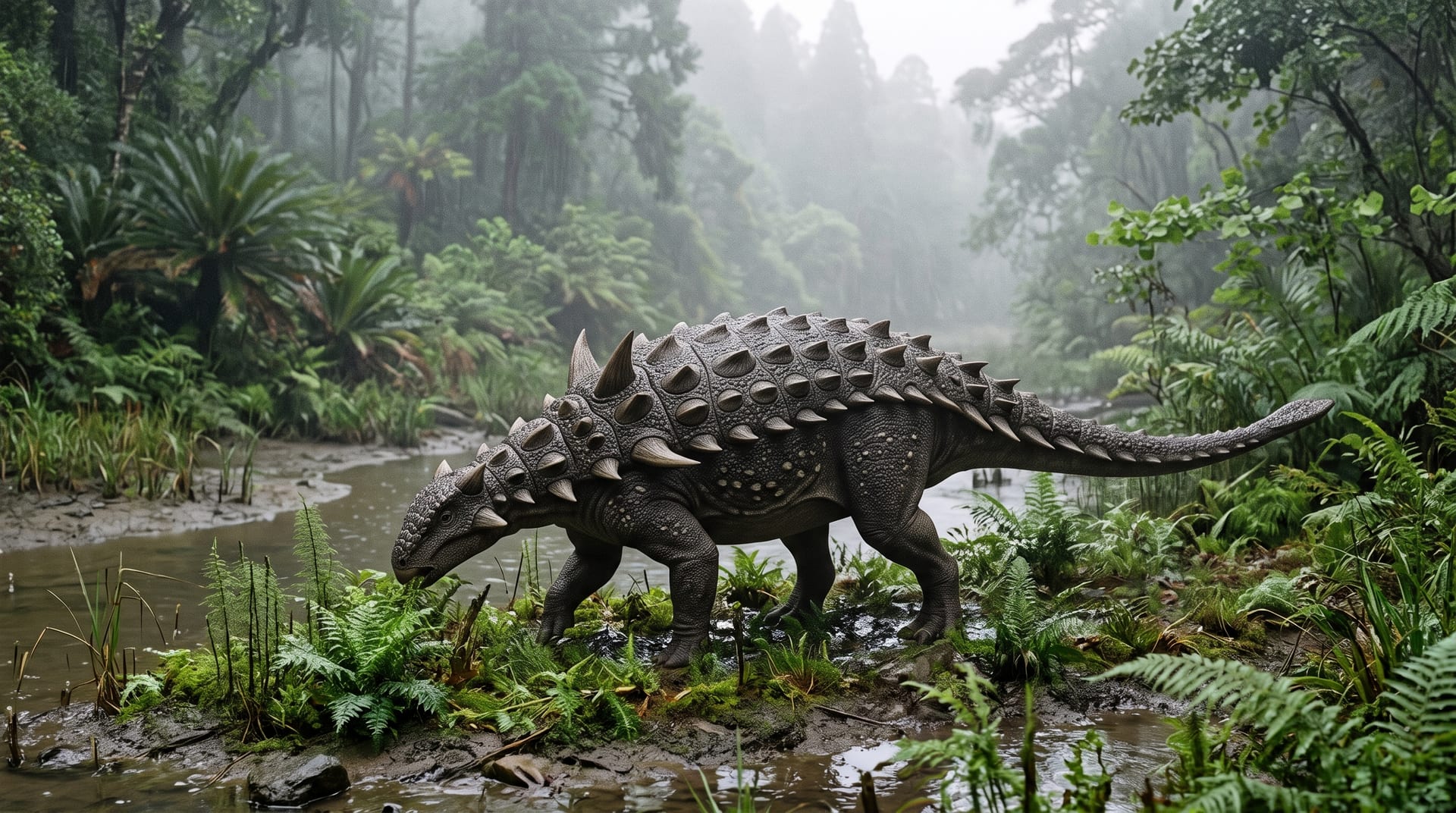
Nipponopelta was a nodosaurid ankylosaur, an armoured dinosaur, that lived in the Late Cretaceous between 96 and 94 million years ago in what is now Hokkaido, Japan. It was about 5 metres long2. It is known only from a partial skull and fragmentary associated remains3. Its only species, Nipponopelta yezoensis, is the first ankylosaur ever formally described from Japan1.
How big was Nipponopelta?
The length of Nipponopelta is an estimate of about 5 metres2. The material includes the rear portion of the skull3, several loose teeth, the atlas (the first neck vertebra) and two armour plates, called osteoderms; the front part of the skull is missing.
For comparison, the Natural History Museum gives Edmontonia a length of 4.0 m4 and Panoplosaurus a length of 7.0 m5.
What did Nipponopelta eat?
Nipponopelta was a herbivore2. The Natural History Museum lists two of its relatives, Edmontonia4 and Panoplosaurus5, as herbivorous too.
When the skull was prepared with acid, isolated, disarticulated teeth were found in the skull’s cavities3, and preparation was stopped to keep the specimen stable. CT scanning later revealed two intact teeth1 and a section of the lower jaw that had never been visible before.
When and where did Nipponopelta live?
Nipponopelta lived between 96 and 94 million years ago, in the Cenomanian age6 of the Late Cretaceous. Its fossils come from the upper part of the Hikagenosawa Formation in Yubari city, Hokkaido1. That formation belongs to the Yezo Group and represents a marine depositional environment3.
Nodosaurids as a group have been found on five major continents: North America, South America, Asia, Europe and Antarctica. In Asia they come mainly from mid-Cretaceous deposits in Japan and China, and in much smaller numbers1 than in North America and Europe.
The team that named it reconstructed the habitats of ankylosaurs. Their results suggest that nodosaurids, and Nipponopelta in particular, retained a preference for marine-influenced habitats, likely inhabiting coastal or estuarine areas. Nodosaurids, they noted, are more commonly found in marine deposits1 than their relatives the ankylosaurids, though this could partly come from post-mortem transport of carcasses. Even so, several kinds of evidence, including fossil trackways, indicate that many nodosaurids mainly lived in lowland, fluvial, and coastal habitats3.
How was Nipponopelta discovered?
Eijiro Goto found the fossil on June 25, 1995, along the bank of the Omakizawa River in Yūbari. The partial skull lay inside a calcareous concretion that had eroded from outcrops of the Hikagenosawa Formation. Goto donated it to the Mikasa City Museum, where it became specimen MCM A5223.
Hiroshi Hayakawa and Kenneth Carpenter first reported the specimen in 1996, and a fuller description followed in 2005. In that 2005 description, Hayakawa, Makoto Manabe and Carpenter identified it as a nodosaurid from the skull fenestration pattern and the structure of the occipital condyle and teeth. They also noted in 2005 that much of the fossil remained encased in the matrix3, hiding many anatomical details. Its taxonomic status remained unresolved1.
Hokkaido University palaeontologist Shumpei Oyabu and co-authors from Japan, Canada and the United States revisited the specimens with three-dimensional CT scanning. The scans showed parts of the skull never seen before, including the dinosaur’s left inner ear, and exposed a distinctive combination of features at the back of the skull. From this, Oyabu and colleagues named it Nipponopelta yezoensis in the journal Cretaceous Research, published online August 21, 20261.
The genus name joins the Japanese word Nippon, “Japan”, with the Greek péltē, “shield”. The species name yezoensis refers to Yezo, the traditional name for Hokkaido. A replica of the holotype3 is displayed at the Fukui Prefectural Dinosaur Museum.
What kind of animal was Nipponopelta?
Nipponopelta was an ankylosaur, one of the armoured dinosaurs. Ankylosaurs are divided in two major clades, nodosaurids and ankylosaurids, and Nipponopelta belongs to the nodosaurids. It is only the second Asian nodosaurid1 known from skull material, not from body bones alone.
The team’s analysis places it deeply nested among derived nodosaurids from North America and Europe, such as Pawpawsaurus, Panoplosaurus, Edmontonia and Denversaurus, rather than with the other nodosaurids described from Asia, and more closely related to Nodosaurus and Panoplosaurus than to Polacanthus or Struthiosaurus. One of their trees recovers it as the sister taxon to Pawpawsaurus, with Borealopelta and a pair of Edmontonia longiceps and Denversaurus as successive sister branches; the closest Asian genus in their analyses is the Chinese Taohelong3. Their ancestral geography model suggests that Nipponopelta and its close relatives originated in Laramidia, Appalachia, and Asia, a wide ancestral area, and that its preference for coastal environments played a significant role in its dispersal patterns1.
Similar dinosaurs
- Edmontonia: a nodosaurid from Canada that lived 76–74 million years ago4.
- Panoplosaurus: a nodosaurid from Canada and the USA, 7.0 m long, whose name means “fully-armoured lizard5”.
- Sauropelta: a North American nodosaurid with large shoulder spines that lived in the Early Cretaceous, 121–94 million years ago7.
- Ankylosaurus: an armoured dinosaur outside the nodosaurids, which are defined as the largest clade containing Nodosaurus textilis but not Ankylosaurus magniventris1.