Contents
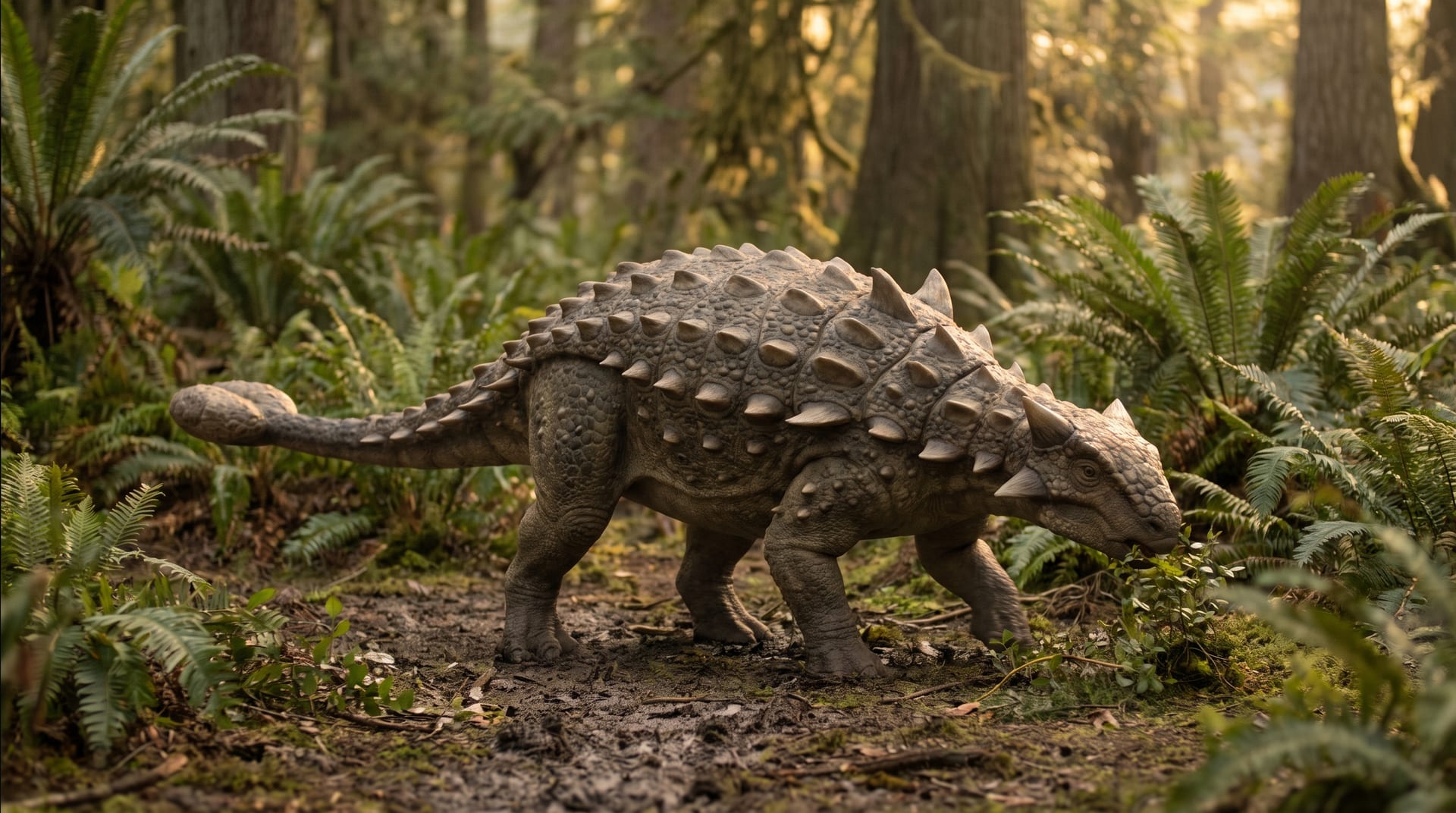
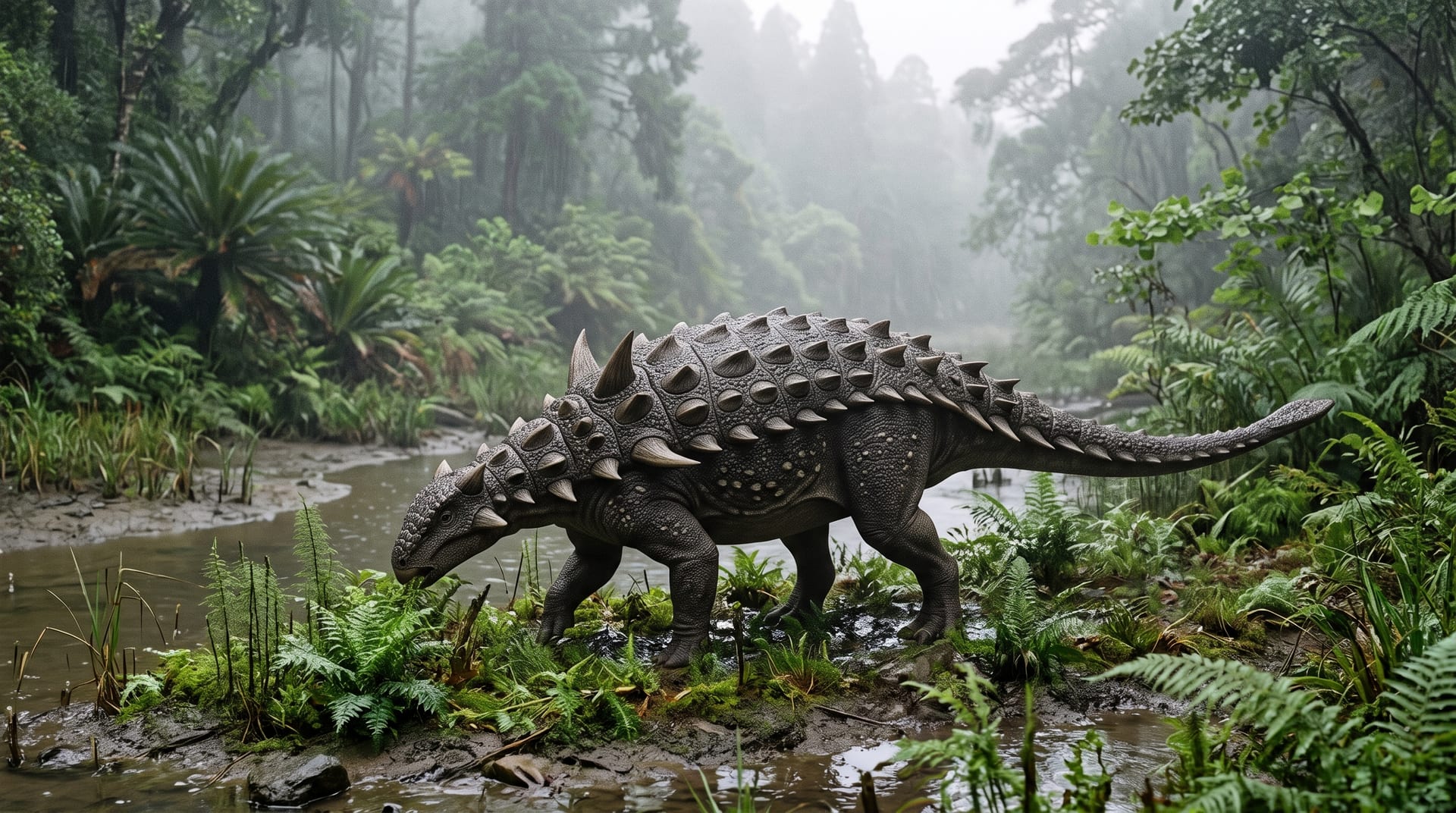
Eopinacosaurus was an ankylosaurid armored dinosaur from the Late Cretaceous (Campanian), known from the Bayan Mandahu Formation of China and Djadokhta Formation of Mongolia. The Bayan Mandahu rocks are dated, somewhat uncertainly, to between 75 and 71 million years ago2. Its only species, Eopinacosaurus mephistocephalus, was originally assigned to the genus Pinacosaurus and got a genus of its own, named by Penkalski in 20261.
How big was Eopinacosaurus?
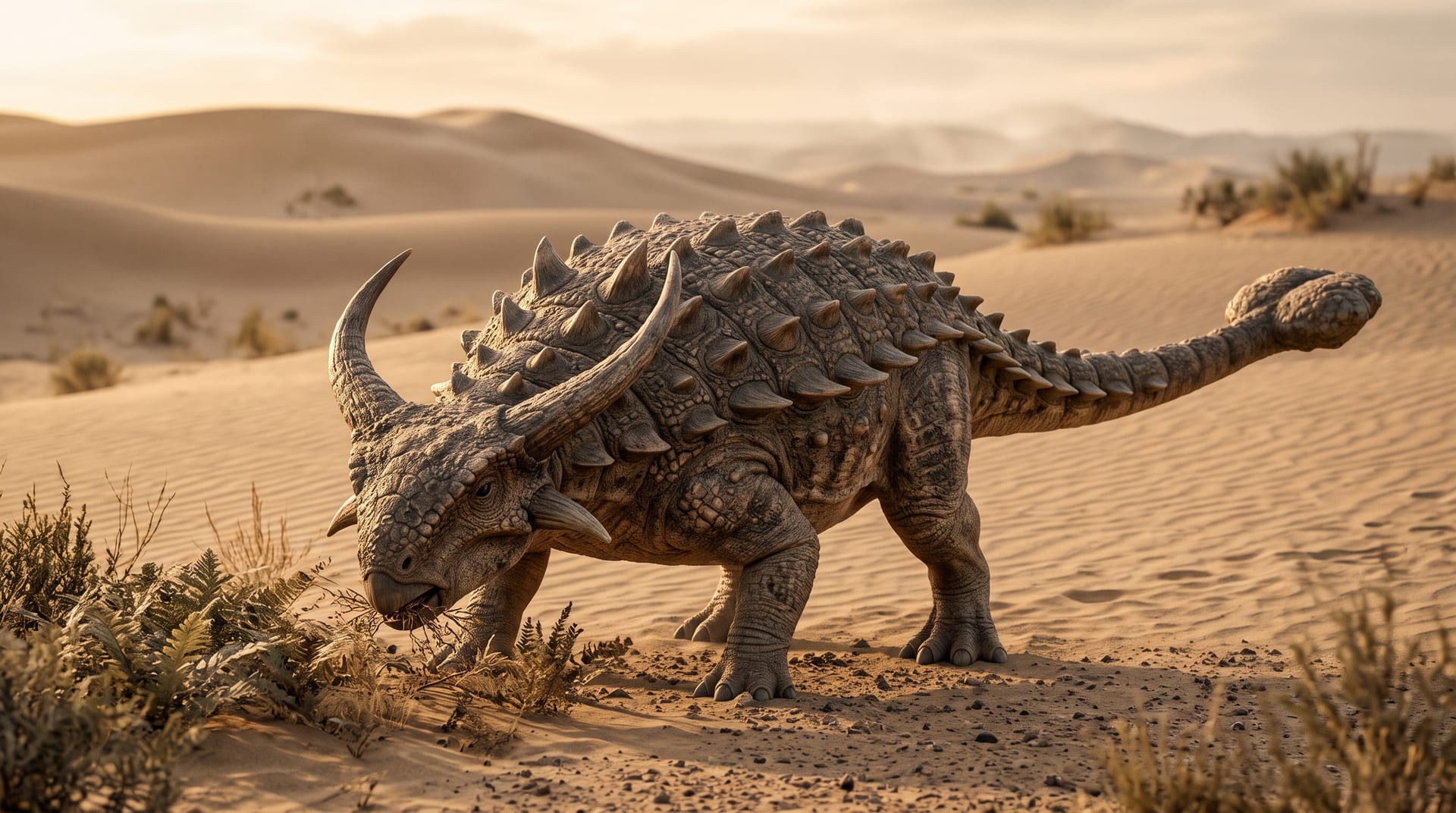
The animal is known from a large, articulated skeleton. The skull carried horns: the species name refers to its “devilish” squamosal horns1.
For scale, Pinacosaurus, the genus it was first placed in, was a medium-sized ankylosaurine, about 5 metres long, that weighed up to 1.9 metric tons3. The Natural History Museum gives Pinacosaurus a smaller weight: a length of 5.0 m and a weight of 1,000 kg4.
What did Eopinacosaurus eat?
Eopinacosaurus was first placed in Pinacosaurus, which the Natural History Museum lists as herbivorous, eating plants4. In Pinacosaurus, the beak cropped plants growing close to the ground, small teeth cut them up, and a very large hind gut3 digested the swallowed food.
The North American ankylosaurid Ankylosaurus had grinding teeth with a beak at the front and ate plant material, including ferns, shrubs and fruit5.
When and where did Eopinacosaurus live?
Eopinacosaurus lived in the Campanian age1 of the Late Cretaceous. The Bayan Mandahu Formation, where its skeleton was found, is dated, somewhat uncertainly, to 75 to 71 million years ago2.
The formation lies near the village of Bayan Mandahu in Inner Mongolia, China, in the Gobi Desert. Its rocks record a semi-arid environment with stream-laid and wind-laid sediments. Most of its vertebrate fossils sit in unstructured sandstone, which points to burial by wind-blown sandstorms2.
Its animal life was very similar to the nearby Djadochta Formation of Mongolia, with many of the same genera but different species. The Bayan Mandahu rocks hold Protoceratops hellenikorhinus and V. osmolskae2, a species of Velociraptor, while the Djadochta has P. andrewsi and V. mongoliensis.
How was Eopinacosaurus discovered?
In 1996, a Belgian-Chinese expedition found a large, articulated skeleton in the Bayan Mandahu Formation. In 1999, Pascal Godefroit and colleagues named this specimen, IMM 96BM3/1, as a new species of Pinacosaurus, P. mephistocephalus. The species name joins Mephistopheles and the Greek kephalè, “head”1, after its horns.
In 2010, Gregory S. Paul suggested it was the same animal as the type species P. grangeri. Robert Hill considered it valid in 2012, based on its squamosal horns and features of the nostrils, and Victoria Arbour and Michael Burns confirmed that the species was valid1.
In 2026, Paul Penkalski moved the species to a new genus, Eopinacosaurus, which means “dawn Pinacosaurus”1. His study, The morphology and systematics of Pinacosaurus, appeared in the journal Historical Biology6. Pinacosaurus itself means “plank lizard”4.
What kind of animal was Eopinacosaurus?
Eopinacosaurus is regarded as a member of the ankylosaurid subfamily Ankylosaurinae. Studies have placed it in a variable position within the clade and relative to P. grangeri. In 2023, Raven and colleagues found it branching off immediately before P. grangeri, while later versions of that analysis1 recovered both Pinacosaurus species as each other’s closest relatives.
Penkalski’s 2026 revision analysed fossils regarded as belonging to Pinacosaurus1 one specimen at a time, together with possible close Asian relatives. After it, Pinacosaurus holds two species, P. grangeri and P. hilwitnorum, the second named in 20263.
Similar dinosaurs
- Pinacosaurus: the genus Eopinacosaurus was first placed in, also from Mongolia and China4; in 2012 Hill considered P. mephistocephalus, now Eopinacosaurus, a valid species based on its squamosal horns and narial characteristics1.
- Ankylosaurus: a North American ankylosaurid, 8.0 m long, from Canada and the USA, that lived 68–66 million years ago5.