Contents
Stegosaurus was a large, plant-eating dinosaur best known for the two rows of bony plates that ran down its back and the spiked tail it used in defence. It lived in the Late Jurassic, about 152 to 145 million years ago, with fossils found in the USA and Portugal2. Adults grew up to about 9 metres long1.
How big was Stegosaurus?
Size varied between species. The Natural History Museum gives a maximum length of about 9 metres1. S. stenops reached 6.5 metres long, while S. ungulatus reached 7 to 9 metres. Stegosaurus carried its head low, probably no higher than 1 metre above the ground2. It was about the length of a bus3.
Weight estimates differ by species too: S. stenops is put at 3.5 tonnes and S. ungulatus, the largest species, at 6.9 tonnes2.
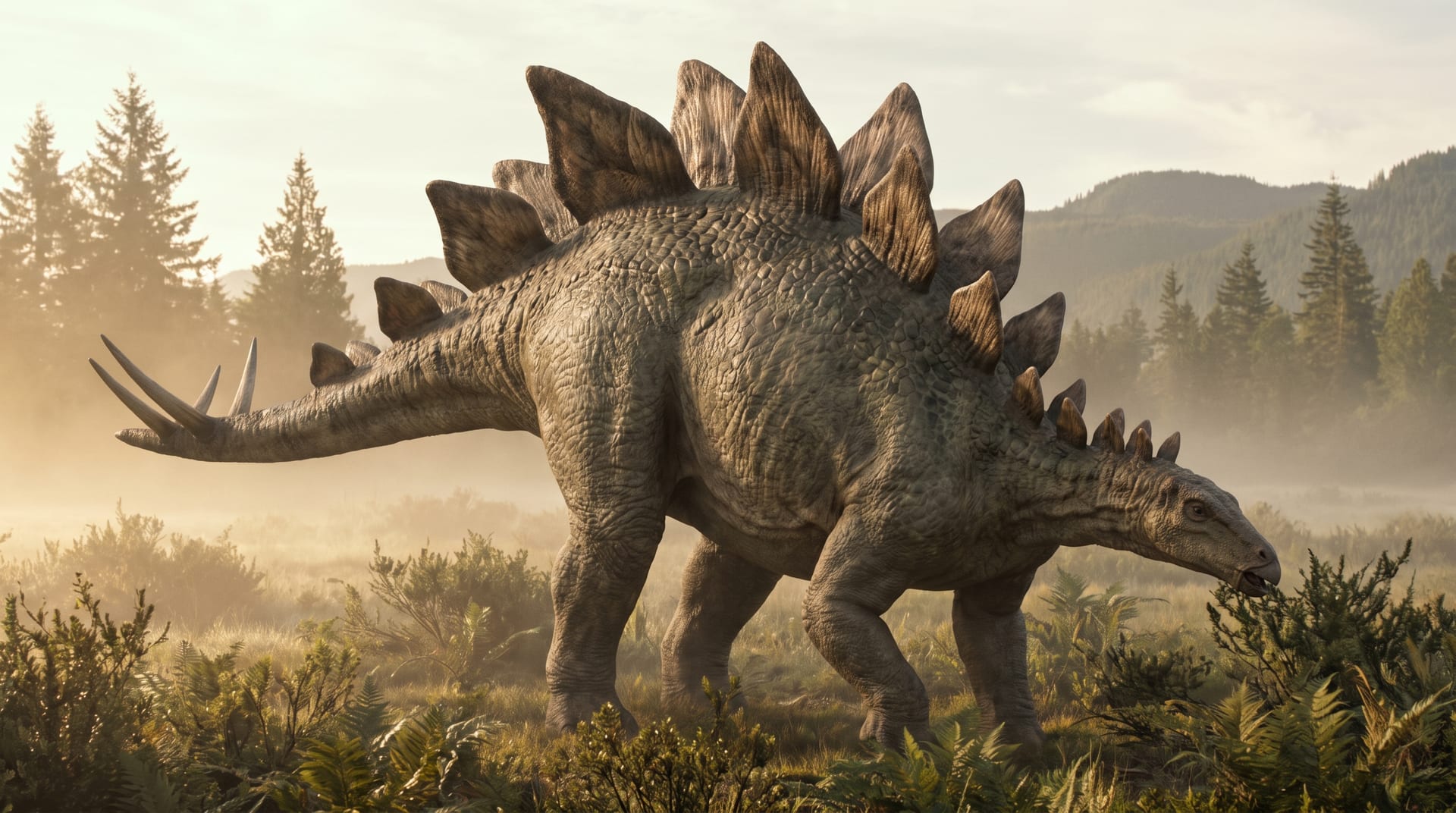
Its most famous feature was the row of bony plates along its back. Stegosaurus carried between 17 and 22 separate plates and flat spines in two alternating rows; the largest plates could measure over 60 centimetres wide and 100 centimetres tall2. The plates sat embedded in the skin, not fixed to the skeleton, which is why they are usually found scattered when a skeleton is excavated. After finding a specimen whose plates had been held in place by mud, O. C. Marsh realised the plates stood upright, alternating on either side of the spine, not lying flat as first thought. The plates themselves were kite-shaped and stuck out from its neck, back and tail. Their purpose is still debated: the Natural History Museum notes they may have warned off predators or let it recognise others of its own kind, one theory holds they helped regulate the animal’s body temperature1, and others think they could have helped attract mates, much like a frill3, similar to that of Triceratops.
The tail carried its main weapon, a set of four spikes known today as a thagomizer, each roughly 60 to 90 centimetres long, pointing out sideways from the tail, and it could swing this tail from side to side with great force. The museum notes it would have defended itself from predators such as Allosaurus and Ceratosaurus1 with this spiked tail, and the fossil record backs that up: a study of fossil tail spikes found that 9.8 percent of examined specimens had injuries2, and a fossil Allosaurus tailbone has even been found with a hole the size of a Stegosaurus tail spike3.
What did Stegosaurus eat?
Stegosaurus was a herbivorous1 dinosaur. With a short neck and a small head, it most likely ate low-lying bushes and shrubs. Its teeth were small, triangular and flat, with wear facets showing they ground food. Its skull was long, narrow and small in proportion to the body2.
When and where did Stegosaurus live?
Stegosaurus lived in the Late Jurassic, in the Kimmeridgian to Tithonian stages, 152 to 145 million years ago1. Its fossils come mainly from the Morrison Formation in Colorado, Wyoming and Utah2, in the western United States, with further remains found at a site in Portugal.
How was Stegosaurus discovered?
The first scraps of Stegosaurus were found by Arthur Lakes and H. C. Beckwith north of Morrison, Colorado2. Othniel Charles Marsh named the genus in 18774. He at first concluded that the plates lay flat on its back, which is why its name means “roof lizard”3.
Marsh’s original species, S. armatus, turned out to be based on remains too fragmentary to work with. A far better skeleton, a nearly complete subadult found by Felch at Garden Park, collected in 1885 to 1886, became the basis for the species S. stenops, and in 2013 the ICZN made S. stenops the official type species of the genus in place of the unworkable S. armatus. An almost complete Stegosaurus skeleton, identified as S. stenops, has been on display in the museum’s Earth Hall since December 20141. That skeleton is nicknamed “Sophie”: first discovered in 2003 near Shell, Wyoming, it is the best-preserved specimen, 85% intact with 360 bones2.
What kind of animal was Stegosaurus?
Stegosaurus belongs to Thyreophora, the armoured dinosaurs, within the family Stegosauridae and the subfamily Stegosaurinae1. Stegosaurinae usually includes Wuerhosaurus and Hesperosaurus2 as well, and Kentrosaurus and Miragaia are other members of Stegosauridae. Fossilised footprints suggest it likely travelled in family groups3.
For all its bulk, Stegosaurus had a remarkably small brain. The Natural History Museum describes it as “around the size of a plum”1. Its braincase was no larger than a dog’s, despite weighing over 4,500 kilograms2, and it was the smallest brain in proportion to body size of any dinosaur endocast then known.
Stegosaurus in popular culture
Stegosaurus is one of the better-known dinosaurs, appearing in films, on postal stamps and across many other kinds of media. Its fame extends to the fossil market too: in 2024 a nearly complete specimen nicknamed “Apex” sold at auction for 44.6 million dollars2, the most ever paid for a fossil.
Similar dinosaurs
- Kentrosaurus: a stegosaurid from Tanzania, only about 5 metres long5, whose plates gradually merged into spikes on the hip and tail6.
- Miragaia: a stegosaurid from Portugal with the longest neck of any stegosaurian, with at least seventeen vertebrae7, against around 10 in Stegosaurus2.
- Hesperosaurus: a stegosaurid from an older part of the Morrison Formation8, a little older than other Morrison stegosaurs such as Stegosaurus.
- Allosaurus: not a relative but a predator Stegosaurus defended itself from1; a fossil Allosaurus tailbone has a hole the size of a Stegosaurus tail spike3.