Contents
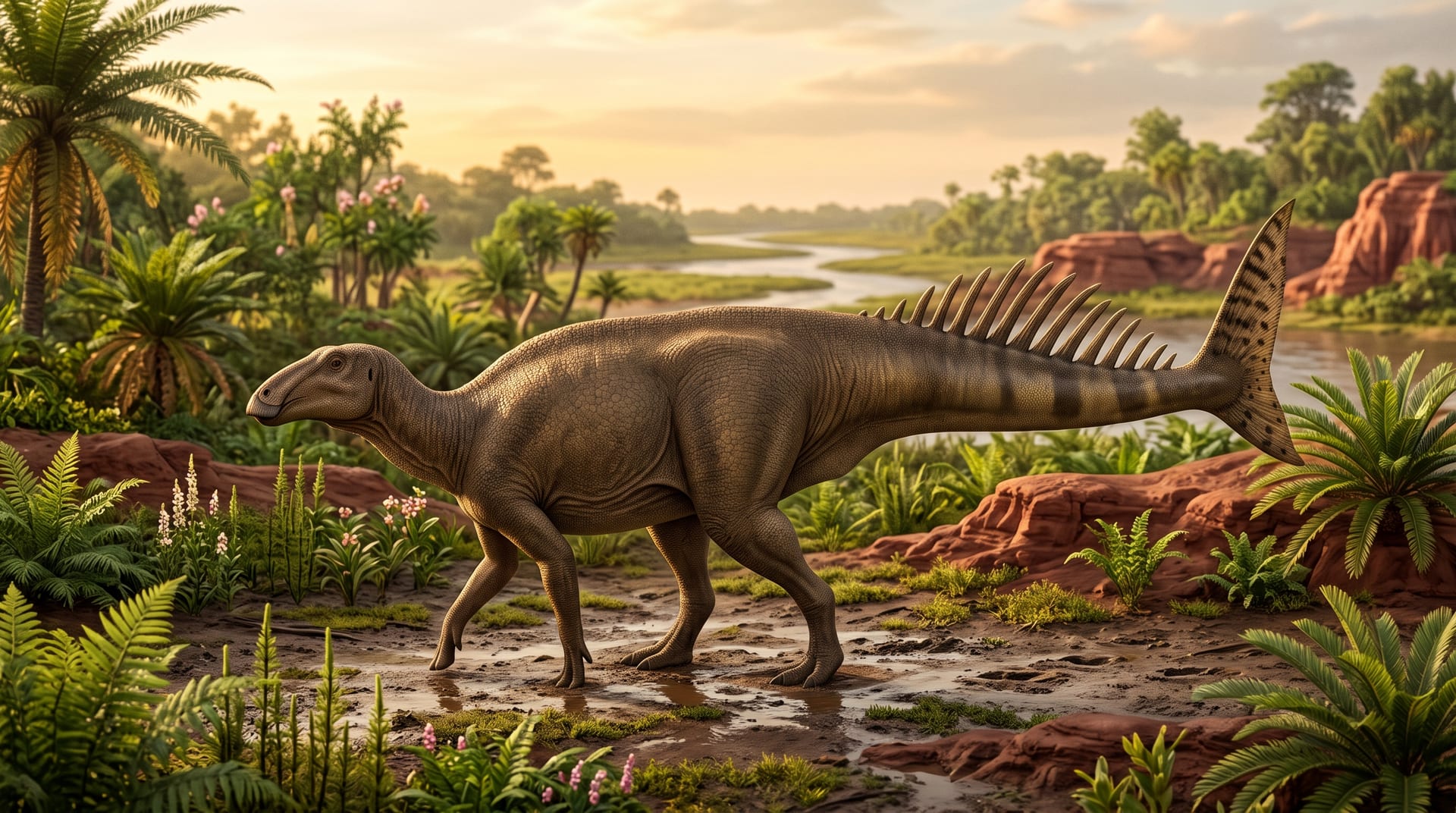
Gongshuilong was a saurolophine hadrosaur, a duck-billed dinosaur, from the Late Cretaceous rocks of the Lianhe Formation in China. Its fossils come from Jiangxi Province, and the duck-billed dinosaur is estimated to have reached a body length of around 7 metres1. Its most unusual feature was the end of its tail, where elongated and curved neural spines2 formed a tall, sail-like structure. The only species is Gongshuilong fanwei, described in 20263.
How big was Gongshuilong?
Gongshuilong is recognised as a medium-sized member of the Saurolophinae, estimated at around 7 metres (23 ft)1 long. The fossils are disarticulated remains of at least two individuals: the team found two left lower jaw bones, shoulder blades and lower leg bones of slightly different sizes2.
The tail is what sets it apart. Some of the neural spines of its tail vertebrae are eight and a half times the height of their centrum, and Everything Dinosaur considers it likely that these tail bones supported a fan-like tail. As of 2026, such an exaggerated, fan-like tail has not been found in any related hadrosaurs1. The feature has also not been recognised in other members of the Iguanodontia2, the larger group that hadrosaurids belong to.
What did Gongshuilong eat?
Gongshuilong was a duck-billed dinosaur1, a member of the Hadrosauridae. That family was a common group of herbivores during the Late Cretaceous, and hadrosaurs were among the most dominant herbivores of that time in Asia and North America. Unlike more primitive iguanodonts, hadrosaurids had teeth stacked into dental batteries4, which acted as effective grinding surfaces.
When and where did Gongshuilong live?
The Paleobiology Database places Gongshuilong in the Maastrichtian, 72.2 to 66 million years ago3. The exposures that yielded it date from the very end of the Cretaceous1.
The bones came from the Lianhe Formation in the town of Shahe in Ganzhou city, Jiangxi Province, China. Hadrosaurid bones had been found in the Ganzhou region before, including a fragmentary skeleton and eggs with embryos2.
How was Gongshuilong discovered?
In the early spring of 20211, construction workers uncovered the fossils in exposures of the Lianhe Formation. The work was for the East China International Trade and Industrial Zone in Shahe. The following month, a permit was obtained that allowed researchers from the Jiangxi Geological Survey and Exploration Institute and the Jiangxi Geological Museum to excavate the fossils in two blocks. The material is kept under the specimen number BGS-JX F0012.
The holotype is a right lower jaw bone (BGS-JX F001-1). A small region of the skull with the left jugal and quadrate bones is the paratype. The bonebed also gave up more skull bones, four neck vertebrae, ten articulated tail vertebrae and bones of the shoulder, arms and legs, all referred to this species2.
Han Yao and colleagues named Gongshuilong fanwei in 20263, in a paper published in the Journal of Systematic Palaeontology. The genus name means “Gong River dragon”1, after the river close to the dig site. It combines the pinyin Gongshui, for the Gong River, with long, meaning “dragon”. The species name fanwei alludes to the sail-like tail2.
Gongshuilong is the first scientifically described hadrosaurid genus from South China1.
What kind of animal was Gongshuilong?
Gongshuilong was an ornithopod dinosaur in the family Hadrosauridae. A phylogenetic analysis places it in the Saurolophinae subfamily, in the tribe Brachylophosaurini, and it is only the second member of this tribe1 discovered in Asia. The other is Wulagasaurus; the remaining members are known from North America2.
Saurolophines lacked hollow cranial crests4, though some had solid crests, and tended to be bulkier than the lambeosaurines. Within the Brachylophosaurini, the analysis found an unresolved polytomy2 made up of Gongshuilong, Wulagasaurus, Acristavus and a group of Maiasaura, Brachylophosaurus and Probrachylophosaurus.
The authors suggest that Gongshuilong increases the possibility of an Asian origin for the Saurolophinae and Brachylophosaurini1. Godefroit and colleagues, who named Wulagasaurus, had already read their analysis of it as evidence that saurolophines originated in Asia5, an idea supported by other finds since.
Similar dinosaurs
- Wulagasaurus: the other Chinese brachylophosaurin, from the Yuliangze Formation of Heilongjiang, named by Godefroit et al. 2008. The Paleobiology Database places it in the same stage as Gongshuilong, the Maastrichtian6. In 2010 Gregory S. Paul estimated it at 9 metres (30 ft)5, and no sail-like tail is known from it: that feature is unique to Gongshuilong2.
- Brachylophosaurus: a North American relative, “short-crested lizard”, found in Canada and the USA and named by C M Sternberg (1953). The Natural History Museum gives its length as 7.0 m and its age as 89–88 million years ago7. Its bony crest forms a flat, paddle-like plate8 over the top of the rear skull.
- Maiasaura: the “good mother lizard” from the USA, 9.0 m long and 2500 kg, which lived 80–75 million years ago. It was named by Horner and Makela (1979) and had a short, solid crest-like structure10 between the eyes. The museum lists it as a herbivore with a horny beak and chewing teeth that moved on 2 or 4 legs9.