Contents
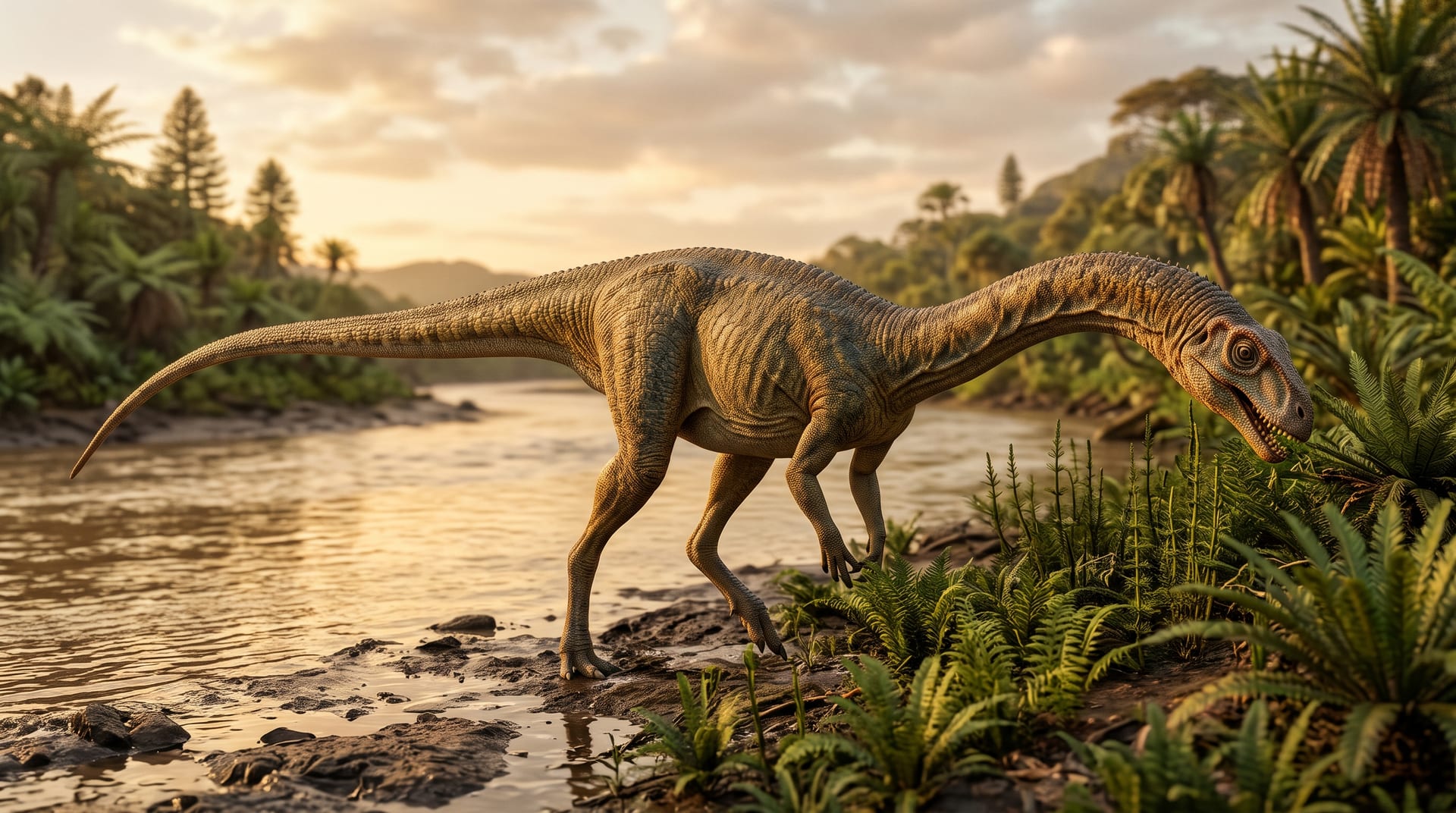
Musango was a lightly built, two-legged dinosaur that lived in what is now Zimbabwe during the Late Triassic, around 210 million years ago. It was an early sauropodomorph, a relative of the long-necked giants, and it reached about 4.5 metres long and an estimated 222 kilograms1. The genus has a single species, Musango matusadonaensis, known from a partial skeleton2. It is the fifth dinosaur species named from Zimbabwe3.
How big was Musango?
The Natural History Museum in London puts Musango at around 4.5 metres long when it died, about the size of a car. It was quite lightly built at just 222 kilogrammes1, which the museum compares to a fully grown pig. In an article for The Conversation, lead author Paul Barrett gives a rounder figure for the same animal: 4.5 meters (15 feet) in length and 220 kilograms (485 pounds)4. Both figures were calculated for the holotype individual2.
The museum says its fossils suggest it was around eight years old and almost fully grown at the time of its death, not quite an adult. Barrett writes that growth marks in its bones4 show it was a subadult. The same animal had previously recovered from a serious infection or injury1.
Its anatomy shows that it was bipedal, walking on its hind legs only4, unlike the four-legged sauropods that came later in its lineage.
What did Musango eat?
Nobody knows for certain, because the skull wasn’t preserved. Barrett notes that its close relatives were largely herbivorous4. The Natural History Museum says that, with the skull missing, it is likely to have been a herbivore or omnivore, one that would have fed on plants growing alongside rivers and streams1 in ancient Zimbabwe.
When and where did Musango live?
Musango lived in the latest Triassic, roughly 210 million years ago3. Its describers date its rocks to the Norian stage: their paper is titled A new sauropodomorph dinosaur from the Pebbly Arkose Formation (Upper Triassic: Norian)1 of Kariba, Zimbabwe.
The partial skeleton was excavated in 2018 from the Pebbly Arkose Formation3 on the margin of Lake Kariba, close to an island that shares its name. Barrett describes the skeleton as found in the bank of the Nyamasango River. The sites lie deep inside Matusadona National Park4, on the shore of Lake Kariba, the artificial lake that forms most of the border between Zimbabwe and Zambia.
The rocks are brick-red mudstones and sandstones that were laid down by ancient rivers. According to Barrett, geological evidence and plant fossils show a Kariba landscape that was dry and dotted with stands of large conifer trees4, with green corridors of vegetation along permanent watercourses.
Musango shared this world with lungfish and crocodile-like phytosaurs1 as well as other dinosaurs such as Musankwa. Barrett writes that lungfish and phytosaurs are rare or absent in South African sites. His team found that the Zimbabwean dinosaurs are not even the closest relatives of their South African neighbors. Zimbabwe lay farther north than South Africa and closer to the equator4, and the team suggests climatic differences might explain the contrast.
How was Musango discovered?
The fossil sites were found by Steve Edwards, a local safari camp manager, on the shore of Lake Kariba. Jonah Choiniere of the University of the Witwatersrand then assembled an international team from South Africa, Zimbabwe and the UK. The team used a Kariba houseboat as a mobile hotel and laboratory and mounted two expeditions, in 2017 and 20184.
The skeleton was discovered in March 2018 on the margin of Lake Kariba and is kept at the Natural History Museum of Zimbabwe in Bulawayo under the code NHMZ 25832. It is fairly complete for its age1, with bones from the spine, ribs, arms, legs and feet. Sci.News lists vertebrae, limb bones, and pieces of its hip and shoulder girdles3.
Paul Barrett and his colleagues named it in a paper published July 28, 2026 in the Journal of Systematic Palaeontology3. The name Musango is a ChiShona word meaning ‘living in the bush’, a reference to the remote area where it was found. The species name matusadonaensis comes from Matusadona National Park1, near the find site.
What kind of animal was Musango?
Musango was a sauropodomorph, an early relative of dinosaurs such as Diplodocus1 that walked on two legs rather than four. Its describers place it in a group of early sauropodomorphs called Unaysauridae3. Unaysauridae is a clade of basal sauropodomorphs from the Late Triassic of Brazil, India, and Zimbabwe5.
Their analysis places it as a close relative of Musankwa sanyatiensis3, another dinosaur found in the same rock formation. In their analysis Musango comes out as the sister taxon to Musankwa2 within Unaysauridae.
Similar dinosaurs
- Musankwa: lived side by side with Musango in the same formation, but the two differ in hip and limb anatomy and in body size; Musankwa is estimated to have weighed more than twice as much3. It is known only from an incomplete hindlimb6.
- Unaysaurus: its species Unaysaurus tolentinoi anchors the definition of Unaysauridae5, a clade of basal sauropodomorphs from Brazil, India and Zimbabwe.
- Macrocollum: listed with Musango among the genera of Unaysauridae5.