Contents
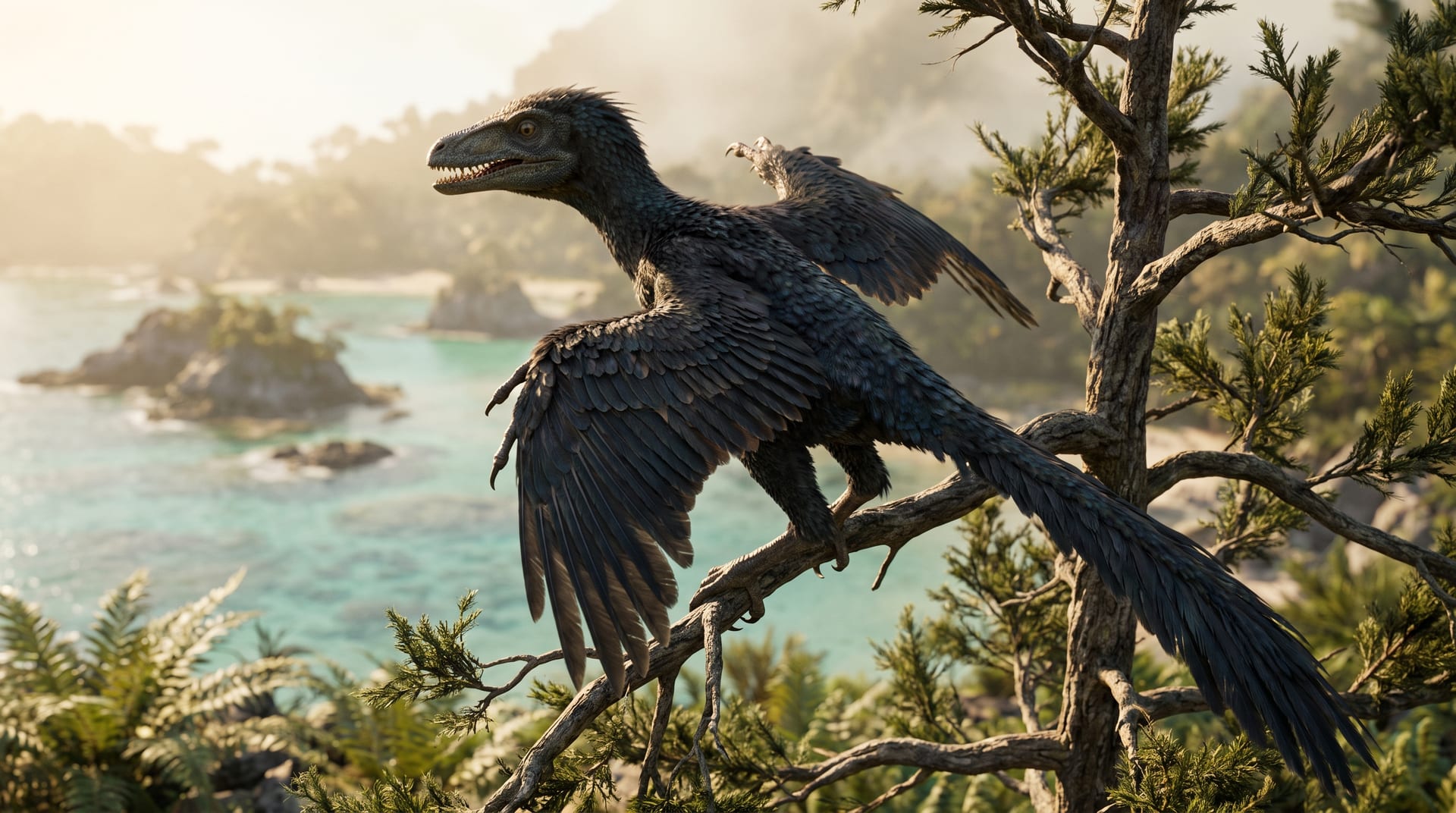
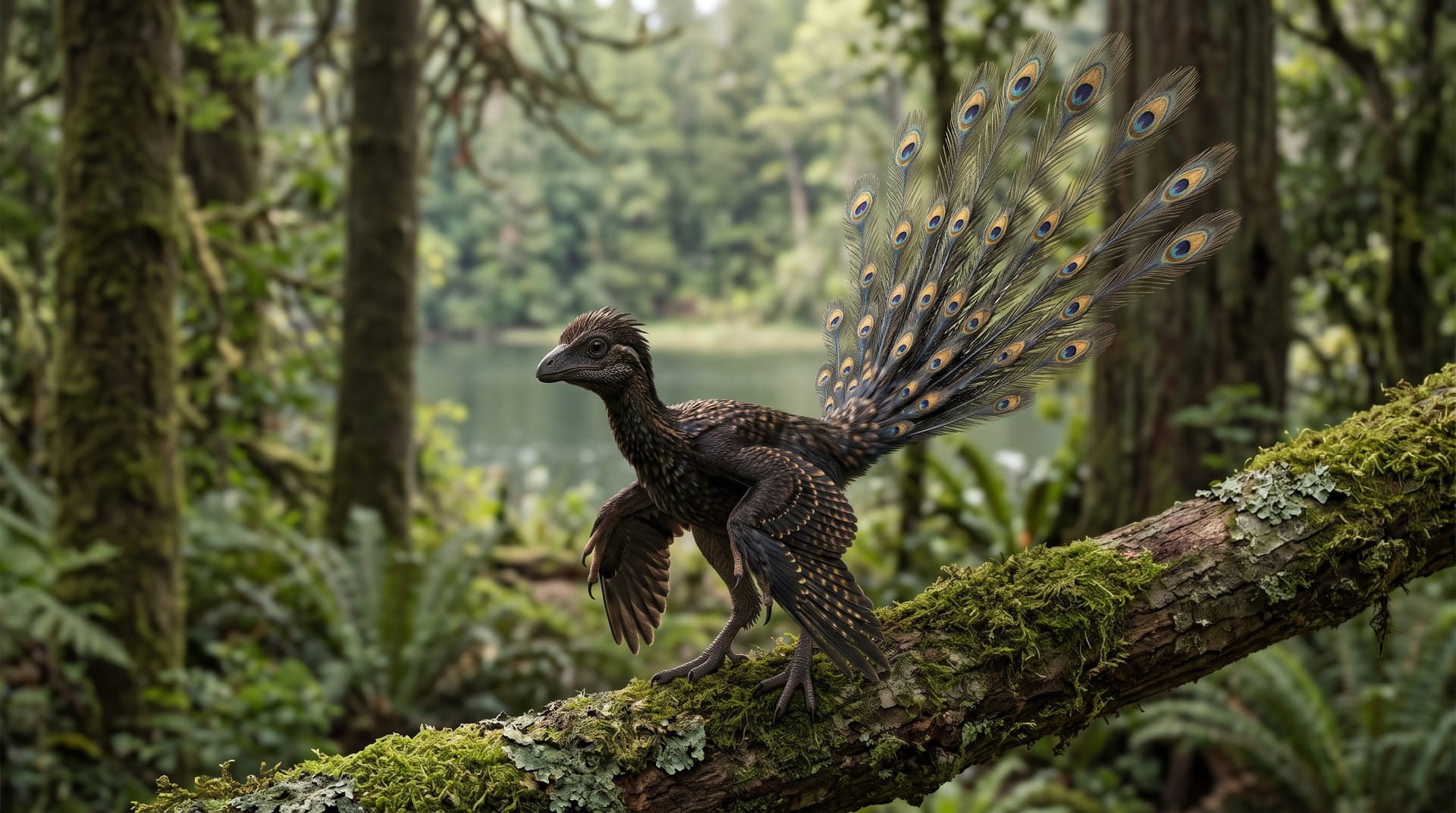
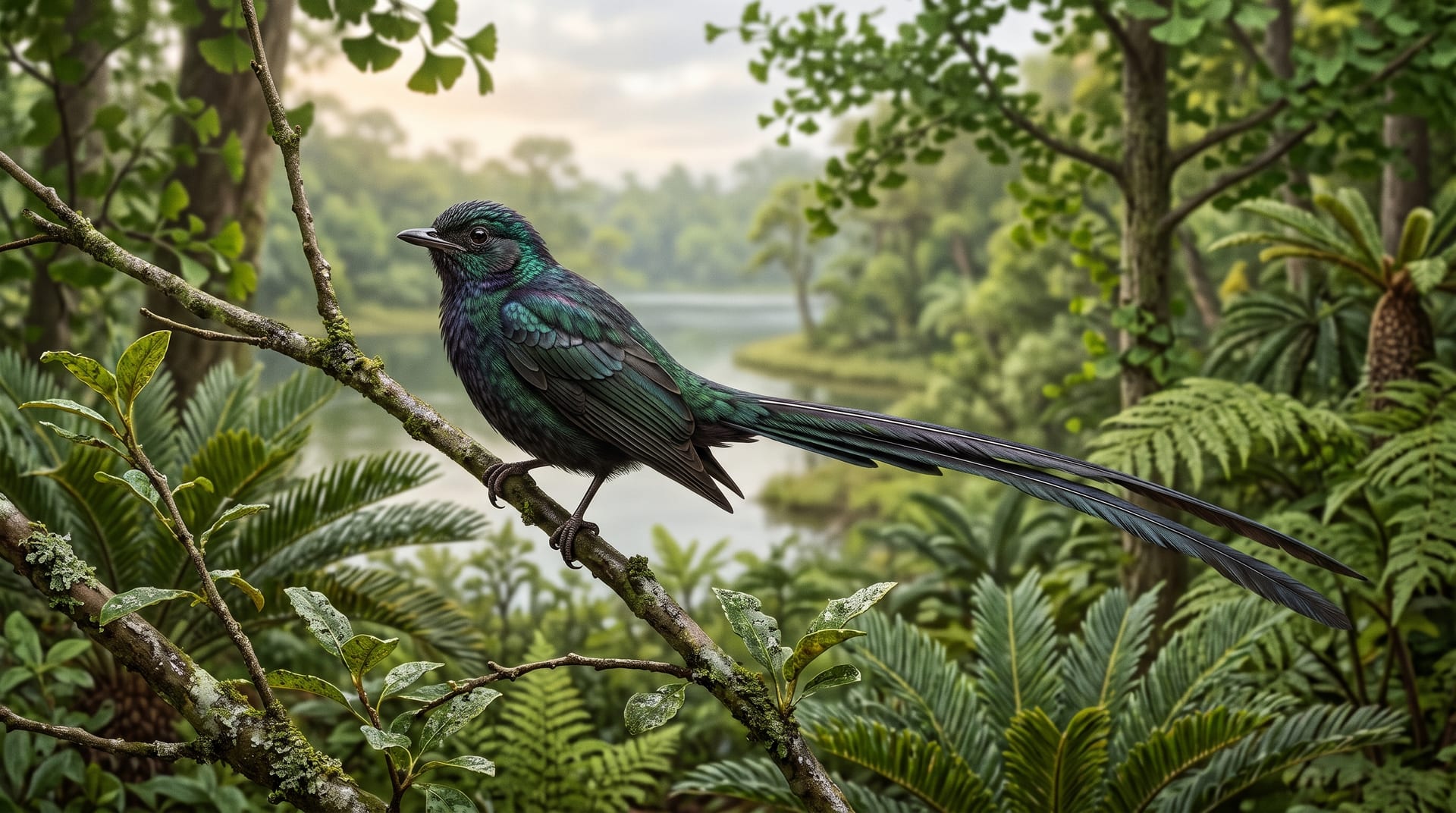
Plumadraco bankoorum was a small bird, an enantiornithine, that lived in what is now northeastern China roughly 121 million years ago, in the Early Cretaceous. It measured just 14.9 cm from beak to tail, but its two tail feathers were 29.3 cm long1, about twice the length of its body.
How big was Plumadraco?
The scientists who described it put its body mass at 112 to 144 grams2, similar to some living thrushes and honeyeaters. Lead author Alex Clark said Plumadraco was “the size of an American robin”1.
The body length of 149 mm was measured from the skull and the backbone, and the complete tail feathers measured 293 mm, nearly twice as long. That makes them 1.97 times the length of the body, the proportionally longest tail feathers recorded in any enantiornithine. The previous record holder, Junornis, had tail feathers approximately 1.6 times its body length2.
Its wings were preserved folded. The longest primary feathers measure 105 and 100 mm on the left and right wings, and their vane asymmetry is similar to values reported for living flying birds. Some wrist and ankle bones are not fused, which the authors read as a sign of osteological immaturity2.
What did Plumadraco eat?
Five teeth are preserved in the right upper jaw, and the lower jaws hold four and six teeth. The teeth are nearly uniform in size and apically pinched, like those of other bohaiornithids, a family known for its robust teeth2.
Bohaiornithids are inferred to be arboreal based on hindlimb morphology, and the toe bones of Plumadraco get longer towards the tip of each toe, resembling the condition in arboreal neornithines2, tree-dwelling living birds.
When and where did Plumadraco live?
The only known fossil comes from the Jiufotang Formation near Xiaotaizi Village, Jianchang County, Liaoning Province, in rocks dated to 121 million years ago (Lower Aptian). These rocks belong to the Jehol Biota (130 to 120 million years ago)2 of northeastern China, where fossils often keep soft tissue, most commonly feathers.
The Jehol landscape is interpreted as a complex of lakes surrounded by forested wetlands2, with a seasonal, temperate climate.
How was Plumadraco discovered?
The holotype, catalogued as STM11−4, is a complete, articulated skeleton on a single slab, with feathers preserved around the head, body, wings and tail. It is kept at the Shandong Tianyu Museum of Nature in Pingyi, China. Much of the skeleton is poorly preserved, but the tail feathers are among the best-preserved examples2 of their kind found by 2026.
Alexander D. Clark, Jingmai O’Connor and colleagues named it in PLOS ONE on 27 May 2026. The name comes from the Latin words pluma, feather, and draco, dragon. The species name bankoorum honours Winston E. and Paul C. Banko for their work on bird biology and conservation, especially in Hawaii; the authors call the bird the Banko’s feather dragon2.
The team also tested the chemistry of the feathers with a portable X-ray fluorescence analyser. All the feathers are high in copper and sulphur, which are associated with darker melanin pigments2, and no sign of red-brown pheomelanin was found. Sci.News reports that the tail feathers were probably dark brown, or black1.
What were the long tail feathers for?
Enantiornithine tail feathers were typically of a type called rachis-dominated feathers, which do not form an aerodynamic surface and would cause drag; the authors say this strongly suggests they were ornaments or signals to other members of the species. Each one ends in a small racket that measures 8% of the feather’s length2, compared with 10 to 54% in other enantiornithines with racketed tail feathers.
The authors suggest STM11−4 represents a male individual whose tail feathers were used in courtship displays and evolved through female choice. The tail muscles of enantiornithines point to a tail that could be raised and lowered, or pumped, rather than spread. Clark told Sci.News that birds like Plumadraco “could pump their tail feathers up and down”1, a behaviour seen in living birds where only the males do courtship displays. The authors add that more evidence about nesting and tail muscles is needed2 to confirm this reading.
What kind of animal was Plumadraco?
Plumadraco was a bird, but not a modern one, and not a non-avian dinosaur either. The Natural History Museum notes that, strictly speaking, all birds are dinosaurs, but not all dinosaurs are birds3; scientists sometimes use the term non-avian dinosaurs for the ones that were not birds. Plumadraco belonged to the Enantiornithes, the most diverse clade of birds during the Cretaceous1, a group that died out together with the non-avian dinosaurs. More than 100 genera2 of enantiornithines had been described by 2026, from every continent except Antarctica.
Within that group, the authors’ family-tree analysis places Plumadraco in the Bohaiornithidae, close to the specimen CUGB P1202 and to Sulcavis. Bohaiornithids were Early Cretaceous birds of the Jehol Biota that weighed about 50 to 200 grams, with robust teeth, a long minor metacarpal and large toe claws. Plumadraco has two more sacral vertebrae than is typical of enantiornithines2, like Neobohaiornis.
Similar dinosaurs
- Archaeopteryx: a bird-like dinosaur from the Late Jurassic of Germany, with a long, bony tail3; Plumadraco had a triangular pygostyle2 instead.
- Junornis: another enantiornithine with long tail feathers, but they reached only about 1.6 times its body length1.
- Sulcavis: a close bohaiornithid relative with a wider-angled wishbone, its interclavicular angle at 65.5º against about 34º in Plumadraco2.